NSA leak fallout: LIVE UPDATES
Published 10 Jun, 2013 15:49 | Updated 10 Jan, 2020 11:01
Former CIA employee Edward Snowden has carried out one of the biggest leaks in US history, exposing a top-secret NSA surveillance program to the media.
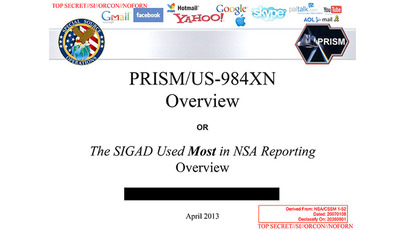
Leading tech companies were revealed to be involved in intelligence gathering through PRISM spy tool.
RT has developed an interactive map showing the countries being spied on, those aiding the US in their surveillance operations.
Thursday, September 12
GMT 23:58: Edward Snowden’s leaks revealing mass data collection by the National Security Agency “probably needed to happen,” Director of National Intelligence James Clapper said Thursday. Speaking at a conference in Washington, Clapper acknowledged the revelations had sparked a needed debate that “perhaps” should have happened earlier. Yet Clapper maintained he was concerned about the disclosures’ “impact, frankly, on our national security and the damage caused by these continuous stream of revelations.”
Wednesday, September 11
GMT 23:52: Matthew Green, a cryptography professor at Johns Hopkins University, was asked to remove a blog post he wrote regarding the latest leak, which revealed that the NSA is capable to subverting internet encryption. While university administrators eventually allowed Green to re-post the article onto school servers, the incident prompted more questions than it gave answers. Green told RT he is unsure of where the take-down request originated and jokingly gave advice to any future cryptographers.
“Somebody somewhere made a decision that there might be classified material on this blog. The instinct was to shut the blog down rather than investigate that. I think that was a mistake. I don’t think I’ll ever know exactly where that came from and I hope it never happens again,” he said.
“Move down to the basement, buy a computer, and never, ever use the internet. That’s the best advice I can give you.”
Tuesday, September 10
GMT 21:02: A majority of Americans oppose the National Security Agency’s data collection programs as well as the secret federal court that has oversight over NSA surveillance, according to a new poll by the Associated Press-NORC Center for Public Affairs Research.
Nearly 60 percent of those polled said they were uncomfortable with the amount of telephone and Internet data collected by the NSA. Fifty-three percent said the government does an adequate job protecting civil liberties, down from 60 percent two years ago. And 6 in 10 Americans said it was sometimes justified to sacrifice freedoms for security.
Also of note, Americans age 18-29 believe whistleblowers like Edward Snowden are justified in leaking classified documents if they show the government broke the law. Only 54 percent of those over age 45 agreed.
Monday, September 9
GMT 21:32: Yahoo joined Google and Microsoft Monday in filing legal action against the US government over the NSA surveillance programs revealed by Edward Snowden.
The tech giants filed motions in the Foreign Intelligence Surveillance Court, which approves government requests to gain data from the companies, asking for the ability to share more about the extent of NSA demands for their customers’ information.
In its motion, Yahoo said it “has been unable to engage fully in the debate about whether the government has properly used its powers, because the government has placed a prior restraint on Yahoo's speech."
Yahoo also criticized news coverage of NSA revelations, saying the PRISM program - the subject of the first reports which resulted from Snowden leaks - does not allow the NSA to access their servers for information.
"Yahoo's inability to respond to news reports has harmed its reputation and has undermined its business not only in the United States but worldwide. Yahoo cannot respond to such reports with mere generalities,” the company claimed in its motion.
Microsoft and Google also filed legal briefs on Monday for the ability to provide more information about data requests.
GMT 01:00: The NSA intelligence agency spied on Brazilian state-run oil giant Petrobras, reports Brazil's biggest television network Globo TV, which said it received the information from Glenn Greenwald, the American journalist who first published secrets leaked by whistleblower Edward Snowden.
A 2012 NSA presentation aired by the network included a slide citing an ‘economic’ motive for spying, along with diplomatic and political reasons. Earlier the US gave assurances that the Department of Defense, under jurisdiction of which the NSA operates, “does not engage in economic espionage in any domain, including cyber.”
An official from the NSA told Globo that the agency gathers economic information not in order to steal secrets, but to monitor financial instability.
Saturday, September 7
GMT 20:19: The NSA can access data on smart phones using the world’s most popular systems including iOS, Android, and BlackBerry, Germany’s Der Spiegel reported. The agency can access contact lists, SMS traffic, notes, and users’ current and past locations.
The agency has also organized a working group for each operating system. The groups are responsible for clandestine operations to gather data saved on phones.
Der Spiegel noted that spying on smart phones has not been a mass surveillance operation. It said the tactic was only used on specific individuals and was done without the knowledge of smart phone companies.
GMT 17:28: Thousands of people took to the streets of Berlin, Germany, on Saturday to protest against NSA surveillance activities and fight for their right to privacy. Demonstrators carried banners which read, “Stop spying on us,” along with the phrases “NSA killed by internet” and “Thanks to PRISM the government finally knows what the people want.”
The protest was mounted by Germany’s Green party, together with the Left and Pirate parties. The event hosts claimed the rally was attended by around 20,000 people. However, police declined to confirm the numbers, only stating that their “tally differs from that of the organizers.”
Friday, September 6
GMT 21:45: Tech giants Microsoft, Yahoo, and Google expressed their concern over reports that US and British spy agencies have the capability to bypass the encryption of online communications.
"We are unaware of and do not participate in such an effort,” a Yahoo spokesman said on Friday, referring to the reports of the multi-million programs of the two countries (US and the UK) to beat encryption. “Yahoo zealously defends our users' privacy and responds to government requests for data only after considering every applicable objection and in accordance with the law.”
A Microsoft spokesperson said, "We have significant concerns about the allegations of government activity reported yesterday and will be pressing the government for an explanation."
GMT 18:47: The US defended its ability to use backdoors secretly inserted in various online services to bypass communication encryption. The office of James Clapper, director of US national intelligence, said his government would simply not be doing its job if it did not use these legally dubious techniques to quietly monitor Americans’ everyday communications.
“It should hardly be a surprise that our intelligence agencies seek ways to counteract our adversaries’ use of encryption,”read the statement issued on Friday. “Throughout history, nations have used encryption to protect their secrets, and today, terrorists, cyber-criminals, human traffickers and others also use code to hide their activities.”
The report detailing the intelligence agency’s efforts was published on Thursday by The Guardian, and is the latest result of leaks from former NSA contractor Edward Snowden.
GMT 01:41: US President Barack Obama has pledged to work with Brazil and Mexico to address their concerns over US spying revealed in recent NSA leaks. Brazilian President Dilma Rousseff appeared to climb down from her earlier position and told reporters on Friday that a planned visit to Washington next month may proceed as planned
"My trip to Washington depends on the political conditions to be created by President Obama," said Rousseff according to the Brazilian presidency's Twitter feed.
The two leaders had an exchange over the NSA spying scandal during the G20 summit in Russia.
Thursday, September 5
GMT 15:57: American NSA and British GCHQ have the tools to bypass sophisticated encryption methods used to secure most Internet traffic that was previously thought to be protected from prying eyes.
The Guardian says the US alone spends around a quarter of a billion dollars each year on this capability. It involves not just intricate code-breaking, but also maintaining partnerships with the tech companies that provide seemingly secure online communication outlets.
“The files show that the National Security Agency (NSA) and its UK counterpart GCHQ have broadly compromised the guarantees that Internet companies have given consumers to reassure them that their communications, online banking and medical records would be indecipherable to criminals or governments,” James Ball, Julian Borger and Glenn Greenwald reported for the Guardian.
GMT 09:12: Brazil has canceled preparations for the visit of President Dilma Rousseff to the United States over reports she was the target of National Security Agency (NSA) surveillance. A Brazilian official told Reuters that Rousseff “is completely [sic] furious” over the revelations and described the situation as “a major, major crisis”.
Wednesday, September 4
GMT 07:33: Brazil’s relations with the US are damaged after it was found the US had been spying on Brazilian President Rousseff. The country’s government accused the US of lying about NSA surveillance programs.
“[The US has] not given any reasonable explanations. In fact, all the explanations that have been given so far are false,” said Minister of Communications Paulo Bernardo after an emergency cabinet meeting called by Rousseff.
Brazil launched a probe into telecommunications companies to see if they illegally shared data with the US intelligence agency.
Meanwhile Brazilian lawmakers asked for federal protection for the American journalist Glenn Greenwald and his partner David Miranda, saying they are key witnesses in the investigation of NSA spying on Brazilians. Greenwald’s reports on American surveillance are based on documents leaked by former NSA contractor Edward Snowden.
Monday, September 2
16:30 GMT: It has emerged, according to new documents seen by German publication Der Spiegel, that the NSA directly targeted the French Foreign Ministry in its surveillance operations. The document from June 2010, marked 'Top Secret' states that gaining access to their VPN computer network was considered a 'success story.' The NSA was especially interested in foreign policy objectives, such as weapons trade and economic stability.
Sunday, September 1
01:16 GMT: New batch of NSA documents leaked by Edward Snowden suggest that Russian Aeroflot airlines and news broadcaster Al Jazeera were spied on by the NSA, the German Der Spiegel claims.
The publication states that based on a 2006 document, the NSA hacked into Al Jazeera's internal communications system to read communication by "interesting targets."
The new data also revealed that reservation services for Russian airline Aeroflot, was also being surveyed. The NSA said these selected targets had "high potential as sources of intelligence."
Saturday, August 31
13:00 GMT: Guardian journalist Glenn Greenwald has released a video honoring Snowden upon his reception of the 2013 'Whistleblower Prize' in Berlin.
11:00 GMT: Snowden's lawyer, Anatoly Kucherena, said that former NSA contractor and whistleblower Edward Snowden did not stay at the Russian consulate in Hong Kong prior to his arrival in Moscow, as previously reported by Kommersant newspaper.
"Edward told me that he never visited any diplomatic missions and that all this is inaccurate. He never had any talks with our diplomats while in Hong Kong," Kucherena said.
On Monday, the same paper declared that Snowden had spent his 30th birthday at the consulate, citing a Western source as having provided confirmation.
However, Kucherena did say that "he and his friends stayed at a hotel there... He understood he was being chased, so he moved often." A Russian government source said that Snowden turned up uninvited for two days before leaving for Hong Kong.
05:04 GMT: US intelligence agencies carried out 231 cyber-operations in 2011, The Washington Post reported in detailing a more aggressive, expanding cyber-attack architecture than was previously known. In addition, a $652 million program named GENIE helps the US break into foreign networks to plant sophisticated malware in computers, routers and firewalls in tens of thousands of machines every year. Almost three-quarters of the 231 attacks in 2011 were against top-priority targets including Iran, Russia, China and North Korea, and activities including nuclear proliferation. The disclosure of US cyber-ops, defined by the US “to manipulate, disrupt, deny, degrade, or destroy information resident in computers or computer networks, or the computers and networks themselves,” were provided by NSA whistleblower Edward Snowden.
Friday, August 30
21:00 GMT: Edward Snowden has refused to meet with American diplomats in Russia, his lawyer, Anatoly Kucherena said Friday.
“A few people approached trying to negotiating the meeting, including US diplomats. I related the message to Edward, but he refused to meet with them. His decision, he explained, was based on the campaign launched against him by the US State Department, which shows only a prejudice against him and his human rights stance. I passed this message on to the diplomats,” the lawyer said.
Kucherena, who is in constant contact with the whistleblower, said that his client was undergoing an adaptation period and is learning Russian. He also told the press that he will not violate client-attorney privilege, and would not disclose Snowden’s whereabouts. What Snowden might do next might be decided once his father arrives in Russia, Kucherena said.
The lawyer said that Snowden was still in danger. “The level of danger threatening him to this day remains high. While in the transit area, he knew he was being hunted by a huge country that can use any of its methods and tools to catch him,” Kucherena said.
Regarding the revelations of Snowden-leaked wires that appeared recently in Western publications, Kucherena said that the material was handed over to the editors before Snowden left Hong Kong. Therefore, he has not violated his pledge to President Putin not to harm US interests.
18:58 GMT: The New York Times was asked by British authorities to destroy classified intelligence files leaked to the media by former national security contractor Edward Snowden.
Wednesday, August 28
19:27 GMT: President Obama has revealed the members of a new review panel that will assess how the US handles issues of technology in the realm of foreign policy and intelligence gathering.
The panel, originally announced on August 9 by Obama to be an independent check on federal government tech initiatives in the wake of the NSA spying revelations, will consist of four former White House and intelligence community staffers -- Michael Morell, Richard Clarke, Cass Sunstein and Peter Swire -- and academic Geoffrey Stone, who has close personal ties to Obama.
Tuesday, August 27
13:17 GMT: Mass tracking and collection of Americans' phone call data violates the US constitution, the American Civil Liberties Union said in a court motion. The National Security Agency’s surveillance program "permits the government to assemble a richly detailed profile of every person living in the United States and to draw a comprehensive map of their associations with one another," the motion says.
ACLU argues that part of the basis for the FISA court's approval of the NSA's mass collection of phone metadata involved Smith vs Maryland 1979 case, surveillance directed at a specific criminal which does not suggest “that the constitution allows the government's mass collection of sensitive information about every single phone call made or received by residents of the United States over a period of seven years."
The motion is part of a lawsuit filed by the ACLU on 11 June 2013, accusing NSA director Keith Alexander, the director of intelligence James Clapper, defence secretary Chuck Hagel, the attorney general Eric Holder and FBI director Robert Mueller of violating the first and fourth amendments.
Monday, August 26
18:05 GMT: The United Nations said it plans to contact the US officials regarding the Der Spiegel report that the NSA bugged its New York headquarters. "We're aware of the reports and we intend to be in touch with the relevant authorities on this," UN spokesman Farhan Haq said, adding that “member states are expected to act accordingly to protect the inviolability of diplomatic missions."
11:00 GMT: On of Merkel's key rivals has threatened to scupper EU-US trade talks over the NSA spying program.
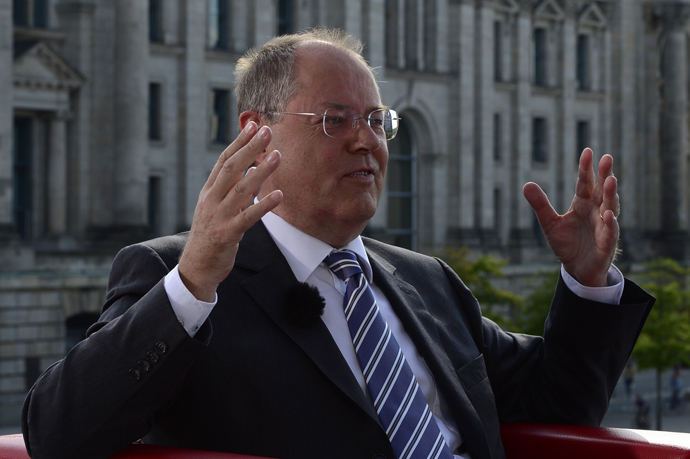
Peer Steinbruck, leader of the Social Democrats, says he will delay EU trade negotiations over the NSA bugging of German government offices.
Edward Snowden was forced to stay in Russia after the US threatened Cuba with “adverse consequences” should the NSA whistleblower get on board Aeroflot’s Moscow-Havana flight, Kommersant newspaper has learnt.
Under US pressure the Cuban authorities informed Moscow the Aeroflot plane would not be able to land in Havana, a source told the Russian newspaper.
The paper also pointed out that Russian authorities did not contact Snowden or issue an invitation to take refuge on its territory, however were aware that he would arrive to Moscow en route to Latin America.
Sunday, August 25
The United States was not just busy spying on the European Union, according to documents obtained by Der Spiegel, but had its surveillance apparatus trained on the international body as well. The US National Security Agency (NSA) successfully cracked the encryption code protecting the United Nations’ internal videoconferencing system.
Within three weeks of initially gaining access to the UN system, the NSA had increased the number of such decrypted communications from 12 to 458, the report revealed.
“NSA pickup lines” trended on Twitter worldwide. Posts sarcastically referenced NSA intrusions as they envisaged how the agency might flirt with an unsuspecting user.
Friday, August 23
National Security Agency officers have engaged in spying on their love interests. It is a popular enough practice to have its own Orwellian label within the agency called “LOVEINT”.
“LOVEINT” is deemed a ‘wilful violation’ and “very rare” misconduct by the organization. “NSA has zero tolerance for wilful violations of the agency’s authorities” and responds “as appropriate,” the agency said in a statement on Friday, published in WSJ.
Wednesday, August 21
19:30 GMT: Speaking about Army Pfc. Bradley Manning’s sentence announced on Wednesday, Edward Snowden’s lawyer, Anatoly Kucherena, told RT that he is “confused.” He believes the US intelligence leaker was given a 35 year sentence as a “warning to others” who might want to “blow the whistle.”
In light of the ruling, “[we can see that] nobody will consider Edward [Snowden’s] position concerning human rights” in the United States , Kucherena stated, hinting that the NSA leaker is not keen on returning to his home country.
Meanwhile, the lawyer noted that Snowden has not yet met with his father, but is “eagerly waiting” for the reunion.
9:55 GMT: The UK’s Labour Party has called for Parliament’s intelligence watchdog to investigate Prime Minister David Cameron’s role in asking The Guardian to destroy their Snowden documents. This follows reports in the Independent and the Daily Mail that the order to destroy the files originated from Number 10.
Clearly the government does have a responsibility to protect national security. However, I think this may be another area where an inquiry by the intelligence and security committee [ISC] may be the right way forward in terms of this particular case and what the prime minister's role was," said Labour MP Yvette Cooper on BBC Radio 4.
Tuesday, August 20
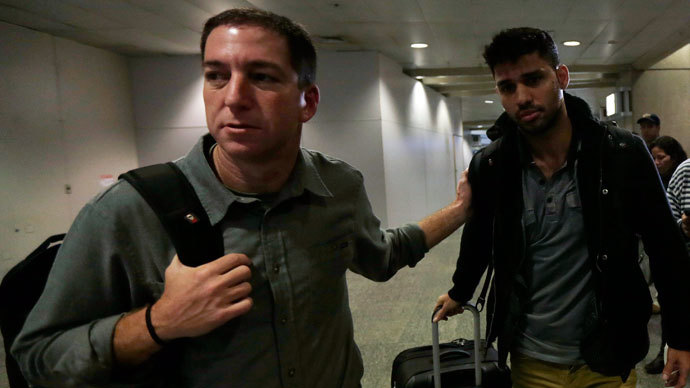
12:20 GMT: Britain has defended its actions against the partner of Guardian journalist Glenn Greenwald David Miranda, who was detained for nine hours under anti-terrorism legislation at Heathrow Airport.
"The government and the police have a duty to protect the public and our national security," a Home Office spokesman said in a statement. "If the police believe that an individual is in possession of highly sensitive stolen information that would help terrorism, then they should act and the law provides them with a framework to do that."
"Those who oppose this sort of action need to think about what they are condoning."
09:48 GMT: Russia has not received any official requests from the US concerning extradition of former CIA employee Edward Snowden, who on August 1 was granted temporary asylum in Russia, Deputy Prosecutor General Aleksandr Zvyagintsev told media. “They only informed us that his passport is annulled,” he said. Earlier the US President Barack Obama canceled a meeting with his Russian counterpart, reportedly because of the situation with Snowden. US Secretary of State John Kerry intends to address Russia’s Foreign Minister Sergey Lavrov to discuss the case of Edward Snowden.
08:00 GMT: On Tuesday Greater London’s Metropolitan Police Service (MPS) said the detention of Miranda was both “legally and procedurally sound.”
Saying the detention of the 28-year-old was “necessary and appropriate”, the MET continued that contrary some reports, Miranda had been offered legal representation and was attended to by a lawyer.
"No complaint has been received by the MPS at this time," the police statement read.
The statement continued that Schedule 7 of the Terrorism Act 2000, which grants police the power to stop and question people traveling through British ports and airports to determine whether they are involved in planning terrorist plots, was used "appropriately and proportionately".
Monday, August 19
19:00 GMT: On Monday, Glenn Greenwald promised to release more documents, saying the UK would be “sorry” for detaining his partner David Miranda for nine hours.
"I have many more documents to report on, including ones about the UK, where I'll now focus more. I will be more aggressive, not less, in reporting," said Greenwald, speaking in Portuguese to reporters at Rio de Janeiro's international airport, Reuters reported.
On Sunday, Miranda was detained under Schedule 7 of the Terrorism Act 2000, which allows police to stop and question people travelling through British ports and airports to determine whether they are involved in planning terrorist acts.
Miranda said he was treated like a terrorist during his detention.
“They treated me like I was a criminal or someone about to attack the UK…they were threatening me all the time and saying I would be put in jail if I didn't cooperate,” Miranda told the Guardian. “It was exhausting and frustrating, but I knew I wasn't doing anything wrong."
17:19 GMT: France’s CNIL agency says that European data protection agencies have written to the European Commission, calling for help in obtaining information needed in order to “assess independently to what extent the protection provided by EU data protection legislation is at risk and possibly breached” by the US intelligence-gathering program PRISM, AFP reported.
In the letter written to Vice President and Commissioner for Justice, Fundamental Rights and Citizenship, Viviane Reding, the agencies have said “they should evaluate the exact impact of the PRISM program on the privacy and data of European citizens,” adding that "many questions as to the consequences of these intelligence programs remain.”
Sunday, August 18
11:50 GMT: David Miranda, partner of the Guardian journalist Glenn Greenwald who broke several stories based on information from NSA whistleblower Edward Snowden, was detained for almost nine hours by British authorities on his way home to Rio de Janeiro, Brazil.
Miranda was detained under Schedule 7 of the Terrorism Act 2000, which allows police to stop and question people travelling through British ports and airports to determine whether they are involved in planning terrorist acts.
The 28-year-old was held for the maximum amount of time allowable by law, having been detained at 8:05 am and released without charge at 5 pm, according to a Scotland Yard statement.
Electronics in Miranda’s possession, including his cell phone, laptop, memory sticks, and “various video game consoles” were confiscated.
The Guardian said it was dismayed at the detention of Miranda and was “urgently seeking clarification from the British authorities” as to why it happened.
Thursday, August 15
23:30 GMT: It is now believed that former NSA contractor Edward Snowden actually began downloading documents of US electronic surveillance programs while working for Dell Inc in April of 2012, about a year prior to what has been reported so far, according to Reuters which cited US officials and other unspecified sources.
Snowden worked for Dell from 2009 until earlier in 2013 as a contract worker for the NSA both in the US and Japan. Snowden downloaded information while employed by Dell regarding surveillance programs led by the NSA and Britain’s Government Communications Headquarters, and evidently left behind electronic evidence of when those documents had first been accessed.
This new information could shift scrutiny away from Snowden’s later employer, Booz Allen Hamilton, which has received the bulk of scrutiny from the whistleblower’s unauthorized leaking of classified intelligence info. Snowden was with Booz Allen for three months. According to Reuters, the material Snowden downloaded in April 2012 while a Dell employee included NSA collection from fiber-optic cables, including transoceanic cables, of large quantities of internet traffic and other communications.
Wednesday, August 14
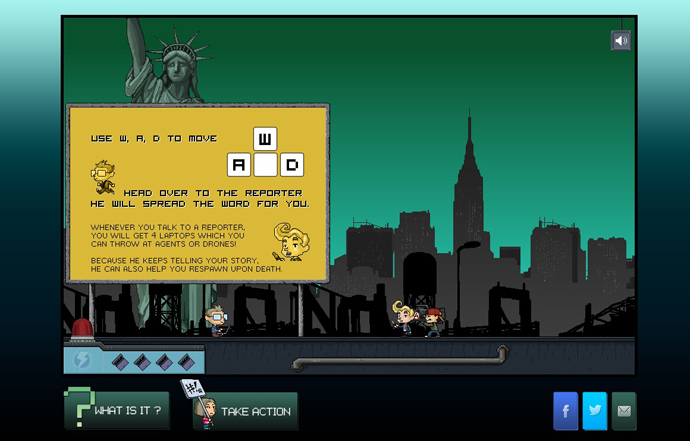
10:33 GMT: Now everybody can help Edward Snowden escape the clutches of Uncle Sam, at least in the digital world of game technology. German game developer Binji has announced the release of a free online videogame entitled, “Eddy’s Run: The Prism Prison,” Time magazine reported. The creators of the game, which takes its cue from “Mario Brothers,” is “a bow” to Snowden, the former NSA contractor who revealed the details of the agency’s vast global surveillance program.
Players are able to help Snowden escape from cameras, drones and government agents with the assistance of reporters and exploding laptops.
It’s not all virtual fun, however. One of the game’s more interactive features involves the “Take Action” button, which directs players to sign a petition on AVAAZ.org, demanding that Snowden be “treated fairly, humanely and given due process.”
Monday, August 12
23:09 GMT: US President Barack Obama has appointed James Clapper, the current head of National Intelligence, to oversee a board which monitors NSA surveillance policies. Obama asserted that the board would be put in place to “maintain the trust of the people,” although Clapper was previously accused of lying to Congress under oath when questioned on the existence of a domestic surveillance database.
The exact duties of the oversight group remain unknown, although Obama said on August 9 that it will consist of “a high-level group of outside experts to review our entire intelligence and communications technologies.”
22:10 GMT: The US Charge d'Affaires in Madrid, Luis G. Moreno, has been summoned to the Spanish Foreign Ministry for "clarifications" over a report published by Der Spiegel on Sunday, Spanish state television reported.
Der Spiegel revealed that Spain had received a mid-priority rank in the NSA’s list of surveillance targets. Moreno said he understood the “given reasons and concerns expressed” by Spain and that he would seek to gain more information regarding the surveillance.
21:09 GMT: If the Russian capital was hosting one of the NSA servers used for surveillance by US intelligence, it would be located in the US embassy in Moscow, an unidentified Russian special services member told Vedomosti daily. The source said that he is "practically 100 percent sure" that one of the XKeyscore servers is located inside the embassy. The existence of such servers, along with NSA spying capabilities, was revealed on July 31 in the Guardian newspaper through information provided by whistleblower Edward Snowden. The leaks detailed more than 700 XKeyscore servers worldwide. One of the dots on a marked map points to Moscow.
John Graham, a former US diplomat, told RT it is no secret that world powers spy on each other, but the news that really shook the world is that America spies on its own citizens.
Friday, August 9
14:18 GMT: Edward Snowden's father plans to fly to Russia from his home in Allentown, Pennsylvania, to meet with his son next week, a representative of Lon Snowden’s lawyer said.
“First thing is for Lon and Ed to be reunited," Mattie Fein, spokeswoman and wife of Lon Snowden's attorney, Bruce Fein, is cited as saying by Wall Street Journal. "He wants to make sure he is healthy and safe and then to get him a lawyer [to defend his interests in the US]."
The spokeswoman added that elder Snowden isn’t planning to make any comments until after he had seen his son, despite media onslaught expected on his Moscow arrival.
"We won't say anything until Lon sees Ed face to face with [his Russian legal advisor Anatoly] Kucherena," she stressed.
08:04 GMT: Former NSA contractor Edward Snowden hasn’t notified the Migration Service in Moscow about his registration in the capital, which means the whistleblower most probably lives outside the city.
"We have no such information. I haven’t received such information - he is not in Moscow," head of the Moscow branch of Russia’s Federal Migration Service Olga Kirillova told RIA Novosti.
The head of FMS for the Moscow Region earlier told reporters that Snowden, who has received a temporary residence permit in the Russian Federation, can notify the Migration Service about his registration anywhere in the country. In case of his request to move to another Russian region, he will have to wait for official permission.
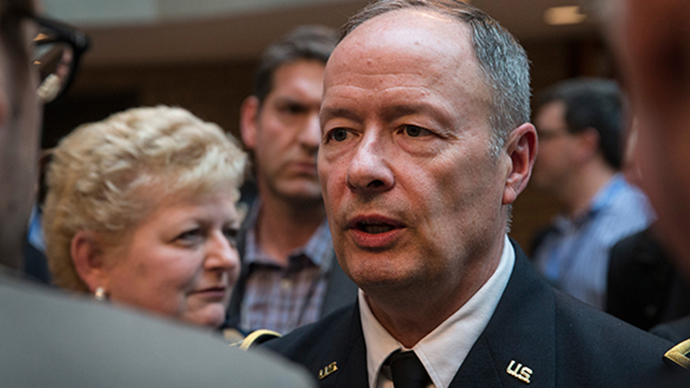
03:11 GMT: The NSA wants to prevent future security breaches by replacing the position once held by whistleblower Edward Snowden with computers, the secretive intelligence agency director revealed.
The National Security Agency, which currently employs up to 1,000 systems administrators, is planning to drastically cut back on the number of people holding this position, Gen. Keith Alexander said during a cyber-security conference in New York City.
“What we’re in the process of doing – not fast enough – is reducing our systems administrators by about 90 percent,” Alexander informed.
“We’ve put people in the loop of transferring data, securing networks and doing things that machines are probably better at doing,” he added.
Snowden, a former employee of government-contracted consulting firm Booz Allen Hamilton, worked for the NSA for over a year before his role changed to systems administrator. It was while holding this position that he leaked classified details about surveillance programs to the media.
While the leaker has been referred to as a systems administrator, he told The Guardian that his job was actually to work as an “infrastructure analyst,” spending his days searching for new methods to infiltrate the internet and telephone networks.
Thursday, August 8
16:14 GMT: Lon Snowden, the father of the former CIA employee Edward Snowden, has filed documents applying for a Russian travel visa, a representative of Snowden Sr.'s lawyer Mattie Fein told Itar-Tass news agency. Snowden Snr. is planning to come to Russia later this month. He will be accompanied by his US lawyers. It’s not clear yet how long it will take the Russian authorities to a visa to the whistleblower’s father.
Edward Snowden’s lawyer, Anatoly Kucherena, earlier informed that he had sent an invitation to Lon Snowden to visit Russia. The invitations were also sent to some of the leaker’s friends and his lawyer.
21:10 GMT: The highly-encrypted email service reportedly used by National Security Agency leaker Edward Snowden has gone offline, and its administrator claims the company is legally barred from explaining why. The homepage of Lavabit.com was changed Thursday to a letter from the company’s owner announcing that the site’s operations have ceased following a six-week long ordeal that is prompting the company to take legal action in the Fourth Circuit Court of Appeals.
Wednesday, August 7
03:07 GMT: The whistleblower’s father Lon Snowden expressed gratitude to Vladimir Putin for granting his son political asylum despite pressure from the US, which is outraged by Russia's decision. On the same day the US President Barack Obama canceled a planned trip to Moscow.
“President Vladimir Putin has stood firm. I respect his strength and courage,” Lon Snowden told Reuters. “He has stood firm against the face of intense pressure from our government and I have to believe that he will continue to stand firm.”
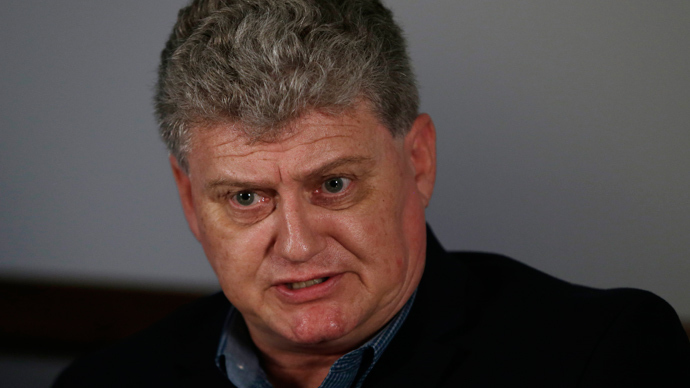
Snowden Snr. said that he has not spoken to his son since Edward traveled from Hawaii to Hong Kong and then on to Russia after revealing the existence of secret government programs that routinely monitor the telephone and electronic communications of millions of Americans. Other revelations included American spying on foreign diplomats and international metadata interception.
19:40 GMT: Barack Obama has canceled a meeting with Vladimir Putin scheduled for September, largely over the Snowden asylum decision.
"Russia’s disappointing decision to grant Edward Snowden temporary asylum was also a factor that we considered in assessing the current state of our bilateral relationship," the White House said in a statement.
The Kremlin says it is "disappointed" with the decision, saying the Snowden situation "was not created by us".
“All this situation shows that the US is still not ready to build relations with Russia on equal footing,” presidential aide Yury Ushakov told the media.
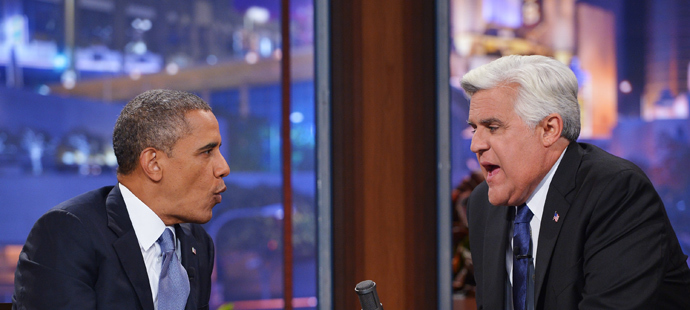
13:00 GMT: Obama claimed that there was no domestic spying program in the US, and called covert surveillance operations a “critical component to counter terrorism.”“We don’t have a domestic spying program,” he said.
03:49 GMT: Glenn Greenwald, the journalist involved in the publication of leaks provided by Edward Snowden, said in a testimony to the Brazilian government that he possesses up to 20,000 secret US government files.
"I did not do an exact count, but he [Snowden] gave me 15,000 to 20,000 documents. Very, very complete and very long," Greenwald revealed.
The Brazil-based American reporter, who was approached by Snowden while the latter still worked as a contractor for the NSA, has published details of US electronic surveillance programs taking place domestically and abroad.
"The stories we have published are a small portion. There will certainly be more revelations on the espionage activities of the US government and allied governments...on how they have penetrated the communications systems of Brazil and Latin America," he added.
Media figures discussing Obama/Putin/extradition should Google these: Robert Seldon Lady, Gonzalo Sánchez de Lozada, Luis Posada Carriles
— Glenn Greenwald (@ggreenwald) August 7, 2013
12:51 GMT: The former head of CIA and NSA hypothesized that a massive hacker attack on the US was possible from "sex-starved" activists, “nihilists, anarchists” like Anonymous in retaliation for any future prosecution of leaker Edward Snowden.
"If and when our government grabs Edward Snowden and brings him back here to the United States for trial, what does this group do?"Michael Hayden asked in a speech to Washington group, the Bipartisan Policy Center.
The retired Air Force general speculated that Snowden supporters would have a hard time attacking ‘dot-mils’, the well-protected military computer networks in the .mil internet domain.
"So if they can't create great harm to dot-mil, who are they going after?" he pondered, according to the Guardian. "Who for them are the World Trade Centers? The World Trade Centers, as they were for Al-Qaeda."
Tuesday, August 6
20:04 GMT: Over 150 civil society organizations from across the world have called on President Barack Obama to end the prosecution of the former NSA contractor Edward Snowden.
“All of us ask that he is protected and not persecuted,” the executive director of the Article 19 campaign for freedom of information, Dr. Agnes Callamard, stated on behalf of numerous international organizations.
According to civil rights activists, Snowden's disclosures have triggered a “much-needed public debate” about online mass surveillance.
However, “rather than address this gross abuse, the US government has chosen to shoot the messenger,” Callamard noted, adding that “the knock-on effect will be to encourage others to follow by example.”
“States that have even less regard for their citizens will justify attacks on those who put themselves at significant risk to expose wrongdoing and corruption or raise matters of serious public concern,” she warned, urging President Obama to protect Snowden and other whistleblowers and initiate a public investigation into the legality of the NSA's actions.
Saturday, August 3
07:00 GMT: British spies working from the government’s GCHQ eavesdropping station will have to answer to MP’s about payments made by the US government and what was expected in return, according to Sir Malcolm Rifkind, chairman of the parliamentary spy watchdog the Intelligence and Security Committee
Friday, August 2
15:33 GMT: Lon Snowden, father of NSA whistleblower Edward Snowden, has not yet applied for a Russian visa, Russia’s embassy in the US reports.
“So far he has not applied to us,” Yevgeny Khorishko, press-attaché of the Russian diplomatic mission in Washington, told the Interfax news agency. Edward Snowden’s lawyer, Anatoly Kucherena, said earlier that an official invitation for Lon Snowden to visit Russia would be sent to the Russian Embassy in Washington by the evening of August 2.
14:06 GMT: Edward Snowden’s legal representative Anatoly Kucherena said the former CIA employee still cannot go out or move freely because of security concerns.
“The level of threat that he [Snowden] is under does not let him calmly go out and walk on Red Square, or go fishing somewhere,” Kucherena stressed, refuting rumors that Snowden has already visited a night club.
However, Snowden has free Internet access as an “absolutely free man, not restrained in his rights,” the lawyer added.
Kucherena also said he does not rule out that Snowden might seek medical attention.
“He certainly needs to undertake some course of treatment, but the decision is up to him,” Kucherena said, adding that Snowden’s condition is “overall normal.”
12:55 GMT: A new photo of Edward Snowden leaving Moscow's Sheremetyevo Airport has appeared in Russian media.
New #Snowden photo from the Russian newspaper "Izvestia" pic.twitter.com/ltbBuLAQmL
— Pierre Côté (@pierrecote) August 2, 2013
12:10 GMT: Russian Presidential aide Yury Ushakov met with US Ambassador to Russia Michael McFaul to discuss the new status of former CIA employee Edward Snowden, who was granted temporary asylum in the Russian Federation.
McFaul and Ushakov also discussed other issues pertaining to Russian-American relations, such as the present situation in Syria, missile defense, nuclear arms reduction, human rights and bilateral trade, the US embassy in Moscow reported.
11:02 GMT: Former NSA contractor Edward Snowden feels good and is absolutely safe, says his lawyer Anatoly Kucherena, who refused to disclose Snowden’s whereabouts.
“He’s on the territory of the Russian Federation,” Kucherena said, adding that the time has not come to disclose Snowden’s location due to “security matters.”
Snowden has everything he needs, Kucherena stressed, and so far “he needs neither new shirts, nor trousers.”
Thursday, August 1
23:43 GMT: The numerous reports in the US press of members of Congress going on TV and expressing their outrage was a quite predictable outcome of Russia's decision to grant Snowden asylum, Daniel Wagner, CEO of Country Risk Solutions told RT.
“This is predictable, it’s to be expected. And in a sense there is no other response that many of them would have. That said, there was a poll that came out just this week by Quinnipiac which said that 55 per cent of the American people view Mr. Snowden as a whistleblower rather than a traitor, and that fits very well with a poll that was just released in Moscow where more than half of Russian people view him favorably,” Wagner said.
“So, I think that there’s going to be some stomping of feet on the other side of the Atlantic, but if you ask the average person they’re probably going to say he’s doing more good than harm.”
19:48 GMT: US ambassador to Russia, Michael McFaul, has discussed Washington’s position on the Snowden standoff with the Russian government, Marie Harf, State Department spokeswoman, said.
She stressed that the US government didn’t want the issue “to broadly negatively affect our bilateral relationship,” but added that the current situation “behoves us to evaluate where the relationship is.”
Harf also said that Russia didn’t notify the US in advance of its decision to grant asylum to Snowden.
18:55 GMT: The EU has declined to comment on the situation around Edward Snowden’s asylum in Russia.
“All I can say is that it’s a bilateral issue between the US and Russia,” Michael Mann, spokesman for EU foreign policy chief Catherine Ashton, told Interfax.
18:53 GMT: Glenn Greenwald, the Guardian journalist responsible for publishing some of Snowden’s first leaks, has slammed the mainstream media for making groundless accusations that the NSA leaker has provided information to Russia and China.
We have zero evidence that China or Russia got any data from Snowden - & he denies it - but we'll just keep saying it anyway #USJournalism
— Glenn Greenwald (@ggreenwald) August 1, 2013
18:42 GMT: US Democratic senator, Charles Schumer, says the G20 summit, which is scheduled to take place in Saint Petersburg on September 5-6, should be moved from Russia after it granted asylum to Snowden.
"Russia has stabbed us in the back, and each day that Mr Snowden is allowed to roam free is another twist of the knife," Schumer, the Senate's third-ranking Democrat, said in a statement. "Given Russia's decision today, the president should recommend moving the G20 summit.”
18:20 GMT: Next week’s talks between US Secretary of State John Kerry and Russian Foreign Minister Sergey Lavrov, are “up in the air” after Moscow granted temporary asylum to Edward Snowden, a US official told Reuters, speaking on condition of anonymity.
18:15 GMT: US Senator John McCain expressed his outrage with Snowden’s Russian asylum and demanded Washington re-examine its relations with Moscow and “strip away the illusions that many Americans have had about Russia.”
“Russia’s action today is a disgrace and a deliberate effort to embarrass the United States,” he said. “It is a slap in the face of all Americans. Now is the time to fundamentally rethink our relationship with Putin’s Russia. We need to deal with the Russia that is, not the Russia we might wish for.”
Snowden stays in the land of transparency and human rights. Time to hit that reset button again #Russia
— John McCain (@SenJohnMcCain) August 1, 2013
McCain’s proposed countermeasures include, expansion of the Magnitsky Act, completion of all phases of the US missile defense programs in Eastern Europe and support for Russian “dissidents” like Mikhail Khodorkovsky and Aleksey Navalny.
18:07 GMT: The White House is re-evaluating if US President, Barack Obama, needs to participate in the autumn summit with Russian counterpart, Vladimir Putin, White House spokesperson, Jay Carney, said.
He stressed the US is “extremely disappointed that the Russian government” has granted temporary asylum to Edward Snowden, adding that the “unfortunate development” undermines the record of law enforcement cooperation between the two states.
Carney also said that Washington doesn’t want “Mr Snowden to become a problem” in US relations with Russia, which cover “important and broad” issues.
The govts US has threatened over Snowden: China, Hong Kong, Ecuador, Venezuela, Nicaragua, Bolivia, now Russia https://t.co/XpfAc5JRpt
— Glenn Greenwald (@ggreenwald) August 1, 2013
17:59 GMT: The NSA has made hush-hush payments of at least $150 million to Britain’s GCHQ spying agency over the past three years to influence British intelligence gathering operations, new Snowden leaks published by The Guardian revealed.
17:02 GMT: It was “very difficult” mentally for Edward Snowden to stay at in Sheremetyevo airport’s transit zone for over a month, whistleblower’s lawyer told the reporters.
Anatoly Kucherena also promised the NSA leaker would personally talk to the media as soon as he gets the chance.
“He [Snowden] asked me to thank everyone, and to ask the journalists personally not to take offence at him, and to understand that the question of security is his priority at the moment,” he said. "As soon as he gets the opportunity to do an interview, we will surely organize it. We have already discussed this issue."
17:01 GMT: Snowden’s legal representative, Anatoly Kucherena, urged the media not to “confuse notions” by saying the NSA leaker was granted “political asylum” in Russia.
“First of all, I’d like to tell you that this is not a political asylum, because today, and I regret to say this, the mass media sometimes confuses the notions and people can’t understand what the issue is about,” he stressed. “Today Edward Snowden has received the papers, which guarantee him a temporary, one-year asylum on the territory of the Russian Federation. It means, that during this time Snowden will be able to live on the territory of the Russian Federation wherever he wants to – from Vladivostok to Kaliningrad, for example, because he himself choses the place to live.”
16:16 GMT: WikiLeaks founder, Julian Assange, has called Russian asylum for Edward Snowden “another victory” in the fight against the Obama administration, which is waging a war on the whistleblowers.
"This is another victory in the fight against Obama’s war on whistleblowers. This battle has been won, but the war continues,” Assange told WikiLeaks website. “The United States can no longer continue the surveillance of world citizens and its digital colonization of sovereign nations. The public will no longer stand for it. Whistleblowers will continue to appear until the government abides by its own laws and rhetoric."
16:15 GMT: A statement by the WikiLeaks reveals the words Edward Snowden said after he was handed the Russian asylum certificate.
"Over the past eight weeks we have seen the Obama administration show no respect for international or domestic law, but in the end the law is winning,” the NSA leaker stressed. “I thank the Russian Federation for granting me asylum in accordance with its laws and international obligations."
WikiLeaks Statement Giving Details on Edward #Snowden’s Successful Russian Asylum Bid http://t.co/w23PUwOTkj
— WikiLeaks (@wikileaks) August 1, 2013
15:30 GMT: Edward Snowden’s father, Lonnie Snowden, told the Rossiya 24 news channel that he’s “thankful to the Russian nation and President Vladimir Putin” for granting one-year asylum to his son, who is wanted on espionage charges in the US.
14:28 GMT: Russia’s biggest social network, VKontakte (VK), has offered Edward Snowden a job in personal data protection.
“We invite Edward Snowden to Saint Petersburg and we’ll be happy if he decides to join the star-team of VKontakte programmers,” the network’s founder, Pavel Durov, wrote on his VK page. “After all, VK is the most popular European Internet company. I think it’ll be interesting for Edward to be engaged in the protection of the personal data of our users.”
14:22 GMT: An image is released of Edward Snowden leaving Moscow's Sheremetyevo Airport after being granted a one-year asylum in Russia.
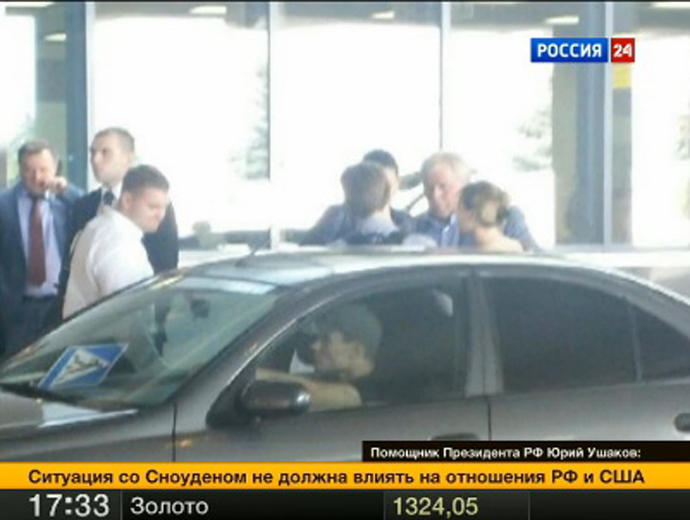
14:01 GMT: Republican senator for Oklahoma, Tom Coburn, believes that Russia’s decision to grant Snowden temporary asylum would harm relations between Moscow and Washington.
“I think it probably hurts the relationship, you know he’s undoubtedly in my mind a traitor to our country and probably most of what he knows, the Russians already know… It’s a goldmine for them,” he said on MSNBC’s ‘Morning Joe’.
13:29 GMT: Russia’s Federal Migration service officially confirms that Edward Snowden has been granted a temporary asylum in Russia.
13:00 GMT: Edward Snowden can’t be extradited to the US, even if with an official request from Washington, after he has received one-year asylum in Russia, the source in Russian law enforcement agencies tells the Itar-Tass news agency.
"Receiving temporary asylum protects Snowden from deportation because, by law, the person receiving asylum can’t be returned against his will to his former place of residence or to the country whose citizenship he previously held,” the source said.
12:42 GMT: Ties between Moscow and Washington will not be affected by Edward Snowden being granted one-year asylum in Russia, Vladimir Putin's aide Yury Ushakov said.
"Our president has expressed the hope many times that this will not affect the character of our relations," Ushakov tells reporters, adding that there is no sign that US President Barack Obama will cancel his planned visit to Moscow in September.
"This situation is rather insignificant and won’t influence political relations," Ushakov says.
12:30 GMT: WikiLeaks thanks everybody who has assisted the NSA whistleblower in Russia.
We would like to thank the Russian people and all those others who have helped to protect Mr. Snowden. We have won the battle--now the war.
— WikiLeaks (@wikileaks) August 1, 2013
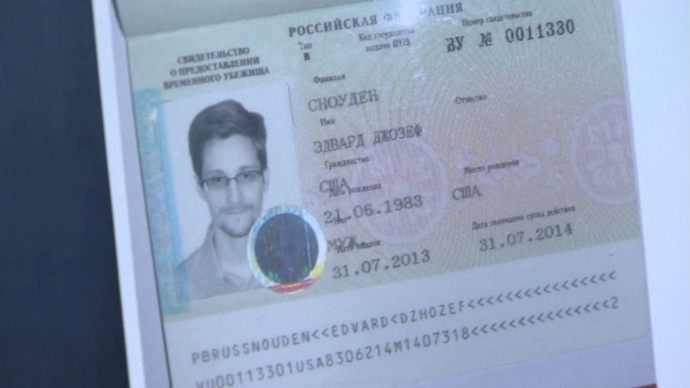
12:22 GMT: Snowden’s lawyer Anatoly Kucherena shows a copy of his client’s Edward immigration services release paper to the press.
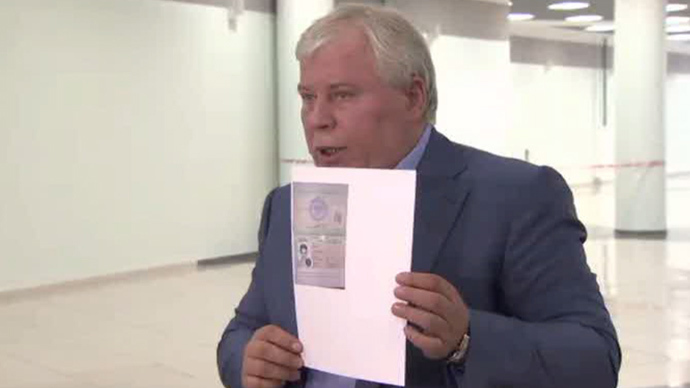
The document allows the whistleblower to stay in Russia until at least July 31, 2014. His asylum status may be extended annually on request.
11:55 GMT: Edward Snowden has left the transit zone of Moscow’s Sheremetyevo Airport where he has been holed up since June 23, RT’s crew at the scene confirms.
The whistleblower was unaccompanied when he left the airport in a regular taxi, Snowden’s legal representative Anatoly Kucherena says.
Snowden’s place of residence in Russia won’t be disclosed to the public as he is among the most wanted people in the world, Kucherena adds.
11:53 GMT: The NSA leaker has been granted one-year asylum in Russia, Snowden’s legal representative Anatoly Kucherena announces.
FLASH: Edward Snowden has successfully acquired refugee status in Russia and will shortly leave the airport.
— WikiLeaks (@wikileaks) August 1, 2013
11:51 GMT: Edward Snowden has been issued papers, allowing him to enter Russian territory, according to his legal representative in the country.
“I have just handed over to him papers from the Russian Immigration Service. They are what he needs to leave the transit zone,” Interfax reports Anatoly Kucherena as saying.
Wednesday, July 31
16:13 GMT: On the same morning that the United States Senate grilled the nation’s top investigators about domestic surveillance, the Director of National Intelligence declassified three documents detailing those programs “in the interest of increased transparency.”
14:42 GMT: No one has been fired and no one offered to resign in light of the fact that former security contractor Edward Snowden was able to take large amounts of classified data from US National Security Agency computers, the deputy director of the NSA said on Wednesday. “No one has offered to resign. Everyone is working hard to understand what happened,” Reuters quoted John Inglis as saying. The official was speaking at a Senate Judiciary Committee hearing.
05:20 GMT: If the former NSA contractor Edward Snowden returned to the US for prosecution, he will not be granted the constitutional right of due process, his father, Lon Snowden, fears.
“The fact is no assurances have been made that he will be given a fair trial, that he deserves, or any citizen of this nation is given by our Constitution,” he told Rossiya 24 news channel during an interview in the US.
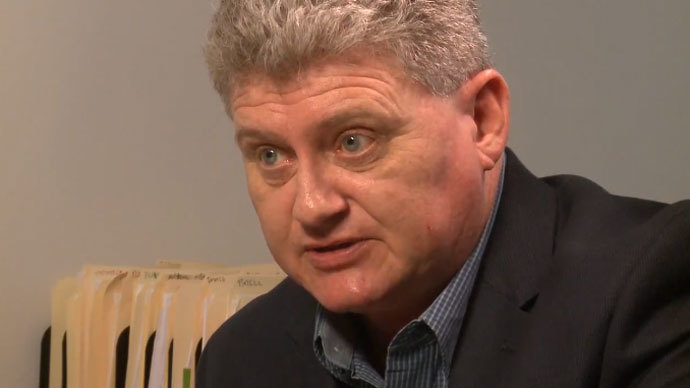
According to the elder Snowden, his son would be maltreated in US custody in the run up to the trial, similar to the case of Pfc. Bradley Manning, who was recently found guilty on 20 offences linked to the leaking of classified US information to WikiLeaks.
“I just don’t have a high level of trust in our justice system, not only because of what has happened to my son,” Lon Snowden said.
Russia is currently considering Edward Snowden’s request for temporary asylum, while the whistleblower still remains in the transit zone of the Moscow’s Sheremetyevo airport.
“I feel Russia has the strength and resolve and convictions to protect my son,” Edward Snowden’s father wrapped up.
Tuesday, July 30
14:15 GMT: US whistleblower Edward Snowden was thrilled by a novel from one of Russia’s most eloquent wordsmiths, Dostoevsky. The author’s most renowned work, "Crime and Punishment", was given to the former NSA contractor by his legal representative in Russia, Anatoly Kucherena, a source close to the Public Chamber member told Interfax, adding that Snowden continues to study the Russian language and Russian history.
The 30-year-old leaker, who has been in the transit zone of the Moscow’s Sheremetyevo airport for over a month, asked Kucherena for a complete collection of works by the prominent historian Nikolay Karamzin.
Apart from food for thought, Kucherena has recently given Snowden a new set of clothes – clean shirts and shoes.
"Anatoly was deeply disappointed when he learned that his guess of Snowden’s shoe size was wrong, and he had to buy a new pair of shoes of a smaller size," the source said.
10:00 GMT: The Russian Justice Ministry has sent a formal response to a letter from US Attorney General Eric Holder detailing America’s position on Edward Snowden. The ministry did not provide details of its reply.
Holder’s letter was aimed at clarifying some points regarding the US case against Snowden, including the statement that the US would provide a legal guarantee that the whistleblower would not be subject to capital punishment if tried on US soil. The document did not include any requests to extradite or deport him.
09:10 GMT: The Russian Orthodox Church supports Russia’s decision to formally review Snowden’s request for political asylum despite pressure from the US to hand him over. Moscow should “defend true freedom from the global ideological dictate, the electronic concentration camp,” believes the spokesman for the Church Vsevolod Chaplin.
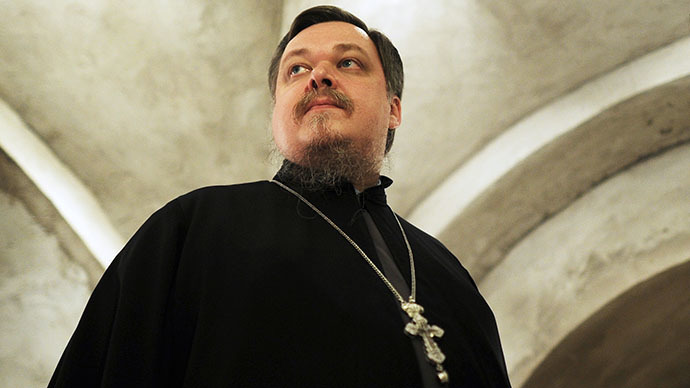
He lashed out at what he described as creeping rise of electronic surveillance and the control over individuals it brings, which “may become more rigid than any totalitarian system of the 20th century”.
Sunday, July 28
12:34 GMT: The thousands of people who marched in protest of a new bill that would grant the New Zealand’s government sweeping spy powers, were misinformed, Kiwi Prime Minister John Key has said playing down the nationwide protests.
"At the risk of encouraging them to have more protests, I would have actually said those numbers were quite light – it wasn't anything like what we saw for mining or anything else," he told TVNZ's Q&A program on Sunday.
"Secondly, a lot of people that would go along would be either A, politically aligned, or B, with the greatest of respect, misinformed,” he stressed.
9:30 GMT: The Russian Ministry of Justice has announced it is working on a reply to a letter it received from US Attorney General Eric Holder, in which he assured that Edward Snowden will not be tortured or given the death penalty if he is returned to the US.
The Ministry does not specify what the answer will be or when it will be sent to the US.
Saturday, July 27
17:00 GMT: The Russian Ministry of Justice said in a statement that according to the country’s laws, former CIA employer Snowden can stay inside the international transit zone for as long as he pleases, even though his travel documents were revoked by the United States.
The ministry also replied to US Ambassador to Russia Michael McFaul’s earlier tweet that the US was not seeking Snowden's extradition, but was instead asking for his return. The ministry explained that it could not comply with such a request, simply because the term “forced return” does not exist in international law.
"As a rule, the term 'return' in Russian law and practice is applied to voluntary entry of individuals from abroad into the country whose citizens they are," the ministry said.
14:00 GMT: Thousands of people have protested in 11 cities and towns across New Zealand against the new surveillance bill that would enable the country’s Government Communications Security Bureau (GCSB) to spy on its citizens.
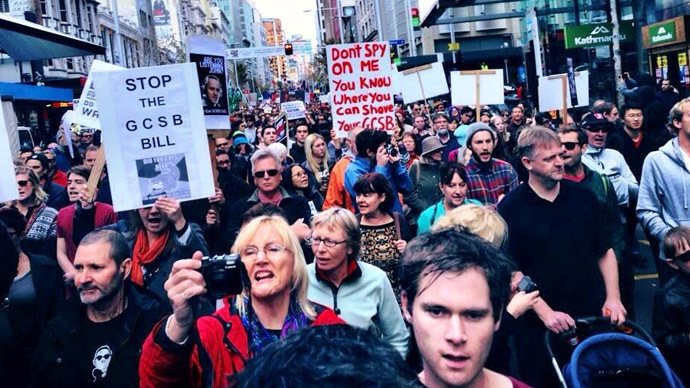
MegaUpload founder Kim Dotcom joined the rally. He told the crowd that the government had invaded his privacy and "if they can do that to me they can do that to any of you."
Prime Minister John Key defended the bill, saying that it would give greater oversight and was "a strengthening of the previous legislation.”
12:00 GMT: Anti-NSA protests have been organized in at least 40 German cities, including Hamburg, Munich, and Berlin, with the largest rally taking place in Frankfurt. Participants responded to calls for demonstrations, which were initiated by a loose network calling itself #stopwatchingus.
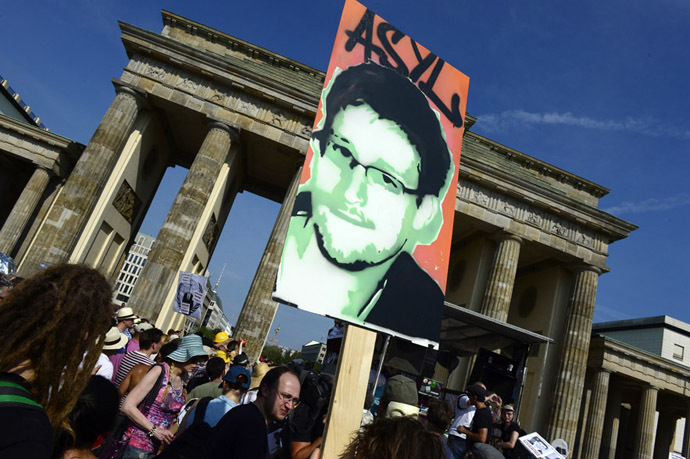
The Germans have been outraged by the news that the country’s secret services helped the NSA in its massive spying, as was exposed by Der Spiegel magazine.
04:42 GMT: The US State Department does not believe that imposing international sanctions because of Snowden would be of any use, said State Department spokeswoman Jen Psaki.
Republican Senator Lindsey Graham has recently proposed that the US State Department set penalties against those nations that seek to help former NSA contractor Edward Snowden avoid extradition to the US.
The Senate Appropriations Committee has already approved the proposal unanimously by voice vote as an amendment to 2014 diplomacy and international aid bill.
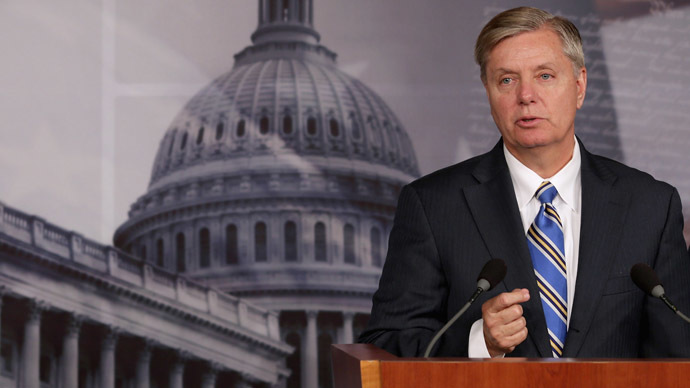
“We have not seen the text of the proposed bill, but we feel that in general legislation imposing sanctions under these circumstances would not be helpful,” Psaki shared, adding that she is not going “to make a prediction about any step we may or may not take.”
“Our focus in this specific case is having Mr. Snowden returned to the United States, and we still feel Russia has the opportunity to do that and to take the right steps,” the spokesperson stressed.
The Obama administration also has no intention to repeat the major scandal of 1980 and boycott Winter Olympic Games in Russia’s Sochi in 2014.
“That’s certainly not what we’re calling for,” the spokeswoman told journalists at a daily press briefing.
Friday, July 26
23:50 GMT: Edward Snowden’s father, Lon Snowden of Allentown, Pennsylvania, told the AP on Friday that he believed his son’s best option was now to remain in the Russian Federation. Lon Snowden had been working with attorneys to arrange for a fair trial of his son in the US, allowing for his return, but on Friday said that he had lost faith in the Obama administration and Congress after his son had been vilified. Mr. Snowden had echoed that sentiment during a Friday appearance on NBC's Today Show stating that there was a concerted effort by some members of Congress to "demonize" his son.
"If it were me, knowing what I know now, and listening to advice of sage people like [Pentagon Papers leaker] Daniel Ellsberg ... I would attempt to find a safe haven," Snowden said.
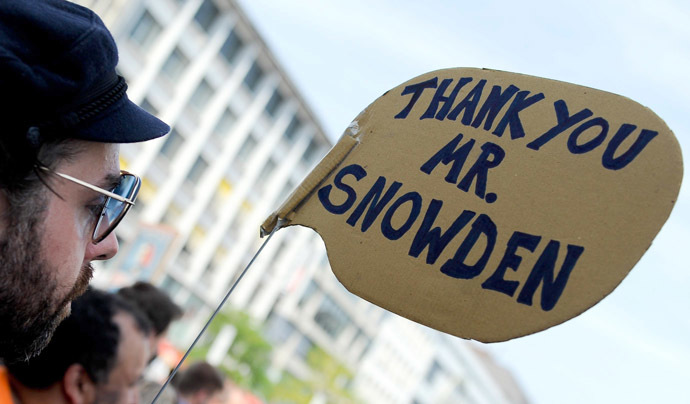
The elder Snowden, a US Coast Guard veteran, and his attorney, Bruce Fein, said they were “disgusted” by Attorney General Eric Holder’s Friday letter to Russian officials promising that Snowden would not face execution if he were extradited to the US. According to the two, that letter reflected a mindset that Snowden is presumed guilty, and that 30 years to life imprisonment is considered a reasonable punishment.
"He sacrificed everything and gained nothing," the elder Snowden told the AP. "He's done what he's done. The consequences are unavoidable, and I don't know if I can mitigate those."
16:42 GMT: US Attorney General Eric Holder has promised Moscow that Snowden will be given a fair trial, and will not be tortured or sentenced to death. The pledge was made in a diplomatic letter Holder sent earlier this week.
“The United States will not seek the death penalty for Mr. Snowden should he return to the United States. The charges he faces do not carry that possibility, and the United States would not seek the death penalty even if Mr. Snowden were charged with additional, death penalty-eligible crimes,” said the missive, which was addressed to Russian Justice Minister Aleksandr Konovalov.
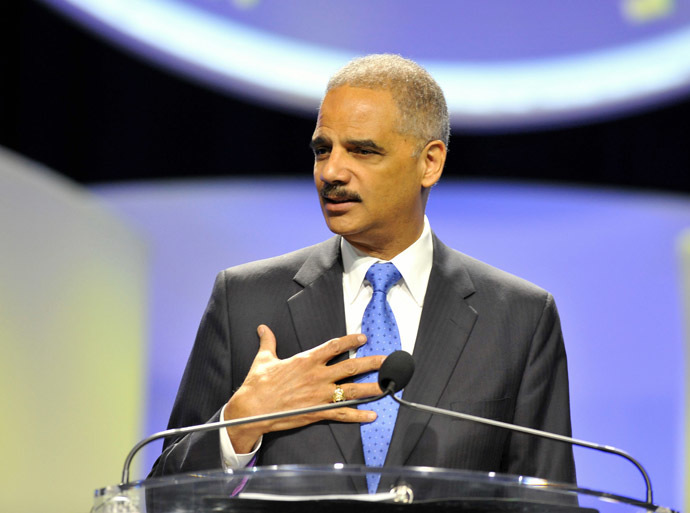
In the letter, the US also promised that Snowden would receive a public jury trial in the civil courts, and would not be subjected to anything but “voluntary questioning” in the lead-up to his trial.
“Mr. Snowden will not be tortured. Torture is unlawful in the United States,” wrote the attorney general.
13:57 GMT: German President Joachim Gauck expressed concern over NSA wiretapping, called for a binding international agreement to safeguard civil rights, and said that whistleblowers like Edward Snowden deserve “respect.”
“I never thought that the fear that secure communication was no longer possible could ever arise in Germany again,” Gauck said in an interview with the Passauer Neue Presse regional newspaper, adding that he now has to question the safety of talking on the phone and sending emails openly.
“We have to make sure that even our allies’ secret services respect the boundaries we find necessary here. A binding international agreement – if that was what was needed – should be created urgently to safeguard civil rights,” the president added, urging the German government to work on such agreement.
Referring to Snowden, Gauck said: “Whoever brings information to the public and acts on grounds of conscience deserves respect.”
13:30 GMT: Russian security agency FSB is in talks with its American counterpart the FBI over Edward Snowden, but Russia has no plans to extradite the former NSA contractor to the US, said Russian President Vladimir Putin’s spokesman Dmitry Peskov.
“Russia has never extradited anyone, and will not extradite,” Peskov stressed.
When asked if Snowden will continue harming the US if granted asylum in Russia, and if the situation is going to undermine Moscow’s ties with Washington, Peskov stressed that “the head of state has expressed strong determination not to allow this.”
09:00 GMT: Germany has announced its intention to update UN data protection regulations in the wake of Edward Snowden revelations. Some top officials are also calling for a suspension of the data exchange treaty between Washington and the EU. Skeptics, though, suspect it might be little more than general election campaigning, as RT’s Peter Oliver reports from Berlin.
08:00 GMT: Nicaraguan President Daniel Ortega, one of the three Latin American leaders to offer asylum to Snowden, exclusively told RT why the whistleblower would be welcome in his country.
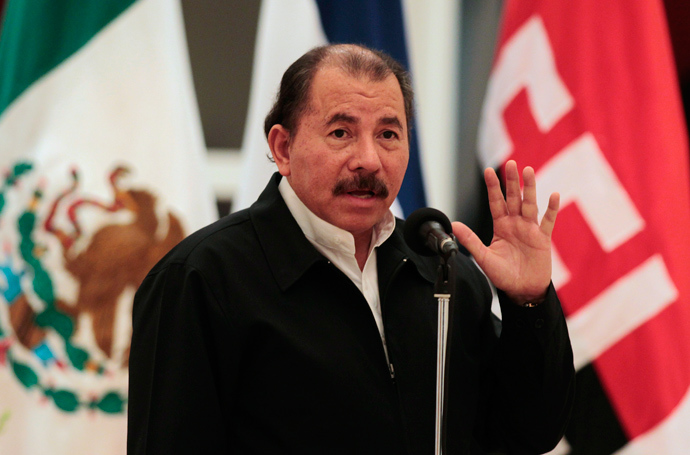
“I think the threats coming from the United States work against them. It’s ridiculous. A power like the United States threatening a young man who’s had enough courage to tell the truth about something that went against his principles. A man who realized at a certain point that he could cross the line of what is called intelligence work. He understood where intelligence ends and the lawlessness begins and that lawlessness has nothing to do with secret operations or War on Terror or protecting the state interests or with the search for scientific information. A point when he saw that this is sheer madness, because it isn’t normal, it’s not like the US are forcing the Europeans’ hand in this. It’s just that they have something in common, common positions, common strategy and the same desire for global domination.“
Thursday, July 25
19:00 GMT: US district court in New York dismissed the request by US Justice Department to delay hearings concerning a lawsuit filed by American Civil Liberties Union (ACLU), arguing NSA surveillance program is unconstitutional. The court set a schedule according to which motions must be filed by August 26 and oral arguments will begin on November 1.
18:00 GMT: US lawmakers voted to introduce trade or other sanctions against any country offering asylum to Edward Snowden.
It was initiated by Sen. Lindsey Graham (R-South Carolina) who earlier urged President Obama not to go to September's G20 summit in Russia - and called for a boycott of Winter Olympics in Sochi.
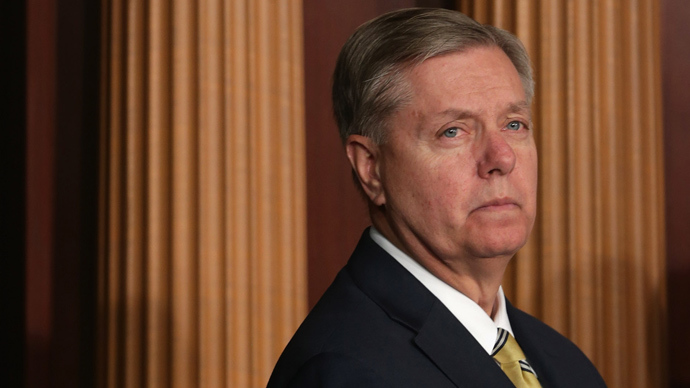
“I don’t know if he’s going to stay in Russia forever. I don’t know where he’s going to go... But I know this: That the right thing to do is to send him back home so he can face charges for the crimes he’s allegedly committed,” Graham said.
12:46 GMT: Google denies granting access to its data to any governments, according to the company’s Vice-President of Southern, Eastern Europe, Middle East and Africa Carlo d'Asaro Biondo.
"We do not provide access to our systems to any governments anywhere. We believe that the debate and discussion of the issue of the protection of security data and private data is a very important matter, and we believe that in a world that is increasingly globalizing, assistance to various cultures to better understand each other is a very noble task,” he said after meeting Russian Senator Ruslan Gattarov, the head of the investigative group over possible violations of Russian legislation in the user agreement of the company.
"We heard this position, and are very pleased that we have once again built a constructive dialogue with Google," said Gattarov.
Wednesday, July 24
20:34 GMT: The NSA will continue collecting the phone data of individuals not currently under investigation. The US House of Representatives voted on Wednesday to reject an amendment introduced by Rep. Justin Amash (R-Michigan) aimed to stop domestic spying by the National Security Agency. The 205 to 217 vote in the House was preceded by a storm of lobbying by the White House against the measure.
18:50 GMT: France denies having a surveillance program similar to the NSA’s PRISM mass electronic surveillance data mining program, according to the French General Directorate for External Security (DGSE). "Allegations that the DGSE was involved in surveillance of citizens are unjustified," Senator Jean-Pierre Sueur said in a statement. He referred to reports published by Le Monde newspaper in July, which stated that the French intelligence agency intercepts and analyzes all email messages and text messages, as well as monitors social networks and telephone conversations.
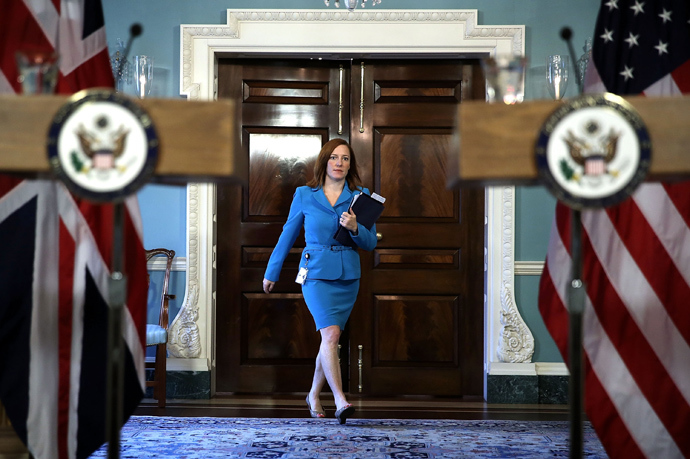
18:30 GMT: The White House says the US will be deeply disappointed if Russia allows NSA leaker Edward Snowden, who is wanted in America, to leave Moscow's Sheremetyevo Airport. “Any move that would allow Mr. Snowden to depart the airport would be deeply disappointing," State Department spokeswoman Jen Psaki told reporters. She added that US Secretary of State John Kerry took part in a phone call with Russian Foreign Minister Sergey Lavrov. Psaki said the Obama administration wants clarification of reports stating that Snowden may leave the airport after his political asylum documents are issued.
17:55 GMT: NSA whistleblower Edward Snowden has been awarded the "Whistleblower Prize" by the German branch of human rights organization Transparency International. Established in 1999, the prize comes with 3,000 euros of prize money. It is given to those who "reveal grave abuses and dangerous developments for people and society, democracy, peace and the environment in the public interest.” The organization’s representatives say the award money will be passed on to Snowden.
14:20 GMT: Lawyer Anatoly Kucherena says Snowden's asylum bid is still being reviewed by immigration authorities and that the whistleblower will have to stay at Moscow Sheremetyevo Airport, but confirmed that the NSA-leaker will live in Russia. He assured that Snowden is staying in good conditions.
However, Kucherena did not give any specific date when documents should be issued. Asked about reasons for that, he explained that the delay in issuing all necessary documents to Snowden is due to the uniqueness of the situation.
13:21 GMT: Snowden has produced documents to Sheremetyevo border control, Interfax source says.
"Documents have been taken from Snowden, most likely for border control registration," the source said.
13:07 GMT: Snowden has been issued his travel documents from Russia’s Immigration Service, the source told Interfax.
“They talked and Mr. Kucherena handed Snowden a package with documents, among which was the certificate that now allows him to leave the transit zone and go through Russian customs.”
13:02 GMT: Lawyer Anatoly Kucherena has entered the transit zone at Sheremetyevo Airport and has met Edward Snowden.
“Mr. Kucherena is in the transit zone, currently talking to Snowden,” Interfax news agency quoted its source as saying.
12:39 GMT: Anatoly Kucherena said he will not comment until he talks to Snowden.
“I am now walking to Snowden and after the consultation with him I will be able to tell you something,” he said.
12:38 GMT: Lawyer Anatoly Kucherena walking through Sheremetyevo Airport:
#snowden advisor arrives... With paperwork?? pic.twitter.com/EtRqFud1HX
— Lindsay France (@LindsayFrance) July 24, 2013
12:36 GMT: NSA whistleblower Edward Snowden, who has been stranded at a Moscow airport since last month, is expected to be issued his travel documents. Russia’s Immigration Service, however, is declining to comment if such a paper has been issued for Snowden. Lawyer Anatoly Kucherena is currently at Moscow’s Sheremetyevo Airport, where the documents have reportedly been brought.
11:06 GMT: Russia is surprised by US statements that there are grounds for extradition of the NSA leaker Edward Snowden, diplomatic sources told RIA Novosti on Wednesday.
"The Secretary of State said that in 2007-2012, the United States gave us some 1,754 people and was ready to extradite another 101 offenders. But when we contacted the State Department and other US agencies with a request to provide comprehensive lists, they only made a helpless gesture,” the source noted.
The source added that in Snowden’s case Washington has confused routine extradition with deportation of foreigners who have violated US laws.
Tuesday, July 23
21:22 GMT: An Iranian NGO named “Justice-Seekers without Borders” has invited former CIA employee Edward Snowden to visit Iran in order to reveal the details of the US intelligence operations against Iran.
"Since one of the United States' illegal actions disclosed by you is spying on the Iranian citizens, we invite you to visit Iran and elaborate on the US administration's measures in this regard in detail," the NGO said in a letter to Snowden.
‘Justice-Seekers without Borders’ expressed pleasure in the US failure in detain Snowden, and stressed that the Iranian people will remain beside those who fight for truth and pay the price for their resistance, Fars reported.
Tehran slammed the US for conducting espionage operations against Iran after Snowden’s revelations according to which Iran was the country where the largest amount of intelligence was gathered.
"...Iran has always been one of the targets of the US espionage operations and the US officials have repeatedly pointed to this issue," Iranian Foreign Ministry Spokesman Seyed Abbas Araqchi said earlier this month. "This move is not acceptable at all," he added.
Monday, July 22
17:30 GMT: RT has developed an interactive map showing the countries being spied on, those aiding the US in their surveillance operations, and those both being surveilled and helping the US simultaneously.
15:50 GMT: Edward Snowden has expressed hope that he will be granted documents which will allow him to leave the transit zone of Moscow's Sheremetyevo Airport by Wednesday, according to his Russian lawyer who spoke to Reuters on Monday.
"He should get this certificate (allowing him to leave the airport) shortly," Anatoly Kucherena said. Kucherena helped the former NSA contractor file a request for temporary asylum in Russia on July 16. If successful, Snowden will be able to finally leave for the city center after a month-long stay at Sheremetyevo which has strained US-Russian relations. His bid for temporary asylum could take three months to process, but the preliminary response to his request will allow him to leave through customs.
Sunday, July 21
16:33 GMT: Der Speigel magazine has revealed German intelligence operated one of NSA’s spying programs. Chancellor Angela Merkel had denied any previous knowledge of NSA’s tactics, adding that she first learned about them through the media.
Germany's foreign intelligence service, the BND, along with the domestic intelligence agency the Federal Office for the Protection of the Constitution (BfV), used American National Security Agency’s (NSA) XKeyScore program, according to Spiegel which claims to have seen the US intelligence service’s secret documents.
Saturday, July 20
06:20 GMT Nicaraguan President Daniel Ortega advised Barack Obama to beware of the FBI, which might be spying on the US President. "I tell President Obama to take care...for sure they are spying on him," Ortega said during a speech to mark the 34th anniversary of the Sandinista revolution.
Ortega extended his warning to other high-level officials in the Obama Administration as well as lawmakers, saying there is nothing new in the FBI keeping tabs on America’s top political figures since the agency’s very first director J. Edgar Hoover “spied on those who were candidates for the Presidency”.
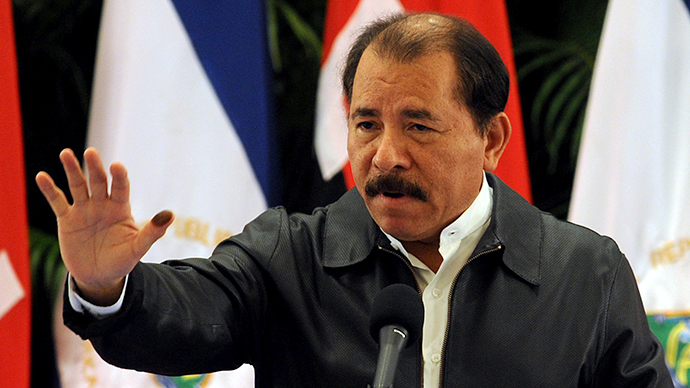
The FBI is filing dirty laundry on every American politician so once a candidate wins the presidency, he has a talk with the FBI chief, who reveals what dirt he has on the president-elect, Ortega explained. This system of blackmail is why a new president has no real power over the ‘intelligence apparatus’.
Ortega also slammed the US for its disproportionate reaction to Edward Snowden's revelations.
"I wonder what else he [Snowden] knows? How much horrifying information is there that they want to prosecute and convict him in the US, where the death penalty is an option?" Ortega asked
Wednesday, July 17
17:20 GMT: A recent poll carried out by 'All-Russian Center for the Study of Public Opinion' showed that thirty nine percent of Russians think that Russia should not extradite Snowden to the US, while 18 percent believe Moscow has to hand him over to Washington. Fifty nine percent out of 1, 500 people questioned could identify the whistleblower. According to the poll, twenty seven percent state that Russia should grant political asylum to Snowden, twenty three are against it, while every second respondent found it difficult to answer this question.
13:15 GMT: Senator Lindsay Graham, suggestets that the USA shoud boycott the winter Olympics in Sochi because of the Edward Snowden affair. Several Russian MPs and members of the country’s National Olympic Committee have harshly criticized the senator's proposal and said they are sure that the US authorities would ignore senator Grahams words.
"Graham: US should consider Olympic boycott over possible #Snowden asylum" Last boycott was re Soviet invasion of Afghanistan. Irony? #tlot
— Gov. Gary Johnson (@GovGaryJohnson) July 17, 2013
09:10 GMT: According to Anatoly Kucherena, the lawyer who is assisting Snowden, the whistleblower has no plans to leave Russia yet and he doesn’t exclude the future possibility of “asking for Russian citizenship.”
In an interview to RT , Snowden’s lawyer stressed that the Russian decision to review the asylum request was based on the “human rights” aspect of the issue, as the US still administers capital punishment and torture.
“When asked a question by the FMS agent why he chose to file a petition in Russia and why he came here, he replied that he fears for his life and wellbeing, that he is also afraid of torture, and that he could get executed.”
Snowden applied for a temporary asylum, and if the Russian Migration Service rules in favor, then he will receive asylum status for one year, Kucherena said adding that Snowden could leave the confinement of the airport after he receives proper paperwork, meaning that “he does not have to wait for a final decision on his petition.”
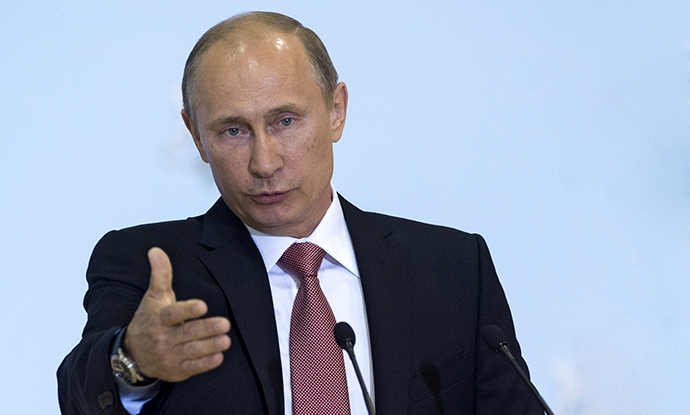
08:25 GMT: Russian President Vladimir Putin said that relations between Moscow and Washington are more important than the intelligence service spat, especially regarding Snowden affair. Putin reiterated the whistleblower was aware Moscow would not tolerate any activity aimed to damage US-Russian relations.
When asked how the Russian authorities would control the NSA leaker’s activity, the President said , "I won’t give you any details. We have warned Snowden that any activity of his that could damage US-Russian relations is unacceptable for us.”
08:04 GMT: The US has sent extradition requests for Edward Snowden to Bolivia, Venezuela, Hong Kong, Ireland and Iceland, WikiLeaks wrote via Twitter.
07:43 GMT: The White House has warned that Russian-US relations could suffer if cooperation in the Snowden affair is not forthcoming.
“The Russian government has an opportunity here to work with us,” press secretary Jay Carney told reporters at his daily briefing. “This should not be something that causes long-term problems for U.S.-Russian relations.”
Tuesday, July 16
23:58 GMT: White House officials made it clear Tuesday that the administration’s frustration with Russia playing host to NSA whistleblower Edward Snowden is mounting. Press Secretary Jay Carney said that, no longer allowing Snowden to stay in the Moscow airport, Russia could “resolve this situation that they have been dealing with now for three weeks.”
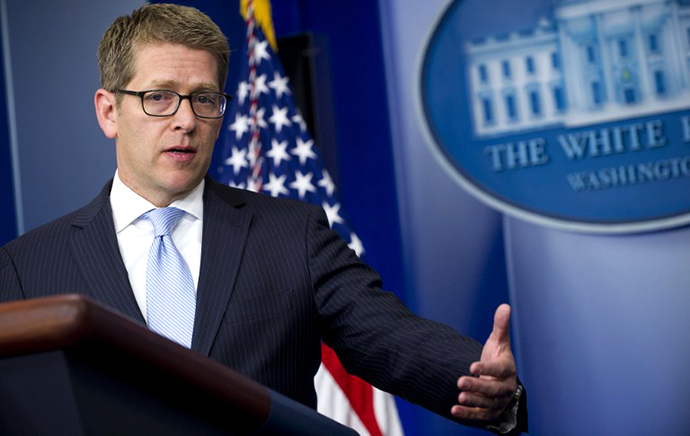
He added, ominously, that that two countries been “engaging on a number of important issues, both economic and security issues, and we want to continue that relationship unimpeded by this issue.”
“The Russian government has an opportunity here to work with us,” Carney said. “This should not be something that causes long-term problems for US-Russian relations.”
19:55 GMT: A long-serving United States senator Gordon Humphrey has sent a letter of support to the NSA contractor, according to correspondence published by the Guardian’s Glenn Greenwald, saying “you have done the right thing in exposing what I regard as massive violation of the United States Constitution.”
19:41 GMT: Microsoft has asked US Attorney General for more freedom to disclose how it handles requests from national security organizations for customer data, the Corporation said. It follows the Guardian newspaper report, citing Edward Snowden leaked documents, that the world's largest software company allowed US security agencies to break an encryption of Outlook emails and capture Skype online chats, Reuters reports. Microsoft said there were "significant inaccuracies" in media reports last week and argued that it does not allow any government direct or indirect access to customers' emails, instant messages or data.
17:39 GMT: The Electronic Frontier Foundation has filed a lawsuit against the Obama administration concerning the NSA surveillance program. The company’s attorneys are demanding the White House stop the dragnet surveillance programs operated by the NSA.
16:10 GMT: The mother of Konstantin Yaroshenko, the pilot found guilty of conspiring to smuggle cocaine into the US and sentenced by an American court to 20 years in prison, has asked Russian Foreign Minister Sergey Lavrov to exchange Edward Snowden for her son. Lubov Yaroshenko told RIA Novosti that she believed that the US will agree to such an exchange, because America needs Snowden more than her son.
“Why do we need this Snowden,” she said.
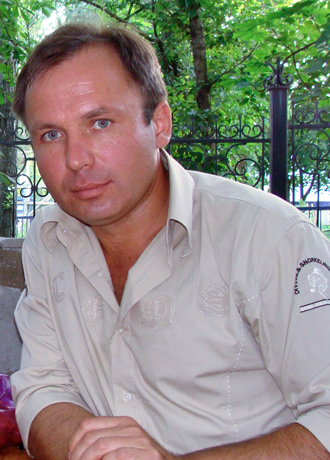
Lubov Yaroshenko believes that for Russia, Snowden will mean deterioration of relations with the US. Earlier the leader of the populist-nationalist party LDPR Vladimir Zhirinovsky suggested the same exchange, but he said that Russia could ask to return both Konstantin Yaroshenko and another Russian citizen Viktor Bout, who is serving 25 years prison term for attempting to sell heavy weapons to a Colombian terrorist group. Russia has slammed sentences to both its citizens, calling the cases “groundless” and “politically motivated” and vowed to take measures to return the men home.
14:18 GMT: The multinational Internet corporation Yahoo! has won a court case ordering the release of US intelligence records in a bid to prove the firm attempted to resist handing over customer data to be used in the NSA surveillance program PRISM.
"The Government shall conduct a declassification review of this Court's Memorandum Opinion of [Yahoo's case] and the legal briefs submitted by the parties to this Court," the ruling read.
13:00 GMT: The Russian Migration Service (FMS) confirmed it has received whistleblower Edward Snowden’s application for temporary asylum. The FMS promised to review his application within a three month period. Meanwhile, President Vladimir Putin has expressed hope that Russian-US relations will develop in a positive manner despite the latest development, the Kremlin spokesman Dmitry Peskov said.
09:33 GMT: The former NSA contractor Edward Snowden is going to submit his application for asylum to Russia in the upcoming days, said lawyer and Public Chamber member Anatoly Kucherena.
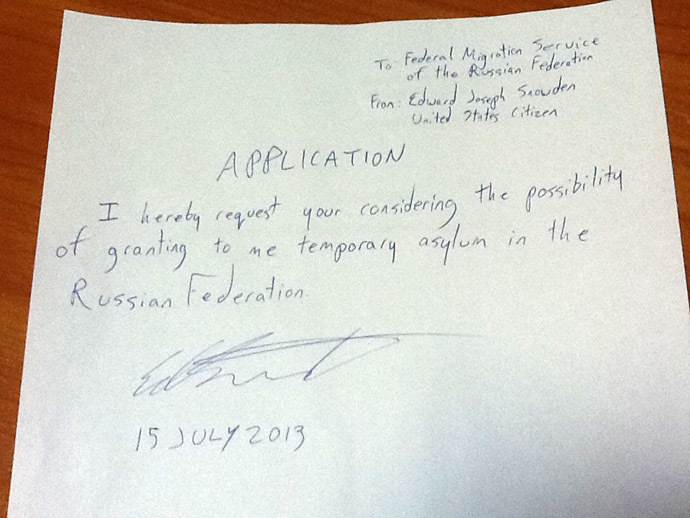
Snowden will be able to submit the application in person as the office of the Federal Migration Service is situated in the transit zone of the Sheremetyevo Airport, where he has been holed up for more than three weeks after the US government revoked his passport shortly before departing for Moscow.
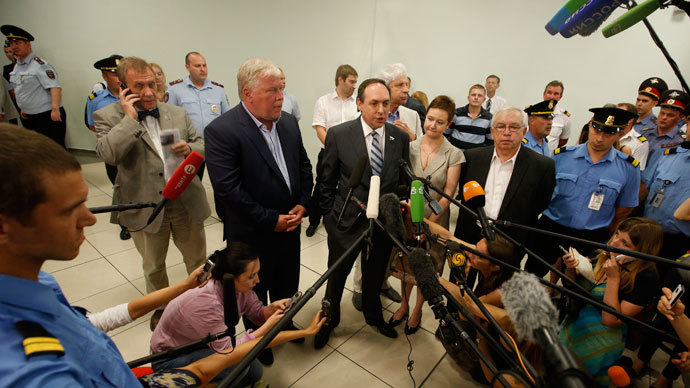
On July, 12, Kucherena, together with other human right activists, met the whistleblower in Sheremetyevo Airport. Kucherena, who consulted Snowden and provided legal aid to the former NSA contractor regarding his asylum bid, continues to actively support the whistleblower.
Monday, July 15
19:33 GMT: The people must join the likes of Edward Snowden and Julian Assange in their fight against Big Brother if they want to have some privacy in the future, software freedom activist and founder of the Free Software Foundation, Richard Stallman, said in an interview with RT’s SophieCo program.
“Thanks to Snowden, we know that in some cases, specifically phone calls, the US government is actually doing this [digital surveillance], and we know that there are other governments that do surveillance without even the flimsy limits of the US government – so I’m tremendously happy to see that Snowden has called the public’s attention to this injustice, because our cause now has more momentum. We might, maybe, be able to stop this,” he said.
12:30 GMT: Europe needs stronger data protection laws to win back the trust of citizens damaged by the revelations of the NSA's PRISM and other spying programs, EU Vice President Viviane Reding said at DLDWomen, a conference bridging media, technology and women's issues. Reding called the NSA-leak by whistle blower Edward Snowden “a wakeup call” that will spark even stronger regulations in Europe to protect personal data from government surveillance.
“We do not want the US government to listen to every phone call we make and read every email," Reding said. “Data protection in Europe is a fundamental right… Strong rules allow trust and, in the internet world, without trust you cannot go ahead.”
“Big data can be big business only if the trust of the consumers comes back,” she added.
12:15 GMT: Human Rights Watch Russia’s Tatyana Lokshina says she has been getting flooded with letters of support and offers of assistance for Edward Snowden, since being part of a meeting between the whistleblower and Russian civil society representatives.
“I have been inundated with letters from Snowden’s fans. One man wrote to me that he is a re-location specialist, and has asked me to pass his details onto Snowden.”
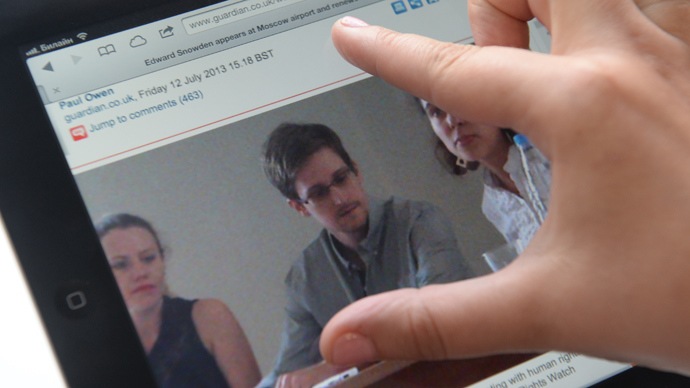
11:56 GMT: Germany's foreign intelligence agency (BND) knew about US surveillance and used the data collected by National Security Agency (NSA) to get information about Germans kidnapped abroad, according to Bild daily. The paper’s sources in the US government said the BND had requested the NSA for the email and telephone records of German citizens kidnapped in Yemen or Afghanistan to set their location. The problem became widely discussed as German Chancellor Angela Merkel claimed during her third re-election campaign that she had never known of NSA spying on German citizens. A poll last week by the Forsa opinion research institute indicated four out of five Germans think the government deceived them by claiming it wasn’t aware of NSA spying.
11:33 GMT: Edward Snowden has decided not to make public "literally thousands of documents" that could “harm the US government,” The Guardian newspaper columnist Glenn Greenwald told AP. The disclosure of the information "would allow somebody who read them to know exactly how the NSA does what it does, which would in turn allow them to evade that surveillance or replicate it," the columnist said. He previously said the documents had been encrypted to help ensure their safekeeping.
Sunday, July 14
19:44 GMT: The chairman of the US House of Representatives Homeland Security Committee, Michael McCaul, urged the Obama administration to exert "any and all pressure" on Russia - including economic measures - to persuade Moscow to hand over Edward Snowden.
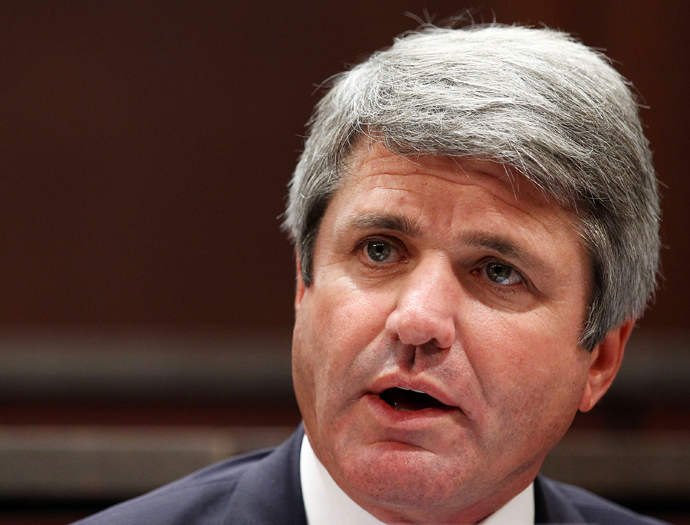
The Republican congressman told Fox News Sunday that he believes that Russia is "making a mockery" of US foreign policy, extracting “more and more information” from the NSA leaker on a daily basis.
He also accused Obama of failing to develop an acceptable relationship with Russian President Vladimir Putin, which has prompted Russia to “thumb their nose at the United States.”
19:40 GMT: German Chancellor Angela Merkel has refused to compare US electronic surveillance revealed by Edward Snowden last month with the activities of the defunct East German security agency Stasi.
“Such comparisons only lead to a trivialization of what the Stasi did to people,” the politician told Die Welt magazine.
The parallel has been widely drawn by German journalists and politicians, and internet entrepreneur Kim Dotcom collaborated with visual artist Oliver Bienkowski to project the words 'United Stasi of America' onto the walls of the American embassy in Berlin earlier this week.
Saturday July 13
23:50 GMT: Bolivian President Evo Morales has said that the US government has access to the correspondence of top authorities in his country, adding that he has shut down his own email.
"Those US intelligence agents have accessed the emails of our most senior authorities in Bolivia,” Morales said in a speech at the Mercosur regional summit in Montevideo.
"It was recommended to me that I not use email, and I've followed suit and shut it down," he said.
Speaking at the summit, Argentine Foreign Minister Hector Timerman also said that more than 100 of his country's officials were under electronic surveillance from a nation he did not name.
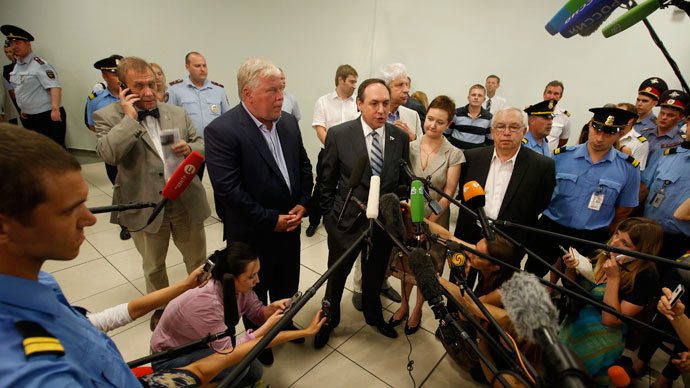
07:47 GMT: Russian Foreign Minister Sergey Lavrov said that to obtain political asylum in Russia, former-CIA employee Edward Snowden must apply to the Federal Migration Service (FMS). "Russian laws require a certain procedure, and the first step is to appeal to the Federal Migration Service," Lavrov told the journalists on Saturday.
"We are not in contact with Snowden; the issues that he discussed with the Russian activists yesterday were widely covered by the media, and I learned from them just like anyone else," he added.
08:08 GMT: Edward Snowden has not appealed to the Russian Migration Service for asylum, the head of the organization, Konstantin Romodanovsky, told Interfax on Saturday. "To date, there have been no appeals submitted by Snowden yet. If an application arrives, it will be considered in accordance with the law," Romodanovsky added.
03:49 GMT: In accordance with Russia’s stipulation for granting Snowden temporary asylum, the NSA whistleblower has indicated he is willing to stop leaking documents that would 'damage the US.' Glenn Greenwald, the journalist who has been in contact with Snowden and was the first to publish the disclosures, has said he still has yet to publish all of the information the former NSA contractor turned over.
“There are many, many more domestic stories coming, and big ones, and soon,” Greenwald wrote in an email to Politico on Friday. “I’d deal with that hypothetical only in the extremely unlikely event that it ever happened, but I can’t foresee anything that would or could stop me from further reporting on the NSA documents I have.”
03:48 GMT: South American countries belonging to the Mercosur trade bloc have announced they will withdraw their ambassadors for consultations from European countries involved in the grounding of the Bolivian president’s plane, which came after a US ambassador told several countries he thought Snowden was aboard. The decision to recall European ambassadors was agreed upon by Venezuela’s President Nicolas Maduro, Argentina’s President Cristina Fernandez, Brazilian President Dilma Rouseff, and Uruguay’s President Jose Mujica during a summit meeting on July 12.
Friday, July 12
19:00 GMT: Russia’s pro-Snowden activists came out to demonstrate against US secret eavesdropping methods and the hunt for the whistleblower.
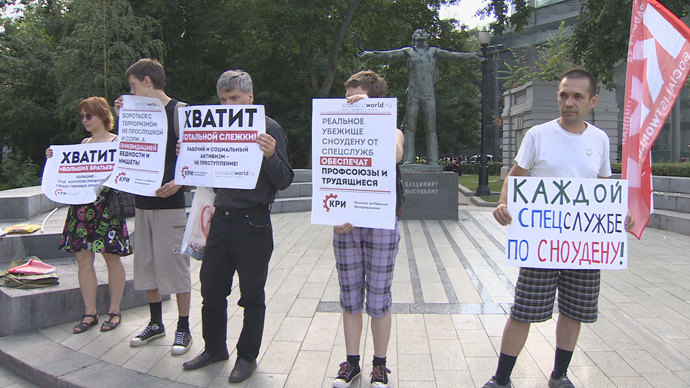
18:20 GMT: South America’s leading trade bloc Mercosur responded to recent allegations of US spying in the region by issuing a statement rejecting telephone bugging and Internet espionage as a violation of human rights, Reuters reports.
18:18 GMT: UN High Commissioner for Human Rights, Navi Pillay, has made her first comment on the Snowden case.
She said people need to be sure their communications are not being unduly scrutinized, and called on all countries to respect the right to seek asylum.
“While concerns about national security and criminal activity may justify the exceptional and narrowly-tailored use of surveillance programs, surveillance without adequate safeguards to protect the right to privacy actually risk impacting negatively on the enjoyment of human rights and fundamental freedoms,” Pillay stated, as quoted by Reuters.
17:20 GMT: President Barack Obama will speak with Russian President Vladimir Putin later Friday, White House spokesman Jay Carney said. The phone call has been scheduled for several days. According to Carney, the Obama administration has been communicating with different nations, letting them know that the US would like Snowden to be returned to face charges in the United States, Reuters reports.
17:18 GMT: Washington says that Russia granting political asylum to Snowden would be on par with providing the NSA leaker with a “propaganda platform” to further harm the US.
White House spokesperson Jay Carney said the administration’s position on the whistleblower remains the same, believing that Snowden should be extradited to the US to face charges of espionage.
17:02 GMT: Washington denies that US diplomats asked Human Rights Watch to deliver a message to Snowden.
“We simply explained our position on Snowden to a representative of Human Rights Watch,” a source at the US Department of State told Interfax.
15:21 GMT: Prior to the Friday meeting, the American Embassy in Moscow called some of the meeting’s participants, asking them to deliver the US position to Snowden, Public Chamber member Olga Kostina told journalists. Washington considers Snowden to be a law violator rather than a rights advocate, she said.
Human Rights Watch representative Tatyana Lokshina said she was also contacted via telephone on behalf of the US Ambassador to Moscow.
14:59 GMT:
RELEASE: Statement read by Edward #Snowden to human rights groups at Moscow airport today http://t.co/HEpWd0QFaG#snowden#nsa#prism
— WikiLeaks (@wikileaks) July 12, 2013
14:53 GMT: Russia should grant Snowden political or temporary asylum, believes the State Duma Speaker Sergey Naryshkin.
“I consider Edward Snowden a human rights activist, who advocates for the rights of millions and millions of people in the whole world,” he said, as cited by Interfax.
The Duma speaker noted that in the US – which has been demanding the NSA leaker’s extradition – Snowden could face the death penalty.
“We simply have no right to permit that,” Naryshkin added.
14:26 GMT: If Snowden is given political asylum in Russia, the relations between Moscow and Washington are likely to worsen, political analyst Dmitry Babich told RT.
“Certainly it will have a negative impact. But any objective observer can notice Russia did not want this scandal. Russia did not want to have one more impediment in these relations with the US,” he said.
14:24 GMT: WikiLeaks website is to publish on Friday evening Edward Snowden’s address to human rights activists and lawyers he made earlier in the day at the Sheremetyevo Airport.
14:20 GMT: Edward Snowden has not yet submitted any documents to the Russian Migration Service, the organization’s representative Zalina Kornilova told Itar-Tass.
14:01 GMT: Edward Snowden has agreed to Moscow’s condition to stop activities harming the US, says Russian lawmaker Vyacheslav Nikonov, who took part in Moscow the meeting with the former CIA employee.
“He said he is aware of that condition and it would be easy for him to accept it. He is not going to harm the US because he is a patriot of his country,” Nikonov told journalists after the gathering.
Tatyana Lokshina of Human Rights Watch, answering a journalist’s question if Snowden has any more revelations replied: “He says that his job is done.”
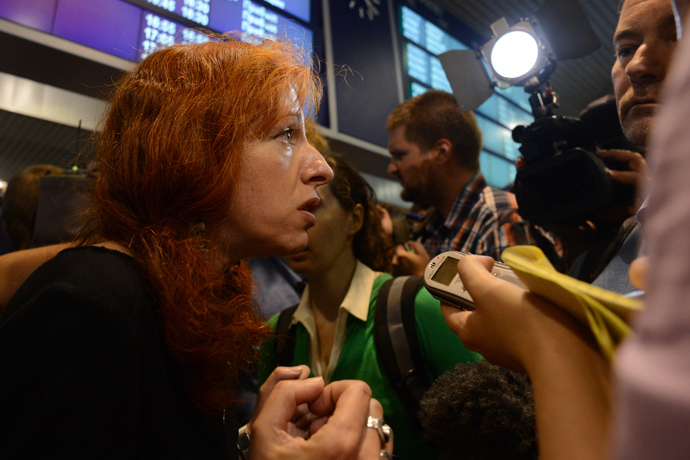
13:59 GMT: The NSA leaker has already written a request for political asylum in Russia, and Russian law allows it to be granted, says the head of the Public Chamber’s commission Anatoly Kucherena. The lawyer added he is going to assist Snowden with his bid.
13:45 GMT: Snowden’s meeting with human rights activists and lawyers is over.
13:43 GMT: Kremlin has not yet received Edward’s Snowden application for political asylum in Russia, president Putin’s press secretary Dmitry Peskov says. The conditions remain the same though, he added. Earlier, Putin said that Russia would grant the NSA leaker asylum if he stops activities aimed at “harming our American partners.”
13:24 GMT: Snowden announces he is going to ask for political asylum in Russia, says a participant of the meeting between the NSA leaker and rights advocates at the Moscow Sheremetyevo Airport, as cited by RIA Novosti.
“He wants to stay here until he can fly to Latin America,” Tatyana Lokshina of Human Rights Watch told Interfax. During the meeting, he asked the rights advocates to help him with the bid.
13:03 GMT: Edward Snowden is meeting with rights advocates and lawyers. The gathering is taking place behind closed doors at Sheremetyevo’s Terminal F transit zone, reports Itar-Tass. Thirteen representatives of public organizations are participating, according to the airport’s press service.
Эдвард Сноуден. Фото: Татьяна Локшина из " Human Rights Watch" (Guardian) pic.twitter.com/OsfTHxn16B
— Rundschau (@Rundschau) July 12, 2013
12:59 GMT: Rights advocates and lawyers are being taken to the meeting with Edward Snowden at Sheremetyevo Airport.
“We were taken to the airfield and got on a bus,” Tatyana Lokshina of Human Rights Watch told Interfax.
12:15 GMT: Russian and international human rights advocates and lawyers are gathering at Moscow Sheremetyevo Airport for a meeting with Snowden, which is scheduled for 5pm Moscow time (13:00 GMT). The NSA leaker is expected to speak out about the US persecution campaign.
Rights advocates, including representatives of Amnesty International, Transparency International, Human Rights Watch and other organizations, as well as well-known Russian lawyers, agreed to meet with the former CIA employee.
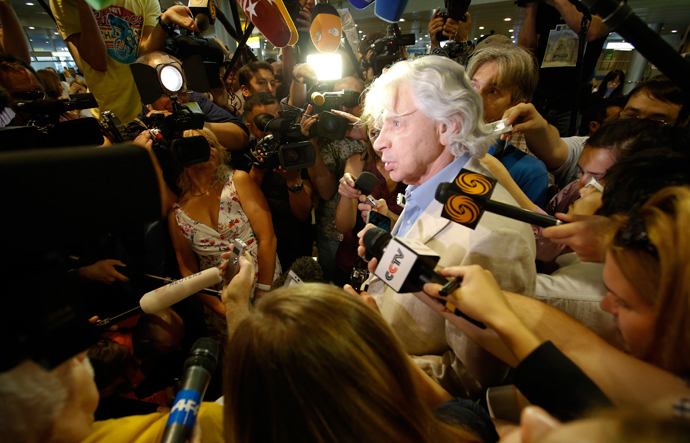
7:01 GMT: Edward Snowden will meet with representatives from Russian human rights organizations in Moscow’s Sheremetyevo Airport, report airport officials.
“Edward Snowden wishes to express his thoughts on the US campaign for his capture that has put other passengers heading to Latin America at risk as a result,” a source told Interfax.
#Snowden to express his thoughts on a campaign against him, unleashed by US, and to make a statement, details of which unknown right now
— Irina Galushko (@IrinaGalushkoRT) July 12, 2013
02:30 GMT: A two-day US-China summit in Washington took a surprising turn when a US senior official used the opportunity to voice his disappointment with China regarding whistleblower Edward Snowden. The former CIA employee was allowed to fly out of Hong Kong despite a US extradition request.
"We were disappointed with how the authorities in Beijing and Hong Kong handled the Snowden case, which undermined our effort to build the trust needed to manage difficult issues," US Deputy Secretary of State Bill Burns said.
China’s State Councilor, Yang Jiechi, responded by saying that Hong Kong’s actions had been in accordance with the law.
“Its approach is beyond reproach,” Jiechi said of Hong Kong, a semi-autonomous territory of the Chinese mainland.
Snowden fled Hong Kong for Moscow on June 23. At the time, Hong Kong authorities explained that despite a US request for a provisional arrest warrant, "there [was] no legal basis to restrict Mr. Snowden from leaving Hong Kong."
Thursday, July 11
18:20 GMT: Venezuela “has not received a formal reply from Snowden” regarding its offer of asylum, Venezuelan Foreign Minister Elias Jaua told Reuters on Thursday.
Snowden has to “ratify his wish to take asylum in Venezuela,” which should be followed by negotiations with the Russian government “to make the asylum possible,” Jaua previously said.
09:21 GMT: Millions of government employees will now be forced to spy on their colleagues for whistleblower tendencies - that's according to the 'Insider Threat Program', President Obama's initiative, which causes concerns, even among the officials, RT’s Gayane Chichakyan reported.
05:31 GMT: For the first time, German Chancellor Angela Merkel spoke about the NSA spying scandal to German weekly Die Zeit, stressing that the work of intelligence agencies is essential to the safety of citizens.
She also sharply rejected comparisons of the US surveillance program with East German spying methods.
Preventing terrorist attacks is not possible "without the possibility of telecommunications monitoring," she told the weekly. "The work of intelligence agencies in democratic states was always vital to the safety of citizens and will remain so in the future."
04:37 GMT: Mexican President Enrique Pena Nieto indicated that if allegations were proven that the United States had spied on its southern neighbor, it would be "totally unacceptable."
02:40 GMT: The US Air Force has concluded that Booz Allen Hamilton (BAH), the contractor that employed Edward Snowden prior to his becoming a whistleblower, is not responsible for the disclosure of the classified information. As such, the firm will not be prevented from working on Pentagon projects in the future.
Booz Allen notified the Air Force of Snowden’s activities under an administrative agreement the contractor had signed in the wake of another ethics lapse in 2012. However, the determination now made by the Air Force allows the company to continue working with the Pentagon.
"At this time ... there is no evidence that at the time of Mr. Snowden's misconduct, BAH knew or should have known, approved, or acquiesced in Snowden's misconduct," an Air Force official told Reuters.
In 2012 the Air Force had proposed banning a San Antonio Booz Allen office as well as several current and former employees from new government work following an incident in which a new hire from the Air Force shared sensitive data.
Booz Allen Hamilton generated $5.76 billion in revenues, mainly through government work, in the year ending March 31, a drop of just under 2 per cent from the year earlier. The Air Force is so far the first government agency to clear BAH in the Snowden case.
Wednesday, July 10
15:20 GMT: Snowden denied media claims of giving any classified information to the Chinese or Russian governments, the Guardian reports. He also denied assumptions that information was ‘drained’ from his laptops by those governments.
"I never gave any information to either government, and they never took anything from my laptops," he said as quoted by the newspaper.
Snowden: I never gave any information to Chinese or Russian governments http://t.co/AULLZ3G3x7
— Glenn Greenwald (@ggreenwald) July 10, 2013
15:16 GMT: WikiLeaks’ major sponsor said that donations to the company surged to $1,285 a day, or about three times the rate before Snowden’s emergence, after the group offered financial support to the NSA whistleblower, according to Bloomberg. Contributions since have slid, says the Hamburg-based Wau Holland Foundation, main collector of the company’s funds.
03:40 GMT: Edward Snowden will likely accept political asylum in Venezuela to escape prosecution in the United States for disclosing secret widespread government surveillance, according to Glenn Greenwald, the journalist who published the NSA documents and remains in contact with the fugitive whistleblower.
While Greenwald noted Snowden has not yet officially accepted Venezuela’s offer, it does appear to be the country most likely to guarantee him safe travel from the Moscow airport, where he has remained in hiding in recent weeks. Greenwald told Reuters a final resolution to the international dilemma could take “days or hours or weeks” to ultimately unfold.
Tuesday, July 9
18:30 GMT: Edward Snowden has not formally accepted asylum in Venezuela, according to Wikileaks. An earlier Twitter post by a senior Russian law maker caused a media frenzy, stating that Snowden had accepted Venezuela's offer of political asylum.
WikiLeaks said that countries which are making decisions regarding Snowden’s political asylum "will make the announcement if and when the appropriate time comes.”
The states concerned will make the announcement if and when the appropriate time comes. The announcement will then be confirmed by us.
— WikiLeaks (@wikileaks) July 9, 2013
00:05 GMT: Venezuelan President Nicolas Maduro has confirmed that his country received an official request for asylum from NSA whistleblower Edward Snowden on Monday.
“We received a letter requesting asylum” from Snowden, revealed Maduro, during a press conference prior to a meeting with Panama’s president, Ricardo Martinelli.
Snowden "will need to decide when he will fly here," added the Venezuelan head of state.
Monday, July 8
23:20 GMT: The Guardian has published the second part of the Snowden interview that drew international attention. It was carried out on June 6 in a Hong Kong hotel. In it, Edward Snowden explains that he is motivated, firstly, by patriotism and that he regards America as a good country at its core. However, he explained that it could no longer provide the kind of freedoms it initially promised, and predicted the smear campaign that would follow his actions.
"I think they are going to say I have committed grave crimes, I have violated the Espionage Act. They are going to say I have aided our enemies in making them aware of these systems. But this argument can be made against anyone who reveals information that points out mass surveillance systems."
Being part of a generation that grew up without a feeling of being constantly watched online, Snowden expressed his distrust for the current state of affairs:
"They are getting everyone's calls, everyone's call records and everyone's internet traffic as well," he said of the NSA.
He also shed light on US’s surveillance system – Boundless Informant – as another big reason why he chose to leak government documents and change his outlook on the US role in world affairs.
"The NSA lied about the existence of this tool to Congress and to specific congressmen in response to previous inquiries about their surveillance activities."
19:40 GMT: Edward Snowden has disclosed his first set of documents outlining Australia’s role in NSA surveillance programs, picking out four facilities in the country that contribute heavily to US spying.
Australian centers involved in the NSA’s data collection program, codenamed X-Keyscore, include Joint Defence Facility Pine Gap in central Australia and three Australian Signals Directorate facilities: the Shoal Bay Receiving Station in the country’s north, the Australian Defence Satellite Communications Facility on the west coast, and the naval communications station HMAS Harman outside the capital, Canberra.
17:08 GMT: Bolivia has demanded the ambassadors from France, Spain, Portugal and Italy provide an explanation, why those countries thought that NSA leaker Edward Snowden was on President Evo Morales’ flight from Moscow last week, Reuters reports. Bolivian communications minister, Amanda Davila, has called the fact that the four European countries banned Morales' plane from their airspace an act of “state terrorism" by the United States and its allies.
"We are simply asking the government of Spain and the other governments, of course, to clarify and explain where that version of Mr Snowden being on the presidential plane came from. Who spread that fallacy, that lie?" he explained.
Davila said his country’s government believes the US knew that Snowden wasn’t on the plane, but simply wanted to intimidate Morales, who has since offered the whistleblower unconditional asylum.
13:50 GMT: Nicaragua’s Moscow embassy has received Edward Snowden’s application for asylum, according to Russian news agency RIA Novosti. The fugitive US whistleblower said he would be “unlikely to receive a fair trial” in his home country in his explanatory letter addressed to president Daniel Ortega, made public on Saturday.
“We have received the formal documents,” an embassy official told journalists.
09:16 GMT: Nicaraguan President Daniel Ortega says his country would provide political asylum for Edward Snowden "if circumstances permit".
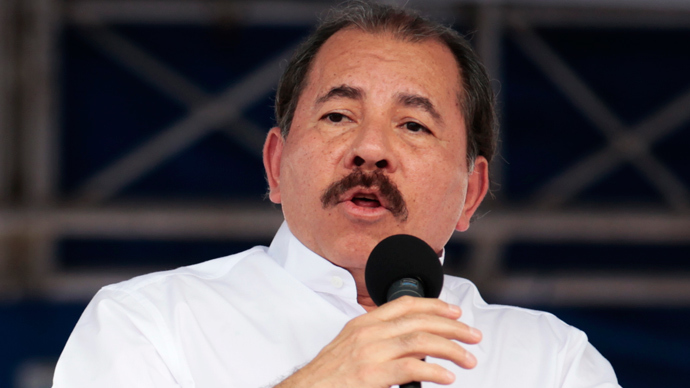
04:15 GMT: Cuba's Raul Castro has backed countries offering asylum to Edward Snowden, while not stating outright whether the country would either itself be offering him asylum or would allow the safe transit of the whistleblower as he passed through en route to other Latin American countries.
"We support the sovereign right of .... Venezuela and all states in the region to grant asylum to those persecuted for their ideals or their struggles for democratic rights," Castro said in a speech to Cuba's national assembly, broadcast on state television.
Bolivia and Venezuela both offered asylum to Snowden over the weekend, with Nicaragua also considering his request. There are no direct commercial flights from Moscow's Sheremetyevo airport to South America, and Snowden would have to change flights in Havana, Cuba.
03:43 GMT: Rallies in support of Edward Snowden have taken place across Australia as activists demanded more privacy protection from government and freedom for the former NSA analyst. Demonstrations took place in Sydney, Melbourne, Brisbane and Perth and attracted hundreds of supporters. The protesters blame media outlets and politicians for attacking Snowden, instead of focusing on protecting internet users’ right to privacy.
01:30 GMT: Venezuela says it has not had a reply from the NSA leaker, Edward Snowden after the country’s President Nicolas Maduro offered him asylum on Friday. "We are waiting until Monday to know whether he ratifies his wish to take asylum in Venezuela," Foreign Minster Elias Jaua told state television as “there has not been any type of communication” from Snowden who is now stuck in Moscow after US revoked his passport.
Sunday, July 7
15:30 GMT: Bolivian President Evo Morales said that he would grant Snowden asylum if he made the request, Reuters reported. The offer was posed shortly after two other leftist Latin American leaders said that they would be prepared to accommodate the former NSA-contractor.
While attending an energy conference in Russia earlier this week, Morales told RT that he would consider granting asylum to Snowden if the request was made.
“If there were a request, of course we would be willing to debate and consider the idea,” said Morales, speaking to RT Spanish, while stating that Snowden had not requested political asylum from his country at that point.
12:45 GMT: US has issued Snowden’s extradition request to Venezuela, demanding that the whistleblower be “arrested” if he “travels to” or “transits through” Venezuela and “be kept in custody” for “the purpose of extradition”.
00:11 GMT: Venezuela's president Maduro says he has decided to offer asylum to US NSA- leaker Edward Snowden, Reuters reports.
"I have decided to offer humanitarian asylum to the young American, Edward Snowden, so that in the fatherland of (Simon) Bolivar and (Hugo) Chavez, he can come and live away from the imperial North American persecution," Maduro told a televised parade marking Venezuela's independence day.
Saturday, July 6
23:34 GMT: Nicaragua's President Daniel Ortega said on Friday that he had received an asylum request from US NSA-leaker Edward Snowden and could accept the bid "if circumstances permit."
"We are open, respectful of the right to asylum, and it is clear that if circumstances permit it, we would receive Snowden with pleasure and give him asylum here in Nicaragua," Ortega said at a public event.
16:27 GMT: Edward Snowden has applied to another six states for political asylum, WikiLeaks reported. In an effort to avoid US interference, the six nations were not disclosed.
Edward #Snowden has applied to another six countries for asylum. They will not be named at this time due to attempted US interference.
— WikiLeaks (@wikileaks) July 5, 2013
15:12 GMT: UK and Sweden have vetoed the discussion of traditional spying by the US on EU members during upcoming talks in Washington. Originally the EU envisaged two working groups - reports the Guardian - one discussing NSA and PRISM, and the other more traditional methods of espionage, but the two objectors said the EU had no authority to discuss matters of national security, particularly since policies differ widely among various member states. "Intelligence matters and those of national security are not the competence of the EU," summed up José Manuel Barroso, the European commission president.
11:57 GMT: German Blush lingerie brand has decided to take advantage of the hype surrounding Edward Snowden, issuing a series of ads in which the whistleblower is mentioned. In one of them, the company offers him asylum in Berlin, promising that a “bed and champagne” is waiting for the NSA leaker upon arrival. Another ad features the slogan “Dear Edward Snowden, there’s still a lot to uncover" next to a female model in sexy underwear.
"We highly sympathize with what Snowden did," said Johannes Krempl, director of Glow Advertising agency. "We owe him so much, and that's why we thought we have to do something to express our feelings towards him and thank him, and that's why we came up with this ad for Blush in support of his deeds."
07:48 GMT: The US government has issued an arrest warrant for Edward Snowden to the Irish government. The request has been sent as a pre-emptive strike against Snowden’s potential attempt to fly to Havana, Cuba on a commercial flight which has a stopover in Shannon, Ireland for refueling.
06:35 GMT: The proposal to give Snowden Icelandic citizenship received limited support in Parliament on Thursday, the last day before summer recess, with only six members of minority parties in favor out of parliament's 63 members.
Saturday, July 6
Venezuela would be the best asylum for former CIA officer Snowden, Russia’s State Duma
Foreign Affairs Committee Chairman said.
"Asylum for Snowden in Venezuela would be the best solution," Aleksey Pushkov wrote on his Twitter account. "That country is in acute conflict with the United States and this can't make things worse."
"He can't live at Sheremetyevo [Airport in Moscow] after all," he added.
It's believed the whistleblower has remained in the transit zone of Moscow's Sheremetyevo airport for over two weeks.
Friday, July 5
21:17 GMT: A short movie on NSA leaker Edward Snowden has been filmed by a group of independent filmmakers in Hong Kong. Called “Verax,” or the truth teller in Latin, the 5-minute film has already been viewed over 130,000 times on YouTube.
Creators say the $600 budget movie was made in less than a week at the time Snowden was still in Hong-Kong.
The film depicts Snowden’s time spent in a Hong Kong hotel room while hiding from the intelligence services. The film also shows the Snowden-alike protagonist solving a Rubik's cube – an object he reportedly identifies with.
'Verax' was reportedly the alias Snowden used when contacting journalists via encrypted chat services.
17:09 GMT: The Icelandic Parliament reportedly has a bill that would give Snowden Icelandic citizenship.
16:06 GMT: Paris has rejected Edward Snowden's asylum request, AFP reports quoting ministerial officials.
So far, twelve countries including France have denied the whistleblower refuge. Egiht applications are still pending.
16:01 GMT: France's external intelligence agency spies on French citizens' phone calls, emails, social media activity and web use, reports Le Monde.
15:19 GMT: Italian Foreign Minister Emma Bonino says Rome cannot support Snowden's request for Asylum. She stated that any request would have to be presented in person at the border or on Italian territory, which Snowden had not done.
"As a result there do not exist the legal conditions to accept such a request which in the government's view would not be acceptable on a political level either," she said.
Snowden has applied for asylum in 21 countries.
14:34 GMT: EU Parliament has voted to scrap two agreements granting the US access to European financial and travel data, unless Washington reveals the full extent of its spying on Europe.
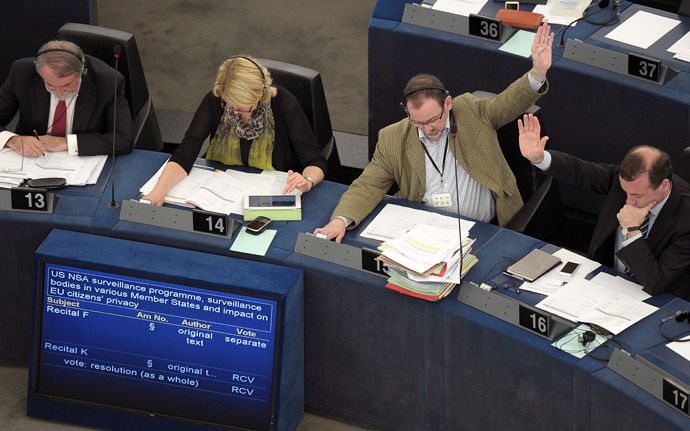
13:20 GMT: EU lawmakers on Thursday demanded 'immediate clarification' of US spying on EU offices and warned the scandal could damage trans-Atlantic relations. Lawmakers however rejected a call for the postponement of talks on a EU-US trade deal, which are due to start on Monday.
12:44 GMT: Venezuelan President Nicolas Maduro has rejected an order for the extradition of former CIA employee Edward Snowden live on Venezuelan state channel Telesur.
“I reject any request for extradition, affirmed the president, speaking about Edward Snowden,” read a tweet posted on Telesur’s Twitter account.
Yo rechazo cualquier solicitud de extradición, afirma presidente de #Venezuela por caso #Snowden
— teleSUR TV (@teleSURtv) July 4, 2013
11:53 GMT: Former NSA contractor Edward Snowden has not applied for political asylum in Russia so it is not in Moscow’s power to decide his destiny, the Russian Foreign Ministry stated. “As of today, Russia has not received an application from Mr. Snowden for political asylum. We believe that without his determined personal decision in one direction or another, without his exact understanding of what is better for him, what solution he considers to be the optimal one, we are unable to decide for him. That's all that can be said currently,” Russian Deputy Foreign Minister Sergey Ryabkov told journalists.
10:05 GMT: “Snowden, will you marry me?” Russian 'femme fatale' Anna Chapman asks via twitter. The red-haired tabloid darling came to world prominence after the spy scandal with ten Russians sleeper agents arrested in the US in June 2010. They were expelled from American soil after being traded on July 9 for four American spies serving jail terms in Russia, in what was the biggest prisoner swap since the fall of the Iron Curtain. After returning to Russia, Chapman has been enjoying an active media life and hosting a program on “Mysteries of the World” Russian REN TV channel.
9:13 GMT: The Bolivian government has rejected the American extradition request for NSA whistleblower Edward Snowden as “baseless and illegal.”
"The bizarre, legally baseless and unusual request for the extradition of a person who is not on the territory of the state in question, will be returned to the United States immediately," said a foreign ministry statement.
The Ministry stressed that Morales had at no point “met with President Morales in Russia, nor did he get on the plane, nor is he presently on Bolivian territory"
5:02 GMT: The Bolivian President’s plane has finally landed in La Paz following its detention for over 13 hours in Vienna’s airport. The presidential craft made two stops during its journey in Brazil and the Canary Islands. President Evo Morales was greeted by a throng of supporters at the airport, who brandished banners and voiced their solidarity. The Bolivian leader addressed the crowd, declaring: “they will never intimidate us! They will never scare us!”
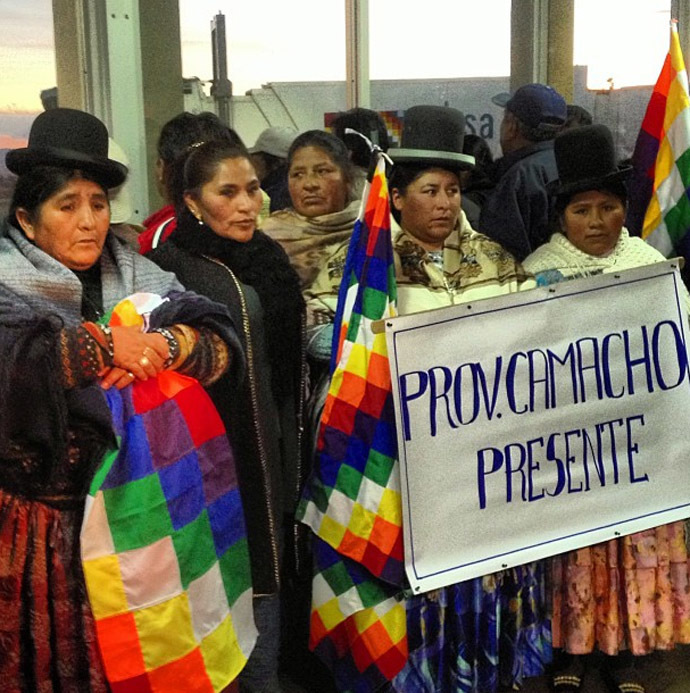
Thursday, July 4
16:15 GMT: Protesters burn a French flag outside the French embassy in La Paz. Bolivian officials accused France, Portugal, Italy and Spain of denying entry to the President's jet late Tuesday over "unfounded rumors" Snowden was traveling on board.
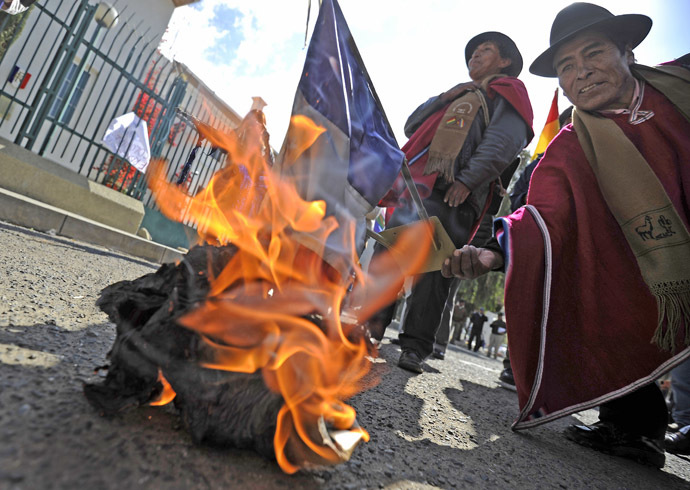
15:08 GMT: Ecuador's President Rafael Correa has asked that the Unasur group of South American nations call an urgent meeting over travel restrictions placed on Bolivian President Evo Morales by France and Portugal, Unasur's secretary general said in a statement on Wednesday.
12:03 GMT:
Reporters Without Borders & WikiLeaks co-sign op-ed calling for EU to protect #Snowden: http://t.co/QN2ydzrMnJ#WikiLeaks
— WikiLeaks (@wikileaks) July 3, 2013
10:47 GMT:“An act of aggression and violation of international law” is how Bolivia’s UN envoy described Austria’s decision to search the Bolivian presidential jet for NSA leaker Edward Snowden. The envoy has pledged to make an official complaint to the UN.
Envoy Sacha Llorentty Soliz told press in New York that he had no doubt the decision to search the plane originated from the US.
10:39 GMT: France wants a temporary two week suspension of EU-US free trade talks in the light of the looming scandal over the US National Security Agency’s alleged spying on 38 embassies, including America’s NATO European allies. "It's not a question of halting the negotiations," French government spokeswoman Najat Vallaud-Belkacem noted, but “On the other hand, it would seem wise to us to suspend them for a couple of weeks to avoid any controversy and have the time to obtain the information we've asked for,” he said.
8:51 GMT: The Austrian authorities searched Morales’ plane for Edward Snowden, but found no stowaways on board, Austria’s deputy chancellor has said.
8:42 GMT: Spain has authorized Bolivia’s presidential jet to pass through its airspace and continue its journey to Bolivia, the Austrian President has said. The plane was grounded in Austria Wednesday morning over suspicions that Edward Snowden was on board.
The Austrian President, Heinz Fischer, announced that the Bolivian presidential jet will be on its way to La Paz "shortly" following a meeting with President Evo Morales. President Morales has spent 11 hours in the airport in Vienna waiting to resume his journey.
Austria's president Fischer said #morales can continue his trip soon pic.twitter.com/qSGh1NN99X
— Alexander Weber (@WeberAlexander) July 3, 2013
03:00 GMT: French officials have stated that technical problems prevented one of their airports from accepting president Evo Morales’ flight from landing. The Bolivian leader was en route from Russia following his attendance at a summit of major gas-exporting nations in Moscow.
morales is in good mood ;) #vienna#Snowdenpic.twitter.com/Y1Ms2xQQ8j
— Olivera Stajić (@OliveraStajic) July 3, 2013
According to the Associated Press, Foreign Minister David Choquehuanca has rejected any claims that the plane carrying the Bolivian head of state was denied entry over France and Portugal for anything other than political reasons.
"They say it was due to technical issues, but after getting explanations from some authorities we found that there appeared to be some unfounded suspicions that Mr. Snowden was on the plane ... We don't know who invented this lie," said Choquehuanca.
While attending the energy conference in Russia this week, Morales told RT that he would consider granting asylum to Snowden if the request was made.
"It is possible that they want to intimidate us due to the statement made by President Morales that we would analyze an asylum request from Mr. Snowden," said Defense Minister Ruben Saavedra.
"We have the suspicion that [France and Portugal] were used by a foreign power, in this case the United States, as a way of intimidating the Bolivian state and President Evo Morales."
Saavedra confirmed that Italy had also denied Bolivia’s aircraft entry into its airspace. The Bolivian president meanwhile is spending the night at a hotel in Vienna.
01:08 GMT: Austrian ministry officials have confirmed that Snowden was not on Morales’ plane, AFP reported.
“President Morales will leave early Wednesday morning for La Paz,” Austrian ministry spokesman Alexander Schallenberg said. He denied any knowledge of why the plane landed there.
00:41 GMT: Imprisoned former CIA officer John Kiriakou has written a letter supporting Snowden’s decision to leak information about the massive surveillance apparatus employed by the US. Kiriakou was the first CIA officer to publicly acknowledge that torture treated as legal under former president George W. Bush. He was convicted in October 2012 of disclosing the name of an officer who worked in the CIA’s Rendition, Detention, and Interrogation program to a reporter and sentenced to thirty months behind bars earlier this year.
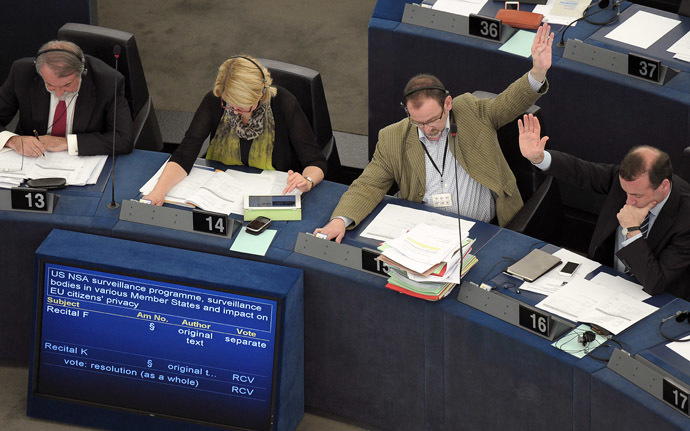
Kiriakou, in his second note published by Firedog Lake, advised Snowden to “find the best national security attorneys money can buy,” while recommending the American Civil Liberties Union and Government Accountability Project as two potential leads.
“You’re going to need the support of prominent Americans and groups who can explain to the public why what you did is so important,” Kiriakou wrote, while adding that the “most important advice” he can offer is to “not, under any circumstances, cooperate with the FBI.”
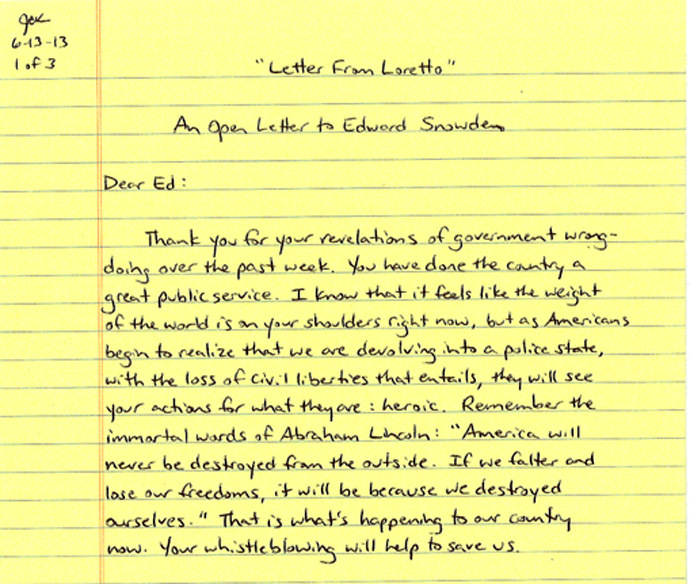
00:07 GMT: The Bolivian Chamber of Deputies, the country’s national legislature, expressed solidarity with President Evo Morales after his plane from Moscow was diverted away from French and Portuguese airspace because of a rumor that Edward Snowden was onboard.
“This is a lie, a falsehood. It was generated by the US government,” Bolivian Defense Minister Ruben Saavedra told. “It t is an outrage. It is an abuse. It is a violation of the conventions and agreements of international air transportation.”
Ecuador also suggested an emergency meeting of the Union of South American Nations (Unasur) after the incident Tuesday.
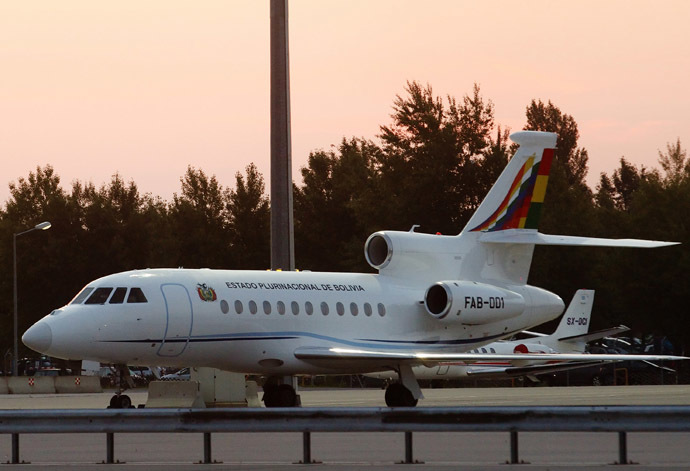
Wednesday, July 3
22:24 GMT: A Bolivian Minister has announced that Morales’ plane was forced to re-route on the suspicion that Snowden was on board, according to the Associated Press.
22:21 GMT: After departing from Russia the plane of Bolivian President Evo Morales was forced to make an emergency landing in Austria. Bolivian authorities denied rumors that Edward Snowden was on board, though the fugitive whistleblower did send a political asylum request to Bolivia that has yet to be answered; he also petitioned Austria but was rejected.
Reports indicated the plane made previous attempts to land in France and Portugal but was denied because of the possibility that Snowden was on board.
17:53 GMT: Snowden's father has written an open letter to him extolling him for "summoning the American people to confront the growing danger of tyranny." Snowden's father has expressed concern that WikiLeaks supporters who have been helping his son seek asylum may not have his best interests at heart. The father has said he'd like his son to return to the U.S. under the right circumstances.
14:43 GMT: In his asylum request to Poland, Snowden said that he risks facing the death penalty if he returns to the US.
14:10 GMT: Venezuela's president, Nicolás Maduro, says Venezuela is ready to consider an asylum request from Snowden.
"In any case, this young man must be protected in terms of international and humanitarian law. He has a right to be protected, because he is being pursued be the US. By its president, vice president, by the secretary of State. Why is he being pursued?What kind of crime has he committed? Has he launched a missile and killed anyone? Has he planted a bomb and killed anyone? No, he hasn’t. On the contrary, he is doing everything to prevent wars, to prevent any kind of illegal action against the whole world. Venezuela hasn't so far received an asylum request from Snowden - when we get it we are ready to consider it," Maduro told journalists in Moscow on Tuesday.
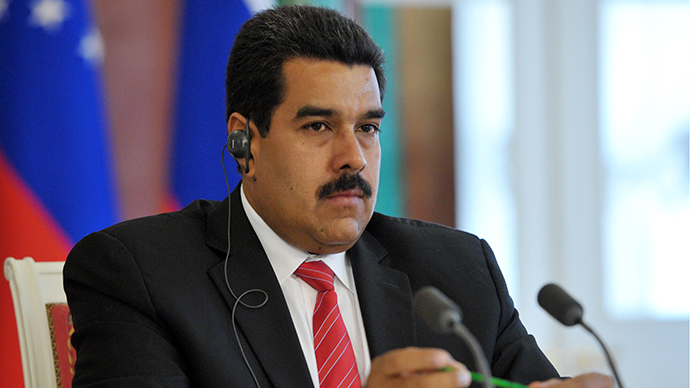
14:07 GMT: According to Wikileaks, Snowden has received asylum rejections from Poland, Finland, India, and Brazil. Applications made to Austria, Ecuador, Norway, and Spain are only valid if made on the countries' home soils. Venezuela says it is willing to consider an asylum request from Snowden.
Bolivia, China, Cuba, France, Germany, Iceland, Italy, Ireland, Netherlands, Nicaragua, and Switzerland have not yet responded to Snowden's requests for asylum.
Snowden gave up on his initial request to stay in Russia, after President Putin said his asylum bid was contingent on his cessation of “anti-American activity," according to presidential spokesman Dmitry Peskov.
13:35 GMT: Italy's Foreign Ministry said in a statement that Snowden's asylum application was not filed correctly because Snowden would have to be on Italian soil for it to be valid. Furthermore, his application was received by fax, which is not allowed under Italian law.
12:40 GMT: Brazil has refused the asylum request from NSA leaker Edward Snowden, a spokesperson for the Brazilian Ministry of Foreign Affairs has said in a statement.
12:25 GMT: Poland, America’s most faithful ally in Eastern Europe, has announced it is going to demand explanations from Washington over NSA surveillance of Polish diplomats in EU facilities and the country’s embassy in the US. "We will demand an explanation for NSA (US National Security Agency) actions towards Poland and the EU," Polish Foreign Minister Radoslaw Sikorski wrote in a Twitter post.
10:36 GMT: India has rejected Snowden’s application for political asylum, stating they have “no reason” to accede to the request.
"Indian Embassy in Moscow did receive a request for asylum in a communication dated 30 June from Mr Edward Snowden," Syed Akbaruddin, a spokesman for India's foreign ministry, said on Twitter.
10:00 GMT: Spanish Foreign Minister Jose Manuel Garcia-Margallo knows nothing of an asylum request from Edward Snowden, but has reiterated statements made by other states that an asylum application is only valid when made on Spanish soil.
"For an asylum petition to become a petition that the government could study, in other words for it to be legally admissible, it has to be made by a person who is in Spain," Reuters cites Garcia-Margallo as saying.
09:00 GMT: Finnish asylum cannot be requested from abroad, according to Keijo Norvanto, Head of the Unit for Communications at Finland’s Foreign Ministry.
“We can confirm that we received the request. But we cannot consider it official. To officially seek political asylum, Snowden must first come to Finland and go to the police or migration service. But in this case the request procedure was violated, so the appeal is not going to be considered,” ITAR-TASS news agency cites Norvanto as saying.
08:30 GMT: Snowden’s request for asylum was handed over to the Austrian embassy in Moscow on Monday, but it can only be submitted in Austria directly, APA news agency cites the country’s Interior Minister Johanna Mikl-Leitner, as saying. When asked by journalists if Snowden could be extradited once in Austria, the Minister answered that no international arrest warrant had been issued for the whistleblower.
08:00 GMT: Edward Snowden gave up on his initial request to stay in Russia, after President Putin said his asylum bid was contingent on his cessation of “anti-American activity”, said presidential spokesman Dmitry Peskov. The whistleblower continues to remain in the transit zone of the Sheremetyevo airport and has never crossed the Russian border, Peskov continued. He reiterated that Russian intelligence had never worked with the whistleblower, nor had Snowden ever been a Russian intelligence agent. Peskov stressed Russia will never hand over anyone to a country where capital punishment is enforced.
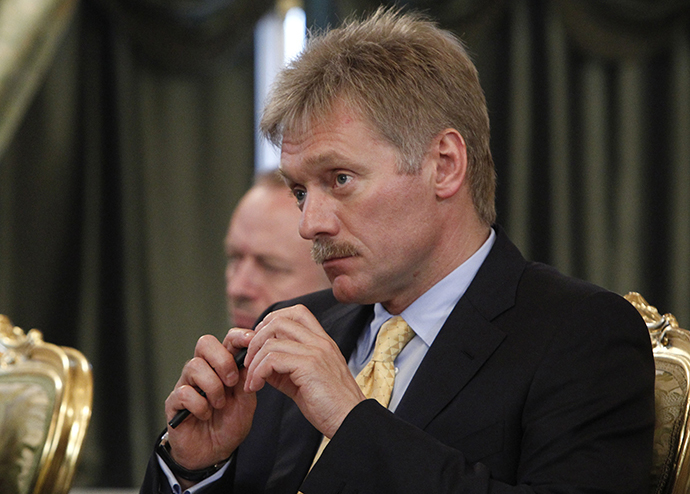
00:00 GMT: In a statement released through WikiLeaks, Snowden thanked his supporters and decried the Obama administration’s method of trying to intimidate countries that would consider granting him political asylum.
“For decades the United States of America [has] been one of the strongest defenders of the human right to seek asylum,” Snowden wrote. “Sadly, this right laid out and voted for by the US in Article 14 of the Universal Declaration of Human Rights, is now being rejected by the current government of my country. The Obama administration has now adopted the strategy of using citizenship as a weapon."
"Although I am convicted of nothing," the statement continues, "it has unilaterally revoked my passport, leaving me in a stateless person. Without any judicial order, the administration now seeks to stop me [from] exercising a basic right. A right that belongs to everybody. The right to seek asylum.”
We will shortly release further details in relation to Edward Snowden's asylum application, including some of the countries involved.
— WikiLeaks (@wikileaks) July 2, 2013
Tuesday, July 2
18:30 GMT: Speaking to RT Spanish, Bolivian president Evo Morales has said that Edward Snowden has not requested political asylum from his country.
“If there were a request, of course we would be willing to debate and consider the idea,” said Morales.
The president further explained that Bolivia was prepared to “assist” the whistleblower.
“Why not? Well, he’s left much to be discussed … and a debate on the international level, and of course, Bolivia is there to shield the denounced, whether it’s espionage or control, in either case, we are here to assist.”
16:00 GMT: US President Barack Obama said Washington and Moscow had held high level discussions regarding the issue of fugitive whistleblower Edward Snowden, adding that he hoped Russia would help resolve the issue on the basis of international standards.
Obama, noting that the US does not have an extradition treaty with Russia, said that Snowden had arrived in the country without a valid passport, and hoped Moscow would thus make a decision which was on par with the regular protocols of international travel and cooperation between law enforcement agencies.
Obama would not confirm reports that law enforcement agencies in both countries had been ordered to find a solution regarding Snowden.
15:32 GMT: Edward Snowden has not applied for asylum in Russia, according to the Russian Immigration Service.
The statement comes after a New York Times report which cited "a Russian immigration source close to the matter" as saying that Snowden has, in fact, sought asylum.
15:30 GMT: Russian President Vladimir Putin said that Russia would not hand over former NSA contractor Edward Snowden to the United States, but added that if Snowden wanted to say in the country he "must stop his work aimed at harming our American partners".
“Russia has never extradited anyone and is not going to do so. Same as no one has ever been extradited to Russia,” Putin stated.
“At best,” he noted, Russia exchanged its foreign intelligence employees detained abroad for “those who were detained, arrested and sentenced by a court in the Russian Federation.”
Snowden "is not a Russian agent", the president continued, stressing that Russian intelligence services were not working with the American whistleblower.
Putin added that Snowden should choose his final destination and go there.
13:56 GMT: Presidents Putin and Obama have instructed their nations’ securities services – Russia’s FSB and American FBI respectively - to solve the situation around the Snowden case, said the Secretary of the Russian Security Council Nikolay Patrushev.
12:53 GMT: France and Germany have demanded the US account for leaked reports of massive-scale US spying on the EU. French President Francois Hollande called for an end to surveillance while Germany said such “Cold War-style behavior” was “unacceptable.”
The German government summoned the US ambassador to Germany, Philip Murphy, to Berlin on Monday to explain the incendiary reports. Chancellor Merkel’s spokesperson said the government wants “trust restored."
While French President Francois Hollande said the spying should “stop immediately.”
09:13 GMT: Juergen Trittin, German parliamentary leader and candidate for chancellor of the Greens – the country’s third largest party – told German television that whistleblower Edward Snowden should be granted safe haven in Europe and not seek asylum in “despotic” countries.
"It's painful for democrats that someone who has served democracy and, in our view, uncovered a massive violation of basic rights, should have to seek refuge with despots who have problems with basic rights themselves," Trittin said.
"Someone like that should be protected," he continued. "That counts for Mr. Snowden. He should get safe haven here in Europe because he has done us a service by revealing a massive attack on European citizens and companies. Germany, as part of Europe, could do that."
The deputy did not specify which “despots” he had in mind.
Tritten’s comments come amidst reports that the National Security Agency (NSA) monitors half a billion phone calls, emails and text messages in Germany during an average month, far outpacing US surveillance of any other European state.
Monday, July 1
05:25 GMT: Tokyo needs explanations from Washington regarding alleged US bugging of Japanese embassy, Japan's Chief Cabinet Secretary Yoshihide Suga announced Monday. "We will strongly call for an explanation of its veracity through diplomatic routes," he said. On Sunday Britain’s The Guardian published a new report based on documents provided by former NSA contractor Edward Snowden. The report maintains that the US National Security Agency (NSA) bugged 38 foreign embassies, including EU missions in New York and Washington, and embassies of NATO member countries and other principal allies including France, Japan, Italy, Greece, Turkey, Mexico and South Korea.
03:39 GMT: In the latest revelations of the NSA leaks scandal, new slides have emerged thoroughly explaining the targeting process of the US government top-secret PRISM program deployed to spy on communication data of targets operating abroad. The slides published by the Washington Post, detail how PRISM tasks are issued by analysts and describes the approval process of an individual requests. To begin with, an NSA analyst "tasks" PRISM to gather information about a surveillance target. The system then temporarily freezes that request and automatically ask for an approval from a supervisor. If the superior decides that the request possesses a "reasonable belief" of perceived threat, then PRISM goes to work.
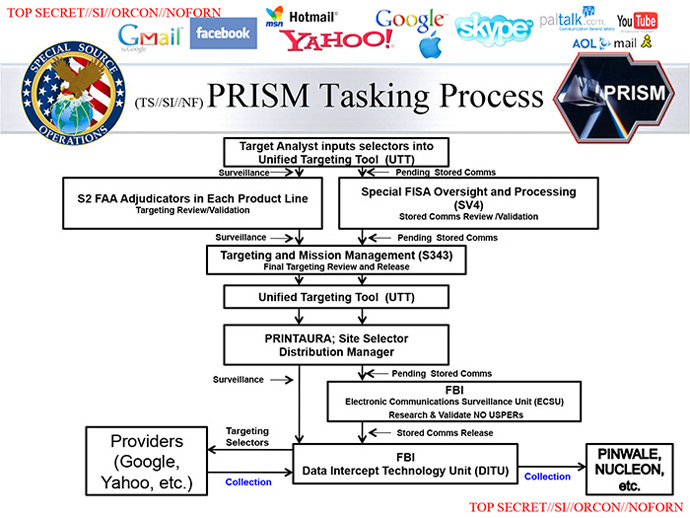
Sunday, June 30
20:05 GMT: The NSA has a “brand new” technology that enables one billion cell phone calls to be redirected into its data hoards, according to the Guardian’s Glenn Greenwald, who told a Chicago conference that a new leak of Snowden's documents was ‘coming soon.’
Calling it part of a “globalized system to destroy all privacy,” and the enduring creation of a climate of fear, Greenwald outlined the capabilities of the NSA to store every single call while having “the capability to listen to them at any time,” while speaking via Skype to the Socialism Conference in Chicago, on Friday.
18:44 GMT: Not only European citizens, but also employees of the EU diplomatic missions in Washington and the UN were under electronic surveillance from the NSA, Der Spiegel magazine reports citing a document obtained by whistleblower Edward Snowden.
The German magazine claims to have taken a glance at parts of a “top secret” document, which reveals that US National Security Agency has placed bugs in EU offices in Washington and at the New York‘s United Nations headquarters in order to listen to conversations and phone calls.
18:28 GMT: WikiLeaks says there are no tensions between Julian Assange and Ecuadorean government as it responded to media reports claiming Assange’s role in Edward Snowden’s case "has raised hackles" among Ecuadorean officials.
“The story is spun to be about tensions that don't exist,” WikiLeaks posted on its Twitter account in response to the article that appeared in the Wall Street Journal on Friday. “Hacked/intercepted emails in relation to an NSA spying story. Talk about missing the obvious,” the tweet read.
Saturday, June 29
17:44 GMT: More than a quarter of US Senate members have forwarded a written address to the director of National Intelligence, James Clapper, requesting him to release more information on the government's secret surveillance of American citizens’ communications, revealed by Edward Snowden.
"Reliance on secret law to conduct domestic surveillance activities raises serious civil liberty concerns and all but removes the public from an informed national security and civil liberty debate," said the letter, which was signed by 21 Democrats, four Republicans and one independent senator.
Among other things, the authors of the letter wanted to know how long the NSA has been engaged in bulk collection of communication records and whether there have been violations of court orders pertaining to the records.
The senators also asked for examples, in which useful intelligence was gained from the records, and wondered if there were plans to collect other forms of information under the Patriot Act, enacted after the 9/11 attacks.
01:15 GMT: The US Army confirmed on Thursday that access to The Guardian newspaper’s website has been filtered and restricted.
Gordon Van Vleet, spokesman for the Army Network Enterprise Technology Command, or NETCOM, said in an email to the Monterey Herald that the Army is filtering "some access to press coverage and online content about the NSA leaks."
The Guardian's website has posted classified information regarding the NSA's surveillance activities, including PRISM, the massive domestic spying program that has Internet companies collude with military intelligence to keep tabs on Americans' online habits.
According to staff at the Presidio of Monterey, a military installation in California, employees told the Herald that they were able to access the paper’s US site, www.guardiannews.com, but were prevented from accessing articles on the NSA that redirected to the British site.
Friday, June 28
21:15 GMT: In an exclusive interview with RT Spanish, Ecuador’s ambassador to Russia, Patricio Chávez, says that media reports regarding his country’s contact with Edward Snowden are only speculations.
The ambassador spoke of Snowden’s request for political asylum from Ecuador from that country’s embassy in Moscow on Thursday.
“We will always consider international norms and Ecuador’s constitution” in evaluating a petition for asylum, said Chávez, while also stressing that no documents for travel or refugee status had been issued by his country.
20:50 GMT: The US announced on Thursday that it is reviewing whether to suspend favorable trade benefits with Ecuador, only a few hours after that country’s foreign minister preemptively renounced them. The Ecuadorian government pulled out of its trade pact, which involves preferential customs tariff rights, claiming it had become an instrument of “blackmail” as relations with the US have been strained over reports the country is considering a political asylum bid from Edward Snowden.
Despite voicing support for the whistleblower publicly, Ecuador has denied reports that it authorized a “safepass” travel document, after news broke yesterday that the country’s London embassy had issued such permission.
"We confirm that the government of Ecuador has not authorized the delivery of any safe passage or refugee document that would allow Mr. Snowden to travel to our country," Political Issues Minister Betty Tola told reporters.
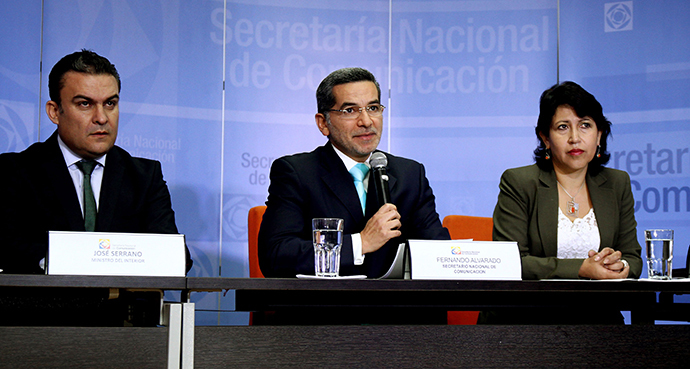
Seemingly unconvinced, US State Department deputy spokesman Patrick Ventrell reiterated Washington’s stance on the issue, warning that giving Snowden asylum would create "grave difficulties for our bilateral relationship."
"If they take that step, that would have very negative repercussions," he added.
19:00 GMT: Ecuador has renounced its US trade benefits. Communications Minister Fernando Alvarez told a press conference that the deal had become a "new instrument of blackmail."
"In consequence, Ecuador unilaterally and irrevocably renounces said preferences," said Alvarez.
Ecuador had been pushing for reduced tariffs on hundreds of millions of dollars' worth of trade, according to AP. The US is a key importer of cut flowers, artichokes and broccoli.
On Wednesday, US President Barack Obama had said that the US would not engage in “wheeling and dealing” in exchange for the handing over of Snowden.
The US Senate Foreign Relations Committee said earlier on Thursday that the US would make an effort to remove preferential trade treatment for Ecuadorian imports if the country offered refuge to Snowden, while Ecuadorian officials said they would waive preferential trading rights under an expiring treaty with the US.
16:07 GMT: The Guardian has published a new set of leaked NSA documents which show that the Obama administration permitted the National Security Agency to continue collecting vast amounts of records detailing Americans’ email and internet usage for more than two years. According to the new documents, the secretive surveillance was authorized by President George W. Bush after the September 11, 2001 terrorist attacks and continued through 2011 under President Barack Obama.
Anyone eager to claim that Obama stopped all email metadata collection in 2011 must confront the actual evidence http://t.co/NKBaPLFPsM
— Glenn Greenwald (@ggreenwald) June 27, 2013
14:55 GMT: Switzerland says it has received answers from US on Snowden’s activities for the CIA in Geneva, Foreign Minister Didier Burkhalter said. He added that Switzerland wants to discuss it further, Reuters reports. On June 12 the Swiss government formally asked the US for "clarification" on a claim from Snowden that CIA agents in Geneva pushed a banker to drink and drive as part of a dangerous recruitment ploy.
13:41 GMT: Apple co-founder Steve Wozniak has spoken out in support of NSA whistleblower Edward Snowden, calling him a hero who acted “from his heart.”
"He's a hero to my beliefs about how the Constitution should work,” Steve Wozniak told The Daily Beast. “I don't think the NSA has done one thing valuable for us, in this whole 'PRISM' regard, that couldn't have been done by following the Constitution and doing it the old way."
Wozniak @stevewoz Snowden's My Hero http://t.co/WUyar7JKQ5
— Lloyd Grove (@TheLloydGrove) June 26, 2013
13:40 GMT: Snowden's revelations have given weight to what many have already long suspected, publisher of The Trends Journal Gerald Celente told RT.
12:44 GMT: Ecuador says it has not processed Snowden’s asylum request because he has not reached any of its diplomatic premises.
12:20 GMT: The US will not try to intercept NSA whistleblower Edward Snowden’s flight, President Barack Obama said during his tour to Africa, rejecting reports that America might force down a plane carrying the NSA leaker.
11:45 GMT: US President Barack Obama said he has not spoken to China’s President Xi Jinping or Russia’s President Vladimir Putin about whistleblower Edward Snowden’s extradition, adding that he “shouldn’t have to.”
09:26 GMT: Snowden hasn’t been seen on the latest flight from Moscow to Havana, reports RT’s Irina Galushko, who is among the many journalists hunting for the whistleblower at Moscow’s Sheremetyevo Airport’s transit zone.
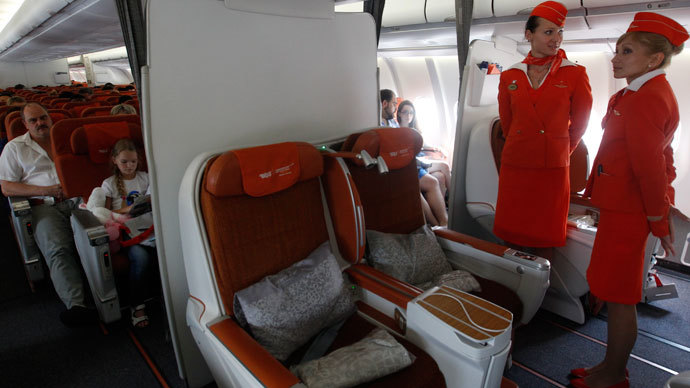
08:46 GMT: The government of Ecuador has not decided whether or not it will grant political asylum to Snowden. “But in any case the process of consideration of the situation is already underway in Ecuador, so the government of this country is obliged to protect the person seeking asylum,” Enrique Santiago Romero, a Madrid-based lawyer and politician, told RT’s Spanish-language sister channel.
He added that Ecuador may provide Snowden with a transit passport to replace the American passport, which he was stripped off as part of the extradition campaign. The transit passport would be good for any country except the US and will allow the leaker travel to Ecuador.
00:30 GMT: Confusion has emerged regarding Snowden’s request for asylum in Ecuador, as Univision news, a US-based Spanish-language broadcaster, has posted what is purportedly an official document issued by the Ecuadorian Embassy in London that would allow the whistleblower, who is thought to be in limbo in a Moscow airport following Washington's cancelation of his passport, to travel to Quito. No comment has been made as to why the London embassy of Ecuador, despite the country having an embassy in Moscow, would issue such a document.
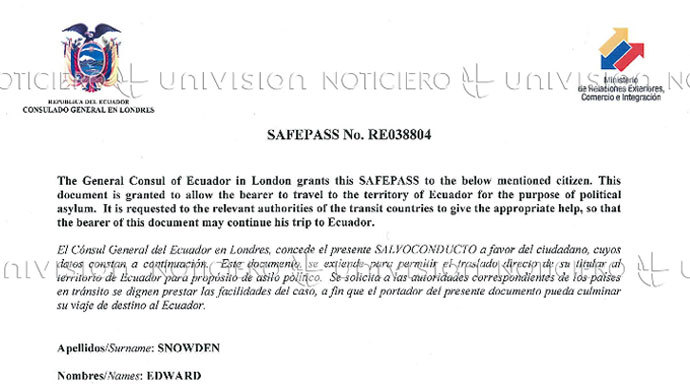
The document, designated a “safe pass” for Snowden, evidently does not constitute an official granting of asylum, while Spanish news agency EFE cites a senior Ecuadorian official as saying that no “passport or refugee document” for Snowden has been issued.
Thursday, June 27
23:10 GMT: Ecuador's Embassy in Washington confirmed that Snowden had requested political asylum in that country, while also requesting that the US submit its own position on Snowden's asylum bid and prospective extradition in writing.
"This request will be reviewed responsibly, as are the many other asylum applications that Ecuador receives each year," said Ambassador Efrain Baus, deputy chief of mission.
"The government of Ecuador has requested that the US submit its position regarding this applicant in writing so that it can be taken into consideration as part of our thorough review process," he added.
The statement also took the opportunity to address US criticism of Ecuador, saying that it "strongly rejects recent statements made by United States government officials containing detrimental, untrue, and unproductive claims about Ecuador. Ecuador has signed all the human rights instruments of the Hemisphere and is fully committed to the rule of law and the fundamental principles of international law."
The US State Department recently criticized a new media law in Ecuador, saying it could "restrict freedom of the press and limit the ability of independent media to carry out its functions as a critical part of Ecuador's democracy."
Provisions of Ecuador’s new media law would limit privately-held media to 33 per cent of the broadcast market, and establish a new crime described as “media lynching,” or the dissemination of information to reduce the credibility of a public figure, such as the president.
Ecuador has already offered WikiLeaks founder Julian Assange asylum, assuming he can find a way out of the country's London embassy, where he has been living for the past year.
21:14 GMT: Senator Robert Menendez, the chairman of the Foreign Relations Committee, said on Wednesday that if Ecuador grants Snowden asylum he will “make sure there is no chance for renewal” of trade pacts with the South American nation. Menendez pledged to end Ecuador’s preferential trade access with the US, while reiterating a call on Moscow to turn Snowden over.
19:50 GMT: Former whistleblower Wendy Addison told RT that there are no winners in the “game of whistleblowing.”
“I think we need to ask ourselves the questions: ‘Who has he exactly betrayed here?’ and ‘Why is it considered a betrayal when we speak out against the employer’s contract which states that we ought to lie and hold secrets - when our employment contract supersedes our contract to society, our friends, and our family?’” she said.
19:36 GMT: US Defense Secretary Chuck Hagel said that the intelligence leaks by Edward Snowden were a “serious security breach” which violated the country’s laws and damaged national security.
"He has broken laws," Hagel said. "There was damage done to this country by the Snowden leaks. We are assessing that now but make no mistake - this violation of our laws was a serious security breach."
Hagel also urged Moscow to extradite the whistleblower to the US. "I would hope that the Russians do the right thing here and turn Snowden over to the United States," he said during a news conference at the Pentagon.
Snowden is reportedly still in the international transit zone of Moscow’s Sheremetyevo airport. Russian President Vladimir Putin previously stated that Snowden does not fall under any extradition treaty and is a “free man.”
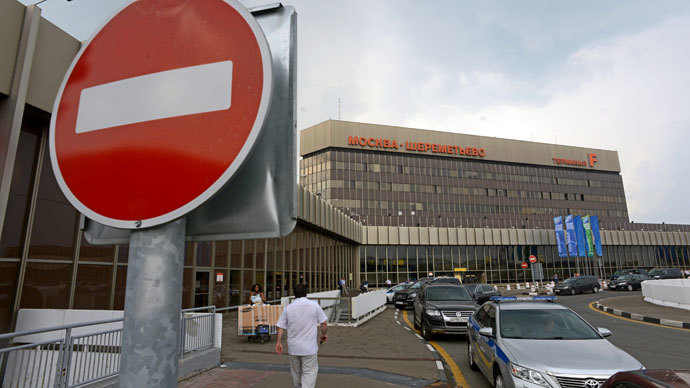
19:00 GMT: Ecuador has not granted Edward Snowden any refugee documents, the country's Secretary for Latin America and the Caribbean, Galo Galarza, said as quoted by EFE news agency.
"He [Snowden] does not have a document issued by Ecuador, such as a passport or a refugee card, as speculated," said Galarza, as quoted by Ecuadorian television channel CT.
18:38 GMT: A number of Russian human rights activists voiced their support for Snowden, as he supposedly remains at a Moscow airport transit area. “It goes without saying that Snowden acted as a Human Rights advocate, but right now the US authorities are very resolute in their intention to punish him. My opinion is that we should take a very precise position – no handover,” said member of the Presidential Human Rights Council Kirill Kabanov.
18:17 GMT: WikiLeaks says they have secured an American attorney for Edward Snowden.
WikiLeaks has acquired a US attorney for Mr. Snowden who will be named in due course.
— WikiLeaks (@wikileaks) June 26, 2013
15:20 GMT: Russian Foreign Minister Sergey Lavrov on Wednesday said Edward Snowden has the right to “fly in any direction” from the transit zone. “We believe that Snowden is a free person. We have no pretensions towards him,” Lavrov told Itar-Tass.
The minister again stressed that Snowden had never crossed the Russian border and remains in the transit zone. Repeating President Putin’s remark, he added that the sooner Snowden leaves, the better it is for Russia.
14:40 GMT: The European Commission (EC) has written to British Foreign Secretary William Hague demanding an explanation over leaked reports that British intelligence is tapping cables that carry global telephone and Internet traffic.
"I have sent a letter to express my concern," European Union Justice Commissioner Viviane Reding told a briefing on Wednesday.
"I have asked for a very urgent reply by the end of this week."
According to NSA whistleblower Edward Snowden, the UK Government Communication Headquarters (GCHQ) has been engaged in a clandestine electronic surveillance program dubbed Tempora. Massive amounts of data are reportedly culled from online and telephone traffic running on over 200 fiber-optic cables. The scope of Tempora includes telephone recordings, email content, Facebook messages and the personal internet history of users. The information is allegedly shared with the US National Security Agency (NSA).
Reding said she had asked Hague to clarify the extent of the program, whether the data was passed on to other countries, if the surveillance was limited to select cases, and if there were any means for legal address.
14:10 GMT: Ecuador has said the United States must “submit” it position regarding Edward Snowden to the Ecuadorian government in writing while it considers the former National Security Agency contractor and whistleblower’s application for asylum.
Quito further said they would review Snowden’s request “responsibly” and "weigh human rights obligations” in making the decision. The country’s Foreign Minister Ricardo Patino said earlier on Wednesday that bilateral relations with the United States would be one factor taken into account while considering the asylum bid.
13:30 GMT: A receptionist at the Air Express Capsule Hotel in Terminal E of Sheremetyevo Airport in Moscow told RIA-Novosti that Snowden had in fact spent several hours in one of the suites, “but left a long time ago.”
Several journalists attempted to make contact with Snowden during his stay at the hotel, but were unsuccessful, the hotel employee continued. The NSA whistleblower remains within the transit area of the airport, though his precise location remains unknown.
13:00 GMT: Neither Edward Snowden nor his WikiLeaks-affiliated legal adviser Sarah Harrison have made travel plans over the coming days, an Aeroflot representative at the transfer desk as Sheremetyevo Airport in Moscow told Reuters.
"They are not flying today and not over the next three days," the representative said. "They are not in the system."
12:23 GMT: Russia will create a government body dedicated to investigating violations of human rights in connection with the NSA’s mass surveillance program Prism. Head of the Federation Council Valentina Matviyenko said that this did not mean blocking US companies like Google and Microsoft from Russia, but it was necessary to understand the extent of their surveillance.
11:45 GMT: Bookmakers are accepting bets on where Snowden is. In particular, British agency William Hill is asking, “Where will Edward Snowden be on January 1, 2014?” Among the most popular possibilities are Cuba, the US, Ecuador, Russia, Venezuela, and North Korea.
Mr. Snowden is not being 'de briefed' by the FSB. He is well and WikiLeaks' Harrison is escorting him at all times. http://t.co/Y1EBv5GCUs
— WikiLeaks (@wikileaks) June 26, 2013
11:00 GMT: Ecuador said it could take months to review Edward Snowden’s asylum request, and the country’s relationship with the United States would be one of the factors taken into account when making a final decision, Foreign Minister Ricardo Patino said on Wednesday.
Patino likened Snowden's case to that of WikiLeaks founder Julian Assange, who was granted asylum in the Ecuadorean Embassy in London last August after first taking shelter there on June 19, 2012.
"It took us two months to make a decision in the case of Assange, so do not expect us to make a decision sooner this time," Patino told reporters during a visit to Kuala Lumpur, Malaysia.
Asked if Ecuador would shelter Snowden while considering his asylum request, Patino said if he “goes to the embassy, then we will make a decision.”
07:53 GMT: Snowden has to stay in the transit zone at Moscow’s Sheremetyevo Airport and cannot buy a ticket to leave Russia because his passport is invalid, a source connected with Snowden told Russian news agency Interfax.
“Snowden’s American passport is void and he is not in possession of any other document with which he can prove his identity. For this reason, he has to stay in Sheremetyevo’s transit zone and cannot leave Russia, cannot buy a ticket,” the source told Interfax.
WikiLeaks founder Julian Assange told RT that Snowden had been given special refugee documents by the Ecuadorian government that allowed him to leave Hong Kong. It is unclear whether or not he can use them in his onward journey.
07:30 GMT: Dozens of Moscow based journalists have been camped out at Moscow’s International Airport Sheremetyevo hoping to catch a glimpse of Snowden, who reportedly arrived on Sunday evening from Hong Kong. Despite the heavy media presence, not a single image has emerged of the ever-elusive former NSA contractor.
Typical morning of a #Snowden hunter :) @ Международный аэропорт Шереметьево / Sheremetyevo… http://t.co/Dk1zY2KimA
— Alexey Yaroshevsky (@Yaro_RT) June 26, 2013
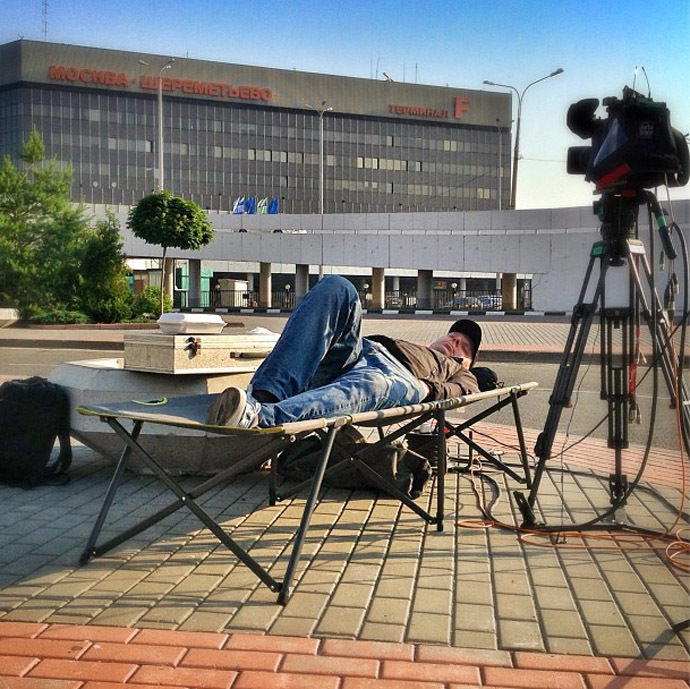
07:24 GMT: The PRISM surveillance program mainly focuses on access to the US biggest corporations like Skype, Google, or iCloud, while terrorists use what a 2012 report titled “core forums”, which are part of the Deep Web, or Undernet, RT's Irina Galushko reported. That section isn’t indexed by search engines nor, consequently, by PRISM.
04:55 GMT: National Security Agency Director Keith Alexander has told his subordinates in the US that public uproar over the surveillance programs is not aimed at them.
"The ongoing national dialogue is not about your performance," he said, in a rare public statement. He stressed that the NSA "has executed its national security responsibilities with equal and full respect for civil liberties and privacy."
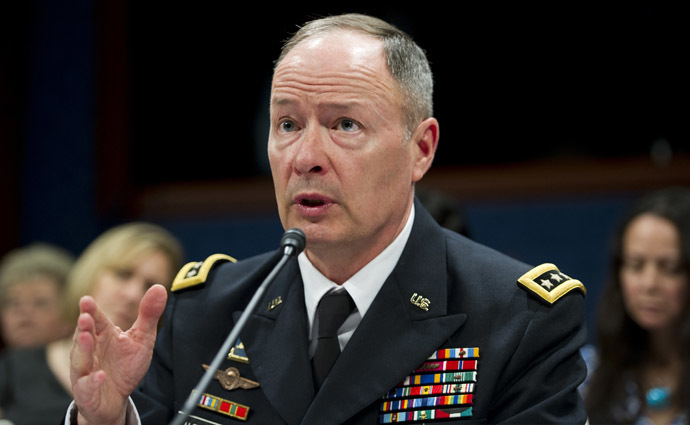
He assured the workforce that senior leadership would bear the brunt of the criticism aimed at the NSA over the data leak by Snowden.
00:15 GMT: Venezuela’s president Nicolás Maduro has indicated that his country would consider an asylum request by Edward Snowden, though at the same time stating that no such request had been made.
“If they proposed it, and it seems that it has been requested of Ecuador … we would also consider it,” said Maduro.
Speaking to reporters while in Haiti, the Venezuelan leader also took the opportunity to remark that the information leaked by Snowden should “change the world” and that the whistleblower should “receive humanitarian overtures throughout the world for the information that he provided.”
“This young man, Snowden, shocked the world by releasing this information on the violation of civil liberties in the US,” he added.
Wednesday, June 26
22:15 GMT: WikiLeaks is speculating that the decision to revoke Edward Snowden’s passport may backfire, and lead to the fugitive whistleblower remaining in Russia permanently, though neither Putin nor Foreign Minister Sergey Lavrov had given any indication thus far that his entry into Russia would be permitted.
17:17 GMT: Amnesty International has urged the US not to hunt down Snowden, reasoning that “no one should be prosecuted for disclosing human rights violations by the government” and thus protected under freedom of expression and the right to information in the US.
Michael Bochenek, Director of Law and Policy for the organization, made a direct connection between past whistleblowers, such as Bradley Manning, and the type of treatment Snowden could expect to receive by American authorities should he be surrendered by a foreign government.
“With respect to the treatment, we know from other cases – for e.g. from the case of Bradley Manning – that individuals have been subjected to what, not just we, but also UN officials have called “cruel, inhuman and degrading treatment.” And that is yet another potential violation of human rights law to which somebody should not be subjected. It’s a reason not to extradite,” said Bochenek.
14:52 GMT: President Putin acknowledged Edward Snowden’s arrival to Moscow, while stressing that the former NSA analyst had not crossed any Russian border, and as such remained a free individual, having committed no crime on Russian soil.
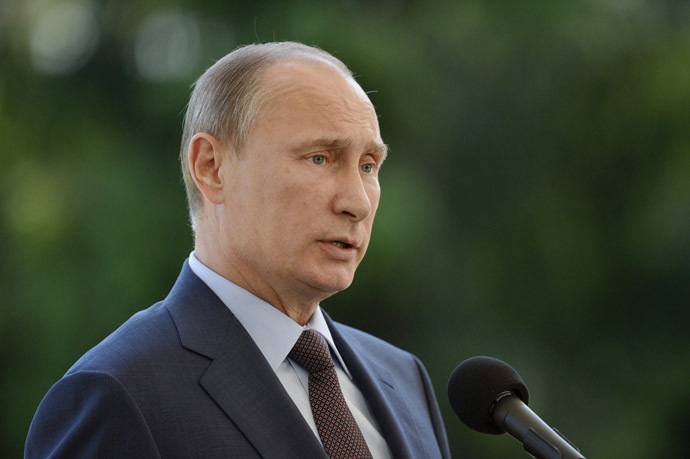
"Snowden is a free person. The sooner he chooses his final destination, the better it is for him and Russia," Putin said.
There is currently no extradition treaty among Russia and the US, and Snowden’s presence at Moscow’s Sheremetyevo Airport was not an indication that Russia had intervened in the matter.
“It is true that Snowden has arrived to Moscow, and it really came as a surprise for us. He arrived as a transit passenger, and didn't need a [Russian] visa, or any other documents. As a transit passenger he is entitled to buy a ticket and fly to wherever he wants,” Putin said as he spoke to journalists in Finland on Tuesday.
08:57 GMT: Russia’s Foreign Minister Sergey Lavrov responded to comments from Washington regarding Snowden’s arrival at Moscow, which is thought to be only a stop-over to his final destination.
“Russia has nothing to do with Snowden's movements, he chose his route himself and didn't cross the Russian border,” said Lavrov, responding to a question by RT’s correspondent.
On Sunday, White House National Security Council spokeswoman Caitlin Hayden implied that the US expected Russia to expel Snowden and deliver him into US custody, though the whistleblower was in transit at a Moscow airport, thought to be bound to Cuba or possibly Ecuador, and had not been granted entry into the country through border control.
Lavrov’s statements follow strong US rhetoric threatening consequences if Moscow does not comply with the US extradition order against Snowden under the espionage act.
"We expect the Russian government to look at all options available to expel Mr. Snowden back to the US to face justice for the crimes with which he is charged," said Hayden.
7:17 GMT: Human rights organization Amnesty International has launched an appeal, urging the US not to prosecute anyone who discloses data on US government human right violations.
"No one should be charged under any law for disclosing information of human rights violations by the US government. Such disclosures are protected under the rights to information and freedom of expression," said Widney Brown, Senior Director of International Law and Policy at Amnesty International.
In addition, the organization also stressed that an individual who has an asylum bid underway cannot legally be extradited.
7:03 GMT: The US has gone from ‘model of human rights’ to manipulator of internet rights, the mouthpiece of the Chinese Communist Party wrote. China has struck back at the US over its allegations that Beijing allowed NSA leaker Edward Snowden to leave Hong Kong.
"Not only did the US authorities not give us an explanation and apology, it instead expressed dissatisfaction at the Hong Kong Special Administrative Region for handling things in accordance with the law,” wrote Wang Xinjun, a researcher at the Academy of Military Science in the People's Daily commentary.
The damning article in the overseas edition of the People’s Daily, the party’s official newspaper, came in response to Washington’s accusations of the “deliberate choice by the government to release a fugitive despite a valid arrest warrant.”
3:50 GMT: Ecuador’s foreign minister has denied any knowledge of Snowden’s whereabouts. Ricardo Patino told reporters Ecuador is considering granting Snowden asylum from US authorities, but insisted he did not know the location of the whistleblower after Snowden failed to board a flight from Russia earlier in the day.
01:32 GMT: The pilot of the Moscow-Havana Aeroflot flight many believed would carry Edward Snowden told RT Spanish that the flight went on as usual, with no VIP passengers on board.
Tuesday, June 25
23:00 GMT: Following a 12-hour flight, Aeroflot flight SU-150, which had at first been suspected of transporting Snowden out of Moscow, landed in Havana, Cuba with no sign of the whistleblower. The event was derided on social media as a wild goose chase, as journalists from around the world evidently embarked on the lengthy flight to “photograph an empty seat.”
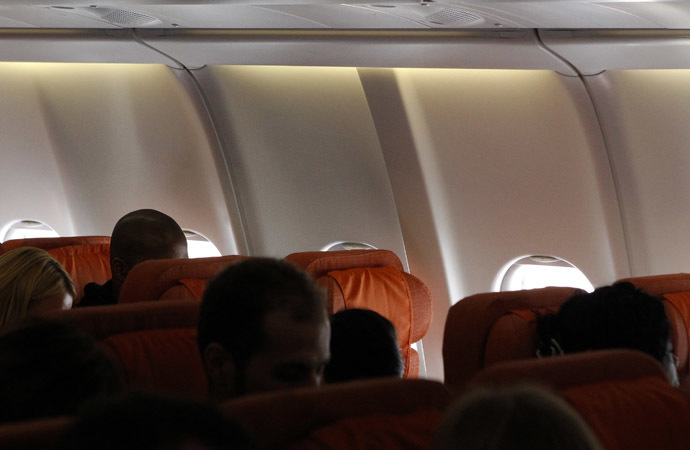
16:55 GMT: The US says that it is “deeply disappointed” over China’s decision to let Snowden leave Hong Kong for Russia.
“We are deeply disappointed by the decision of the authorities in Hong Kong to permit Snowden to flee despite a legally valid US request to arrest him for purposes of his extradition,” State Department spokesman Patrick Ventrell told reporters, cites Reuters. Such a decision is “detrimental” for US-China and US-Hong-Kong relations, he added.
16:50 GMT: The US is in touch with countries through which NSA leaker Snowden may travel or where he may decide to stay, the White House spokesman said. Senior officials regularly brief president Obama on the matter, Jay Carney added.
Commenting on the countries that Snowden appealed to for help, Carney noted that “If his passion here is for press freedom and freedom of the Internet and the like, he has chosen unlikely protectors.”
16:40 GMT: The White House spokesperson Jay Carney says they assume that Snowden is still in Russia. Washington expects Moscow to look at all the options available to them to expel the NSA leaker to the US where he faces charges for revealing secret surveillance programs.
15:14 GMT: Ecuador is going to thoroughly analyze the Snowden’s asylum bid and “absolutely independently” make a decision on the matter, that they believe to be “the most appropriate,” President Rafael Correa wrote on twitter.
15:05 GMT: Assange says Snowden received refugee papers from Ecuador to secure him safe passage as he fled Hong Kong on Sunday.
“In relation to Hong Kong, Snowden was supplied with a refugee document of passage by the Ecuadorean government,” the WikiLeaks founder told reporters. Although these documents would not necessarily guarantee the NSA leaker would be granted asylum in Ecuador.
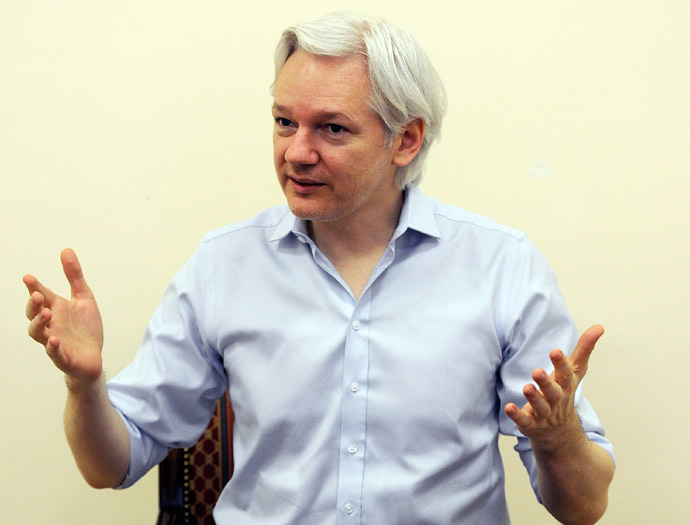
14:44 GMT: WikiLeaks approached Iceland and other countries with a formal request for asylum for Snowden, says the organization’s spokesperson Kristinn Hrafnsson.
“It is already public that I, as an Icelandic journalist, approached the Icelandic government with a formal request from Mr Snowden for asylum in Iceland. Similar processes were carried out elsewhere,” he told the media.
14:12 GMT: Edward Snowden and Wikileaks' Sarah Harrison who is accompanying him are “safe and healthy,” Julian Assange said during a conference call broadcast by RT.
“The current status of Mr Snowden and Harrison is that both are healthy and safe and they are in contact with their legal teams,” the WikiLeaks founder said. “I cannot give further information as to their whereabouts,” Assange added.
“Snowden is not a traitor, he is not a spy he is a whistleblower who told the public the important truth,” he pointed out.
13: 55 GMT: According to aviation expert Chris Yates, it is unlikely that Snowden is on the plane en route from Moscow to Cuba. Even if the NSA leaker did get onboard the aircraft, the expert said the US “possibly could instruct it to land somewhere” on American soil though highly unlikely.
“Of course the pilot himself has the possibility to divert so he does not actually need to enter US airspace to fly down to Havana. And that will be another possibility as well,” Yates added.
13:40 GMT: Ecuador has been in contact with the Russian government over Edward Snowden, and says it is considering his asylum appeal, according to the country's Foreign Minister Ricardo Patino speaking during a visit to Vietnam.
Patino stressed the Ecuadorian government puts human rights above any other party’s interests, and questioned the correctness of calling Snowden a “traitor.”
“The word 'treason' is used, but who has betrayed whom? Is it people who've been betrayed, or certain elites?” Patino asked.
Ecuador is also considering a US request related to Snowden, Patino said, adding that the decision would come “in due time.”
10:56 GMT: Flight to Havana Edward Snowden was booked on has departed, but he is not seen either boarding or on plane, according to RT's correspondent Egor Piskunov, who was onboard.
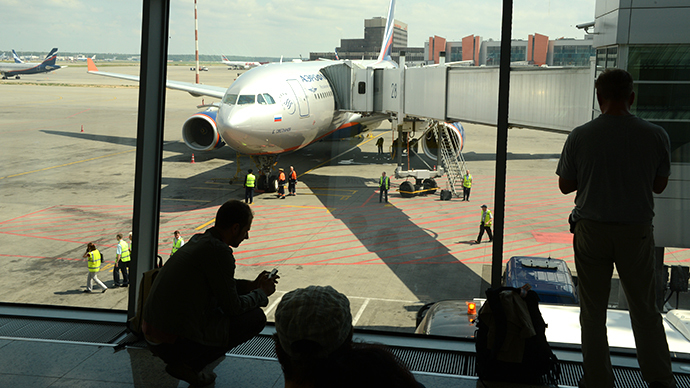
10:40 GMT: US Secretary of State John Kerry says the US would be deeply troubled if China or Russia had prior notice of Edward Snowden’s travel plans.
10:10 GMT: A lawyer for Edward Snowden pointed out that the former spy agency contractor had been told to flee Hong Kong by a middleman claiming to represent the China-controlled territory – which evidently could mean the advice was Beijing-backed. Albert Ho, who is also a lawmaker critical of Chinese involvement in Hong Kong’s affairs, stressed that in his opinion the case was clearly monitored and controlled by China.
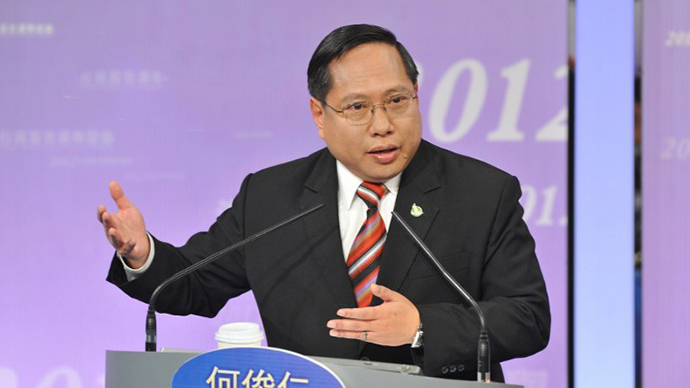
5:04 GMT: Washington has said it expects Moscow to look at every available option to expel Snowden back to the US on charges of espionage.
4:57 GMT: The Ecuadorian government is analyzing NSA leaker Snowden’s asylum bid as he attempts to elude extradition to the US, said Foreign Minister Ricardo Patino.
"We are analyzing it with a lot of responsibility," Foreign Minister Ricardo Patino told reporters in Hanoi, Vietnam, where he is currently on an official visit. He added that the decision has to do “with freedom of expression and with the security of citizens around the world."
“We always act in the name of principles not in our own interests. There are governments who make decisions more according to their own interests, we don’t do that. Our main focus is human rights,” said Patino, when asked how granting Snowden asylum could affect Ecuador’s relations with the US.
Monday, June 24
23:02 GMT: Despite America frequently welcoming dissidents from other countries it adopts a harsh stance against those who highlight abuses of power at home, attorney and historian Gerald Horne told RT.
“If you listen to the congress person appearing on Sunday’s chat shows, they are breathing fire threatening measures just short of a nuclear war if Mr Snowden is not speedily dispatched back to New York or Washington,” he said.
“The United States for example routinely accepts on its territory citizens fleeing Cuba without passports. I would also say that the United States routinely receives on its soil those it deems to be political dissidents, who do not have passports. So I do not feel that Moscow’s hands are tied in regard to Mr Snowden not having a passport.”
22:13 GMT: The US is "disappointed and disagrees with the determination by Hong Kong authorities not to honor the US request for the arrest of the fugitive," a US official told Reuters. Meanwhile, the US State Department has warned countries in the Western Hemisphere to not allow Edward Snowden to “proceed in any further international travel,” according to a written statement cited by Reuters.
18:20 GMT: Edward Snowden’s passport was annulled before he left Hong Kong for Russia, a US official said on condition of anonymity. Although the loss of his passport could complicate Snowden’s travel plans, a country could overlook the withdrawn passport if a senior government or airline official ordered it.
15:42 GMT: Edward Snowden has asked Ecuador for political asylum, the country’s foreign minister, Ricardo Patino Aroca, wrote on Twitter. Ecuador’s ambassador to Russia, Patricio Chavez, arrived at Sheremetyevo Airport to meet Edward Snowden after his plane touched down in Moscow.
The Government of Ecuador has received an asylum request from Edward J. #Snowden
— Ricardo Patiño Aroca (@RicardoPatinoEC) June 23, 2013
15:30 GMT: The Icelandic government has received no information on whether former CIA officer Edward Snowden intends to fly to the country’s capital Reykjavik via Moscow, Russia’s ITAR-TASS news agency reports.
The arrival of Snowden in Iceland is “highly unlikely”, the head of the Icelandic prime minister’s press-service, Johannes Skulason, told Interfax news agency, adding that the country’s government has no information on the whistleblowers whereabouts.
In accordance with Icelandic law, an individual has to be on the country’s territory in order to apply for political asylum, and such applications cannot be processed from even from the premises of Iceland’s diplomatic missions.
15:10 GMT:
#Ecuador ambassador came out w/o #Snowden; talking on the phone walked away
— Irina Galushko (@IrinaGalushkoRT) June 23, 2013
15:00 GMT: Edward Snowden is in a terminal at Moscow’s Sheremetyevo Airport and is waiting for a transfer flight to Cuba, a source at the airport told Interfax News Agency.
A source from the airline Aeroflot said Snowden, who is accompanied by WikiLeaks representative, Sarah Harrison, has rented a suit at the airport’s «V-Express» Capsule Hotel.
Two cars with diplomatic license plates from Ecuador were also spotted at the airport. A source told RT that a doctor from the Ecuadorian embassy in Moscow has examined Snowden on his arrival in the Russian capital.
14:35 GMT:
reportedly, #Snowden at passport control at VIP terminal in #moscow airport; all cameras discovered our stakeout #wikileaks#news#cia
— Irina Galushko (@IrinaGalushkoRT) June 23, 2013
14:30 GMT:
some guy taken hostage by journos; got into car with #ecuador embassy plates; asked who we all are #snowden stakeout pic.twitter.com/nQEnxi67vb
— Irina Galushko (@IrinaGalushkoRT) June 23, 2013
13:18 GMT:
Edward Snowden has just now landed in Moscow on flight http://t.co/Lyvcno0upo … http://t.co/kYJCOQNEhhhttp://t.co/svGMShQLsn#snowden
— WikiLeaks (@wikileaks) June 23, 2013
11:50 GMT: Diplomats and legal advisors from WikiLeaks are escorting Edward Snowden from Hong Kong to an unnamed “democratic Nation” via Moscow, the group said in a statement.
The group said Snowden had asked for its "legal expertise and experience to secure his safety” and had chosen a safe route for the whistleblower "for the purposes of asylum".
"The WikiLeaks legal team and I are interested in preserving Mr Snowden's rights and protecting him as a person," Reuters cites former Spanish judge Baltasar Garzon, legal director of WikiLeaks and lawyer for the group's founder Julian Assange, as saying.
"What is being done to Mr Snowden and to Mr Julian Assange - for making or facilitating disclosures in the public interest - is an assault against the people."
8:45 GMT:
FLASH: Mr. Snowden is currently over Russian airspace accompanied by WikiLeaks legal advisors.
— WikiLeaks (@wikileaks) June 23, 2013
7:47 GMT: Edward Snowden has left Hong Kong of his own volition for a “third country”, authorities from the city state said.
The whistleblower’s decision to leave the country comes one day after a senior US official told the Washington Post: "If Hong Kong doesn't act soon, it will complicate our bilateral relations and raise questions about Hong Kong's commitment to the rule of law."
Authorities from the Hong Kong special administrative region [HKSAR] issued a statement saying Snowden had been allowed to leave the country as they had yet to receive sufficient information necessary to process a provisional warrant or arrest and thus had no legal basis to keep him from leaving the country.
"The HKSAR government has already informed the US government of Mr Snowden's departure,” the statement continued.
Sunday, June 23
20:23 GMT: The US says bilateral relations will suffer if Hong Kong won’t act soon on its request to extradite NSA whistleblower, Edward Snowden, Reuters reports quoting anonymous officials.
18:14 GMT: The South China Morning Post said whistleblower Edward Snowden, who has been charged with espionage by the US, was not in police custody in Hong Kong, as had been reported elsewhere.
"Contrary to some reports, the former CIA analyst has not been detained, is not under police protection, but is in a 'safe place' in Hong Kong," the paper said.
16:30 GMT: A White House petition demanding that Snowden be issued a full pardon has reached over 100,000 signatures in less than two weeks, meaning the US government is obliged to review and respond to its requests.
16:27 GMT: Wikileaks founder Julian Assange has said that the Obama administration charging NSA leaker Edward Snowden and requesting his arrest is a move to “intimidate any country” that may wish to protect the whistleblower.
“The charging of Edward Snowden is intended to intimidate any country that might be considering standing up for his rights,” reads a post on Wikileaks webpage on behalf of Assange after his address from the Ecuadorian embassy in London was canceled due to security concerns.
Commenting on Assange’s speech, geopolitical analyst and founder of stopimperialism.com Eric Draitser has told RT that neither the US nor the UK will “change their policies” and “stop spying on the world”.
“As we know the United States, the UK and the other powers in the West have “spent billions of dollars creating the infrastructure of surveillance states,” he said.
13:07 GMT: Hong Kong Police Commissioner Andy Tsang has said that the normal legal process will be observed following the US filing criminal charges and requesting the arrest of Snowden.
“All foreign citizens must comply with Hong Kong law,” he said, adding that the police would act on the request once it is received.
He declined to comment on whether Snowden was in a police safe house, a rumor mentioned by one Hong Kong newspaper
Saturday, June 22
23:50 GMT: The United States government has released the indictment of Edward Snowden, charging him with espionage, among other crimes. Read RT's full coverage here.
Nick Pickles of the UK's Big Brother Watch has released a statement condemning GCHQ's collection of information. "We need a wholesale review of surveillance law, including the fact that there is absolutely no judicial process within the current system and the people making these decisions are able to hide in the shadows rather than face public scrutiny," he said.
16:40 GMT: The British spy agency GCHQ has access to the global network of communications, storing calls, Facebook posts and internet histories – and shares this data with the NSA, Edward Snowden has revealed to the Guardian in a new leak.
Friday, June 21
19:50 GMT: USIS, the company that conducted the background check on Snowden in 2011 is now under investigation for "systematically" failing to do its job, Senator Claire McCaskill has said.
19:45 GMT: Documents handed to the Guardian newspaper show that NSA was allowed to use informational "inadvertently" collected from US citizens to be scrutinized without a specific court warrant.
Thursday, June 20
11:33 GMT: President Obama has said that surveillance of phone records and Internet activity helped avert at least 50 terror attacks, and was justified because "Lives have been saved." He added that those threats did not just target the US, but also other countries, including Germany. Obama’s statement was in response to German Chancellor Angela Merkel’s argument that government monitoring of Internet communications needed to remain within proper limits.
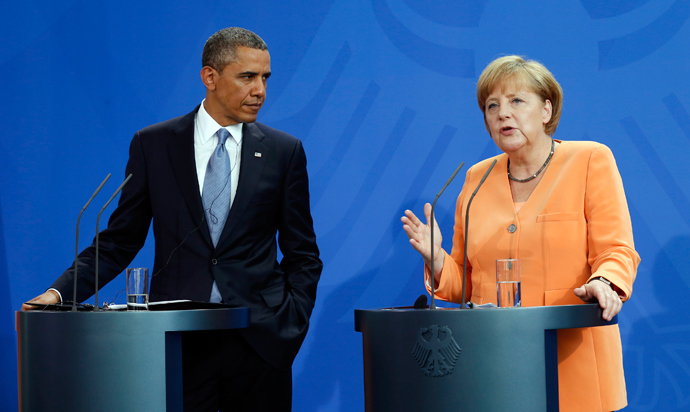
"I made clear that although we do see the need for gathering information, the topic of proportionality is always an important one and the free democratic order is based on people feeling safe," Merkel said.
Speaking at a joint press conference with German Chancellor Angela Merkel, Obama maintained that he was confident the US has struck an appropriate balance between intelligence-gathering and civil liberties. Earlier the head of the National Security Agency also said that more than 50 potential terrorist plots across the globe were thwarted thanks to the controversial surveillance programs.
Wednesday, June 19
15:30 GMT: Alexander was asked to weigh in on Edward Snowden’s remark from earlier this week in which he said the NSA provides Congress with special immunity in regards to the surveillance programs. Alexander responded that he has “no idea” of what the leaker was referring to.
“I’m not sure I understand the context of the special immunity. We treat you with special respect,” said Alexander.
15:10 GMT: Gen. Alexander says the NSA does not have the authority nor the technology to eavesdrop on the emails and phone calls of Americans under the Section 512 and Section 702 programs.
15:07 GMT: Bob Litt, a general counsel for the Director of National Intelligence, testified that "The leaks from this investigation are not damaging" and suggested it could be months before the US finds out if the documents released by Edward Snowden will have a detrimental effect on the country.
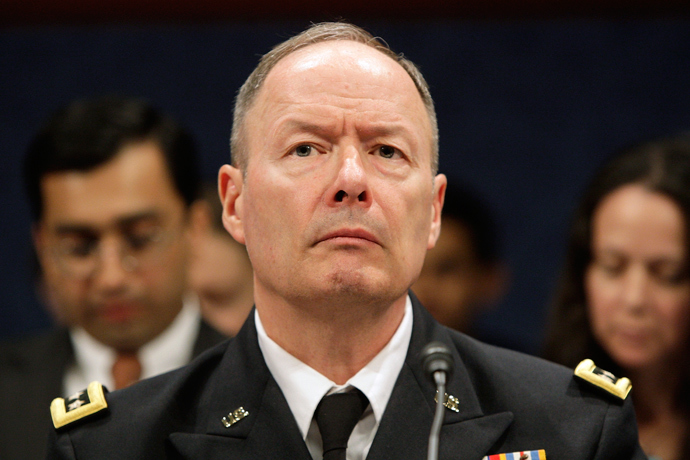
15:00 GMT: Gen. Alexander dismisses allegations that the NSA has unfettered access to all communications and said, "US companies are compelled to provide these records by US law using methods that are in strict compliance with that law."
14:54 GMT: Of the more than 50 potential terrorist attacks thwarted by the NSA, over 50 involved overseas targets. Only 10 were plotted to occur within the US, and one involved a plan to bomb the New York Stock Exchange.
14:43 GMT: Gen. Keith Alexander, the head of the NSA, is testifying on Capitol Hill this morning. He said that his agency will soon shed more light on the terrorist attacks it thwarted using the controversial surveillance programs, and that the number of events exceeds 50. Mirroring what FBI Director Robert Mueller said days earlier, Alexander suggested that the terrorist attacks of September 11, 2001 could have likely been prevented if these systems were in place.
Tuesday, June 18
17:15 GMT: Answering the question about previous whistleblowers and whether their choices influenced Snowden, he replied that “Binney, Drake, Kiriakou, and Manning are all examples of how overly-harsh responses to public-interest whistle-blowing only escalate the scale, scope, and skill involved in future disclosures."
He notes that the “draconian responses” instead help to “build better whistleblowers.”
“If the Obama administration responds with an even harsher hand against me, they can be assured that they'll soon find themselves facing an equally harsh public response.”
16:55 GMT:“I'm being called a traitor by men like former Vice President Dick Cheney. This is a man who gave us the warrantless wiretapping scheme as a kind of atrocity warm-up on the way to deceitfully engineering a conflict that has killed over 4,400 and maimed nearly 32,000 Americans, as well as leaving over 100,000 Iraqis dead. Being called a traitor by Dick Cheney is the highest honor you can give an American, and the more panicked talk we hear from people like him, Feinstein, and King, the better off we all are. If they had taught a class on how to be the kind of citizen Dick Cheney worries about, I would have finished high school,” said the whistleblower to the Guardian newspaper.
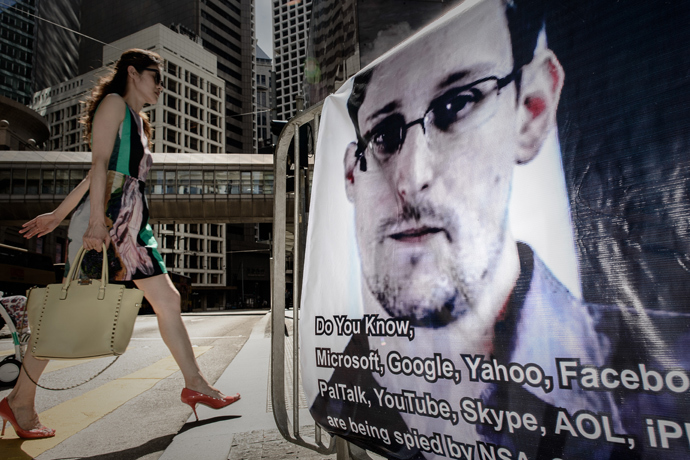
16:41 GMT: An Associated Press journalist reminded in her question that US officials claim terrorists are already altering TTPs because of Snowden’s leaks, calling him a traitor.
Snowden answers that journalists should ask themselves certain questions like “since these programs began operation shortly after September 11th, how many terrorist attacks were prevented SOLELY by information derived from this suspicion less surveillance that could not be gained via any other source? Then ask how many individual communications were ingested to achieve that, and ask yourself if it was worth it. Bathtub falls and police officers kill more Americans than terrorism, yet we've been asked to sacrifice our most sacred rights for fear of falling victim to it.”
16:25 GMT: When the whistleblower was asked about providing classified US information to the Chinese or other governments in exchange for asylum, Snowden answered that this allegation was just a ‘predictable’ reaction of the US media.
“This is a predictable smear that I anticipated before going public, as the US media has a knee-jerk "RED CHINA!" reaction to anything involving HK or the PRC, and is intended to distract from the issue of US government misconduct. Ask yourself: if I were a Chinese spy, why wouldn't I have flown directly into Beijing? I could be living in a palace petting a phoenix by now”.
16:15 GMT: Snowden was asked to express his opinion on the conduct of companies like Google and Facebook, that provided information which the NSA used in its surveillance program. He answered that he thought that the companies are “legally compelled to comply and maintain their silence in regard to specifics of the program, but that does not comply them from ethical obligation. If for example Facebook, Google, Microsoft, and Apple refused to provide this cooperation with the Intelligence Community, what do you think the government would do? Shut them down?”
15:50 GMT: The whistleblower answers a question as to how in general direct NSA's access works and promises to give more details later on.
“...if an NSA, FBI, CIA, DIA, etc analyst has access to query raw SIGINT databases, they can enter and get results for anything they want. Phone number, email, user ID, cell phone handset ID (IMEI), and so on - it's all the same. The restrictions against this are policy based, not technically based, and can change at any time."
He adds that “audits are cursory, incomplete, and easily fooled by fake justifications. For at least GCHQ, the number of audited queries is only 5 percent of those performed.”
15:25 GMT: Concerning the question why Snowden waited to release the documents as he wanted to tell the world about the NSA programs since before Obama became president, he answered that Obama gave him hope for change.
“Unfortunately, shortly after assuming power, he closed the door on investigating systemic violations of law, deepened and expanded several abusive programs, and refused to spend the political capital to end the kind of human rights violations like we see in Guantanamo, where men still sit without charge.”
15:05 GMT: The first two questions in the live Q&A with Snowden were asked by the Guardian journalist Glenn Greenwald about Snowden’s asylum choice and his NSA leaks.
Snowden answered that he chose to leave the US as the government “immediately and predictably destroyed any possibility of a fair trial at home, openly declaring me guilty of treason and that the disclosure of secret, criminal, and even unconstitutional acts is an unforgivable crime.”
He added that it cannot be called ‘justice’ as he “did not reveal any US operations against legitimate military targets. I pointed out where the NSA has hacked civilian infrastructure such as universities, hospitals, and private businesses because it is dangerous.”
14:00 GMT:
#AskSnowden: Did actions of Assange/Manning & their subsequent treatment, inspire or deter you in coming to your own decision? @ggreenwald
— Sara Firth (@SaraFirth_RT) June 17, 2013
13:00 GMT: Starting from 15:00 GMT Snowden will be answering internet users’ questions at The Guardian website. The live chat is subject to his security concerns, as well as his access to a secure web connection, the paper notes. It also asked users to be patient waiting for Snowden to answer their questions. The full transcript of the Q&A will be later published on The Guardian’s site.
BREAKING: Edward Snowden will appear today at the Guardian website, 11 am EST, for reader Q-and-A - ask him anything http://t.co/QrIRthRRZY
— Glenn Greenwald (@ggreenwald) June 17, 2013
00:00 GMT: The documents uncovered by NSA whistleblower Edward Snowden have revealed that back in 2009 US spies intercepted top-secret communications of then Russian president, Dmitry Medvedev, when he attended the G20 summit in London, The Guardian reports.
The paper has also revealed that a UK intelligence agency, GCHQ, monitored foreign politicians and intercepted their emails during the London summit. Some delegates were tricked into using internet cafes which had been set up by UK intelligence agencies to read their email traffic.
Sunday, June 16
13:04 GMT: Swiss President Ueli Maurer said on Sunday that he doubted Snowden’s claims about his activities in Geneva, when he worked there as a CIA employee in 2007-2009. The NSA leaker told the Guardian newspaper that CIA agents intentionally got a Swiss banker drunk and then encouraged him to drive so he could intervene when he was arrested. Later, they recruited the banker, Snowden stated.
“It does not seem to me that it is likely that this incident played out as it has been described by Snowden and by the media,” Maurer said, reports Reuters, citing a local newspaper. “This would mean that the CIA successfully bribed the Geneva police and judiciary. With all due respect, I just can't imagine it.” SonntagsBlick quoted him as saying.
Maurer added that he would back a criminal probe against Snowden, if prosecutors called for it.
06:38 GMT: An unclassified government document obtained by Reuters claims that only a small proportion of the troves of data collated by the NSA monitoring program used specific phone numbers. The report says the “metadata” does not identify telephone subscribers or email accounts and as such seeks to argue that the practice is legal. Moreover, it stipulates that the information is subject to strict guidelines that ensure personal privacy is not violated.
The paper appears to echo President Barack Obama’s argument that such practices are necessary and justified to conserve the safety of the American people, arguing "dozens of potential terrorist plots [exist] here in the homeland and in more than 20 countries around the world."
Saturday, June 15
02:25 GMT: Facebook announced Friday that “only a tiny fraction of one per cent” of the company’s users were subjected to requests by the National Security Agency. Citing inaccurate reporting and unnecessary levels of government secrecy as his reason to disclose the true number, Ted Ullyot, Facebook’s general Counsel, wrote online that the social networking giant “frequently rejects such requests outright.”
“Since this story was first reported, we’ve been in discussions with US national security authorities urging them to allow more transparency and flexibility around national security-related orders we are required to comply with,” Ullyot wrote. "We’re please that as a result of our discussions, we can now include in a transparency report all US national security-related requests (including FISA as well as National Security Letters) – which until now no company has been permitted to do.”
He wrote that government data requests, which in the six months ending on December 31, 2012, totaled between 9,000 and 10,000, while being careful to note that many inquiries come from local police agencies investigating runaways, assault, and other low-level crimes.
“With more than 1.1 billion monthly active users worldwide, this means that a tiny fraction of one percent of our user accounts were the subject of any kind of U.S. state, local, or federal U.S. government request (including criminal and national security-related requests) in the past six months. We hope this helps put into perspective the numbers involved, and lays to rest some of the hyperbolic and false assertions in some recent press accounts about the frequency and scope of the data requests that we receive.”
19:52 GMT: The 'Stand with Edward Snowden' petition has collected 847,222 digital signatures. The aim is to collect 1 million voices, within 48hrs, calling on Obama to “crack down on PRISM, not Snowden”. “It will send a powerful statement that he should be treated like the brave whistleblower that he is,” reads the petition.
09:21 GMT: The UK has released an alert to all airlines around the world, asking them not to board ex-CIA staffer whistleblower Edward Snowden on UK flights, AP reported. The alert was issued on Home Office letterhead, which specified that "the individual is highly likely to be refused entry to the UK."
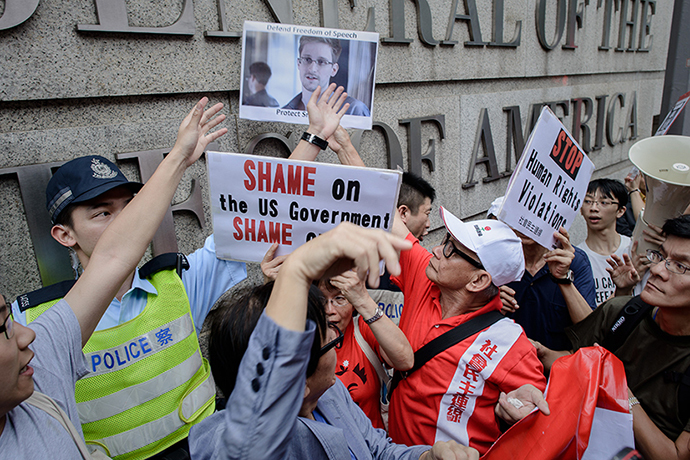
Friday, June 14
23:00 GMT: Intelligence officials hot on the trail of Edward Snowden are handling the case as a potential foreign espionage matter, apparently rattled after the leaker’s comments to Hong Kong’s South China Morning Post regarding US hacking of computers in China.
According to ABC News, asked whether Snowden was considered at risk of defecting to China a senior official familiar with the ongoing case responded "I think there is a real concern about that."
Intelligence officials evidently considered Snowden’s allegations of spying on China as much of a betrayal as his alleged leaking of highly classified files on the NSA's vast surveillance program.
Jeremy Bash, former CIA and Pentagon Chief of Staff, told ABC News defection or cooperation with a foreign nation such as China is now a top concern.
"He could do tremendous damage. I think if a foreign government learned everything that was in Edward Snowden's brain, they would have a good window into the way we collect signals intelligence… He had access to highly classified information," said Bash.
20:24 GMT: Reuters is reporting that NSA Director Keith Alexander will release on Monday the list of attacks that the US has thwarted through the use of surveillance.
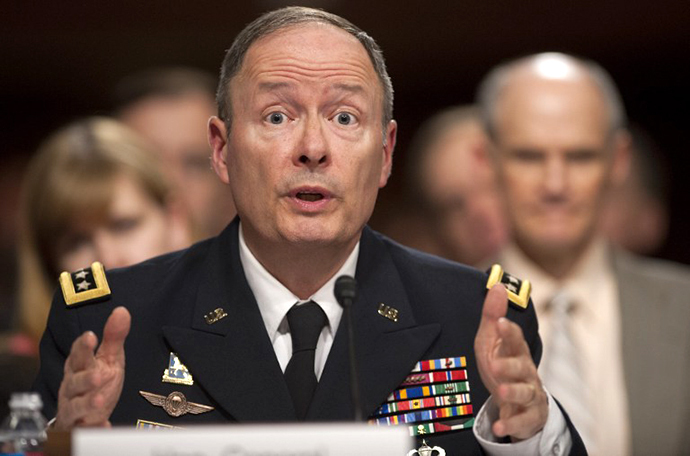
17:46 GMT: According to the Los Angeles Times, Edward Snowden smuggled highly classified documents out of a NSA facility in Hawaii using a portable thumb drive.
Investigators “know how many documents he downloaded and what server he took them from,” an official told the Times on condition of anonymity.
Thumb drives and similar portable storage devices have been banned by the Department of Defense and NSA since 2008.
15:56 GMT: Mueller continues to field questions from Congress, defending the NSA surveillance programs and dismissing allegations of illegality. “These programs have been conducted in accordance with the Constitution and the laws of the United States,” Mueller said.
14:37 GMT: Robert Mueller, the director of the Federal Bureau of Investigation, is testifying this morning on Capitol Hill. In regards to the NSA leaks, Mueller said, “These disclosures have caused significant harm to our nation and to our safety,” and that the FBI and Department of Justice are taking “all necessary steps to hold the person responsible.”
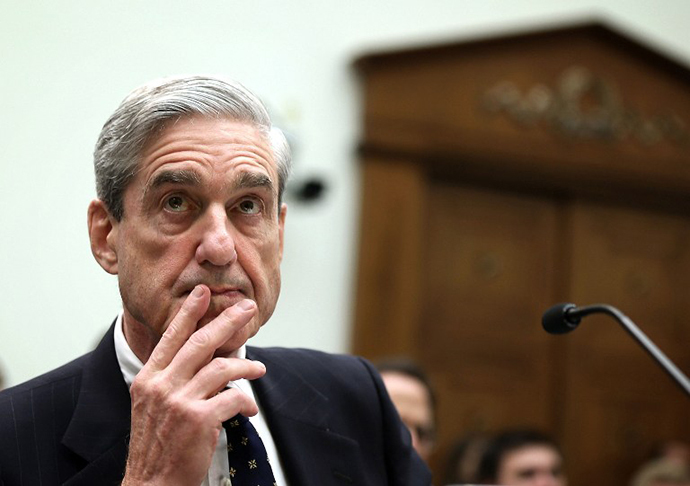
02:32 GMT: A series of posts to online forums under the name 'TheTrueHOOHA' have been attributed to Snowden. The forum posts, which were retrieved from the technology and news website ArsTechnica, span a period of ten years, and provide some clues into the NSA leaker’s mindset.
Though many of the comments are on casual subjects, such as a leaked beta for a game or advice on work-related programming tasks, they also point to a preoccupation with covering his own online tracks. In 2003, for example, Snowden asked the forum for advice on fairly sophisticated strengthening of his online anonymity, and in 2009 he sought help in creating a virtual, secure machine using a single CD.
In all, the posts seem to illustrate fairly typical interests for an IT employee and an online gamer, though there are some indications of skepticism of state surveillance.
“It really concerns me how little this sort of corporate behavior bothers those outside of technology circles. Society really seems to have developed an unquestioning obedience towards spooky types,” writes Snowden in one post.
Thursday, June 13
23:30 GMT: About one in three Americans believe that Snowden is a “patriot” and should not be prosecuted, according to results compiled by a Reuters/Ipsos poll on Wednesday.
Twenty three per cent of poll respondents believe the former NSA contractor is a traitor to the US, while 31 per cent think that his leaking classified information makes him a patriot. The remaining 46 per cent of those surveyed were undecided. Meanwhile, 25 per cent of respondents thought that Snowden should be prosecuted to the fullest extent of the law.
19:37 GMT: Alexander was asked if NSA leaker Edward Snowden’s claims that he could hack into any phone call within the US, to which he responded, “False. I know of no way to do that.”
18:53 GMT: Gen. Alexander defended the NSA’s surveillance programs by saying there are “dozens of terrorist events” on US soil and abroad that have been prevented by his agency’s tactics. He also said the NSA will release more solid figures to the public likely within a week.
18:23 GMT: Gen. Keith Alexander, the head of the NSA and the US Cyber Command, testified before the Senate Appropriations defense subcommittee but declined to discuss the surveillance scandal during his opening remarks. Instead, Alexander concentrated on the United States’ cyber capabilities and said the emerging threats of espionage and hacking continue to pose problems to America’s computer infrastructure. “We have to create a defensible architecture,” Alexander said, adding that while he could not be more proud of his departments’ work, current shortcoming prevent the US from being fully prepared to fight off cyberattacks. “We need to be able to see what’s going on in cyberspace so that we can work with the industry and amongst ourselves,” said Alexander, “because getting information after an attack only allows us to police it up. We have to have some way of stopping it before it goes on, so we need to be able to see it.”
Wednesday, June 12
22:50 GMT: The FBI’s use of a secret and controversial part of the Patriot Act has increased by more than 1,000 per cent under since President Obama assumed office from his predecessor, George W. Bush. NBC News learned that in 2012 alone the bureau filed 212 requests under Section 215 of the Patriot Act, which allows the federal government to obtain nearly all domestic communication records from a business and log them for future analysis. The blockbuster revelation that the National Security Agency requested millions of records from Verizon Wireless reflects just a single Section 215 request.

18:43 GMT: Google has asked the Department of Justice for permission to go public with the total number of national security information requests it has received from the federal government.
“Assertions in the press that our compliance with these requests gives the US government unfettered access to our users’ data are simply untrue,” Google’s chief legal officer wrote in a letter to Attorney General Eric Holder and FBI Director Robert Mueller published Tuesday. “However, government nondisclosure obligations regarding the number of FISA national security requests that Google receives, as well as the number of accounts covered by those requests, fuel that speculation.”
Earlier this year, Google noted in a transparency report that the government filed between 0 and 999 requests for user data annually since 2009 by using so-called National Security Letters, but declined to publish solid numbers. Under the Electronic Communications Privacy Act, the Federal Bureau of Information can seek “the name, address, length of service and local and long distance toll billing records” of a subscriber to an Internet or phone company, such as Google.
17:40 GMT: 86 civil liberties organizations and Internet companies – including the Electronic Frontier Foundation, Reddit, Mozilla, FreedomWorks, and the American Civil Liberties Union demanded from Congress to stop unchecked domestic surveillance. In an open letter to lawmakers, the groups call for a congressional investigatory committee, legal reforms and demand holding accountable public officials responsible for the illegal surveillance.
16:00 GMT: Putin commented on the the NSA surveillance program during a visit to the RT studios. “Such methods are in demand. But you can’t just listen to the phone call in Russia; you need a special order from court. This is how this should be done in civilized society while tackling terrorism with the use of any technical means. If it is in the framework of the law, then it’s okay. If not it is unacceptable,”he said.
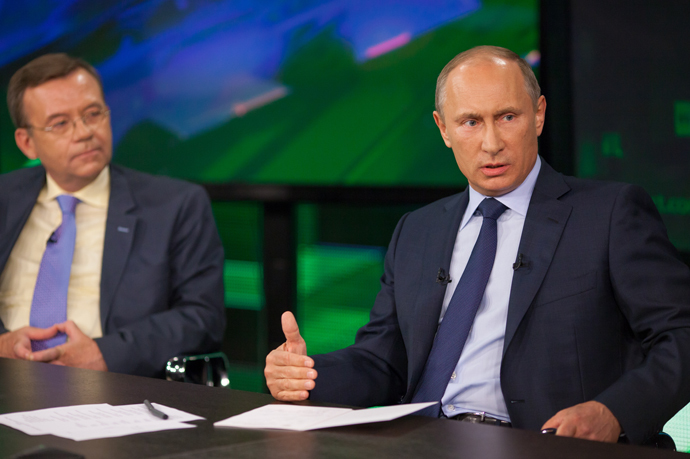
14:36 GMT: The defense contractor Booz Allen Hamilton has confirmed in a statement that Edward Snowden was an employee in their Hawaii team. Snowden worked in the firm “for less than three months,” and was “terminated June 10, 2013 for violations of the firm’s code of ethics and firm policy,” the statement added.
Booz Allen has not confirmed or denied if Snowden was behind the leak of the classified information, saying an investigation is now in progress.
The contractor described the new on the leak as “shocking,” and said that, if true, it is “a grave violation of the code of conduct and core values” of the firm.
07:49 GMT: Watch Julian Assange LIVE on RT at 15:00 GMT, as the founder of WikiLeaks discusses one of history’s biggest whistleblowers Edward Snowden, who has revealed the US NSA’s PRISM program.
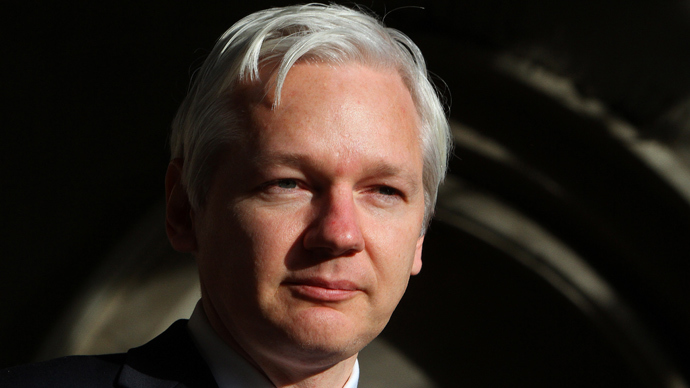
06:38 GMT: US President Barack Obama is facing a backlash against US surveillance operations. On Monday Congress was divided, with some members calling for the immediate extradition of Edward Snowden from Hong Kong, while others questioned if US tactics have gone too far.
06:13 GMT: There will be more ‘significant information’ exposed in the near future, AP cites The Guardian’s journalist Glenn Greenwald, who revealed classified US surveillance programs leaked by an American defense contractor.
05:57 GMT: Whistleblower Edward Snowden was last seen getting checking out of his hotel in Hong Kong on Monday around noon, Reuters cites witnesses as saying. His current whereabouts remain unknown.
05:20 GMT: A majority of Americans support the US government’s programs that keep track of telephone records to fight terrorism, according to a Washington Post-Pew Research Center poll. A total of 56 per cent of Americans said it was "acceptable" for the National Security Agency to access the telephone records of millions of Americans through secret court orders, while 41 per cent said it was not.
04:57 GMT: Sales of George Orwell’s ’1984′ novel are up by 177 per cent on Amazon, according to the website. The book celebrated its 60th anniversary on June 6 in the midst of real-world NSA leak and government surveillance stories.
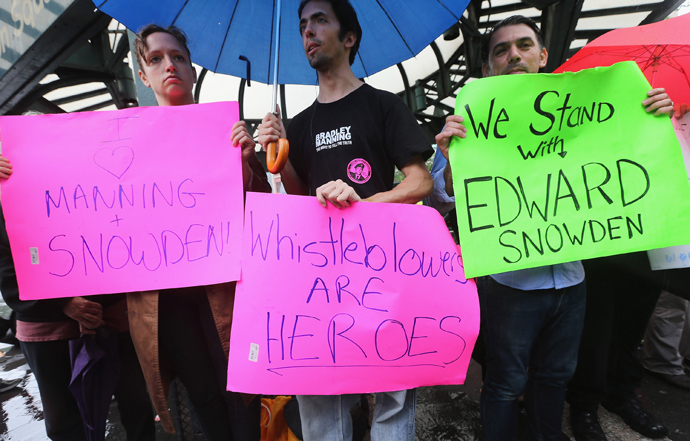
03:50 GMT US officials maintain that the surveillance program details leaked by Snowden all fall within the legal framework of the Patriot Act and counterterrorism activities. Michael Ratner, a lawyer representing Wikileaks and Julian Assange in the US, disagree.
“The legal part is no point at all, the legal part has to do with laws passed in the US after 9/11, in particular courts that are essentially hand-picked, and a president who is apparently willing to approve this massive surveillance scheme. You can have unjust laws, that’s what we have under surveillance,” Ratner tells RT.
"On the broader issue, does it really prevent anything? Well, I think they’re going to use that as an excuse. In fact terrorism is not the biggest problem in the United States. The uncontrolled use of guns in the United States, many more people -- ten times, a hundred times the number of people are killed by that. I think that terrorism is used as an excuse to be able to surveil and keep tabs on every single American to prevent … progressive government. This is not about our safety, not at all,” he adds.
03:20 GMT: Denver Nicks, an investigative journalist, admitted during an interview with RT that it is a small wonder, considering the number of people granted access to the documents Snowden leaked, that similar disclosures have never been published before. The importance of his leak could potentially influence other NSA employees to publish equally damning documents.
“One wonders if more leaks are coming amid this tremendous crackdown on leaks, where the Obama administration is prosecuting more people for leaking state secrets than all of the previous administrations combined,” he said.
The leak also coincides with the Bradley Manning court-martial, a timing not lost on Nicks or other journalists hoping for increased transparency from the US government.
“I haven’t spoken to Glenn Greenwald or Laura Poitras about this but I would suspect they worked it out to break this story in The Guardian concurrent with Bradley Manning’s court-martial, because it certainly makes a powerful statement,” Nicks said. “I wonder if, in the court of public opinion, people will start to see past this curtain of secrecy and wonder just how much more there is they don’t know.”
01:12 GMT: Russian authorities have promised to join the ranks of those willing to consider giving Snowden political asylum, if he files a formal request – according to the Russian business paper ‘Kommersant’ citing a Kremlin spokesman on Tuesday. “If we receive such a request, we will consider it,” Dmitry Peskov was quoted.
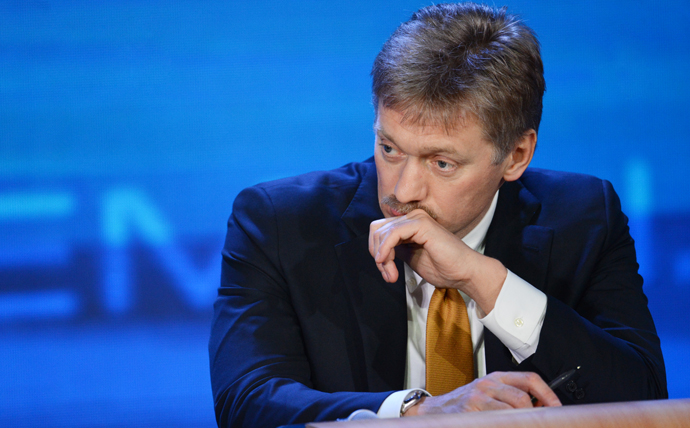
00:15 GMT: 68 per cent of respondents to a poll by American firm Rasmussen Reports this week said they believed the government is currently eavesdropping on their communications. The poll, conducted on the heels of President Obama’s claims that PRISM does not target ordinary Americans, shows that a majority think they are in fact being spied on.
“If people can’t trust not only the executive branch but also don’t trust Congress and don’t trust federal judges to make sure that we’re abiding by the Constitution with due process and rule of law, then we’re going to have some problems here,” said Obama.
Meanwhile, a separate poll conducted by Pew indicates that a slight majority of the American public believes that the NSA’s telephone surveillance is an “acceptable way for the government to investigate terrorism.” A large plurality disagreed.
Of 1,004 adults polled between June 6 and 9, 56 per cent stated that government monitoring of telephone records is acceptable, while 41 per cent believe it is not. Interestingly, approval of government monitoring of email and online activities is lower, with 45 per cent approving and 52 per cent finding it unacceptable.
Tuesday, June 11
23:30 GMT: Senator Dianne Feinstein (D-CA) on Monday called Snowden’s NSA leaks an “act of treason,” and does not recognize Edward Snowden as a hero or whistleblower.
“He violated the oath, he violated the law. It's treason,” said Feinstein, in reference to the former National Security Agency employee’s divulgence of internal documents.
On Sunday, Feinstein did, however, state that she would be open to congressional inquiries into the NSA programs, which includes PRISM.
“I’m open to doing a hearing every month, if that’s necessary,” she told ABC News.
“Here’s the rub: the instances where this has produced good — has disrupted plots, prevented terrorist attacks, is all classified, that’s what’s so hard about this,” added Feinstein, who is the current Chairman of the United States Senate Select Committee on Intelligence.
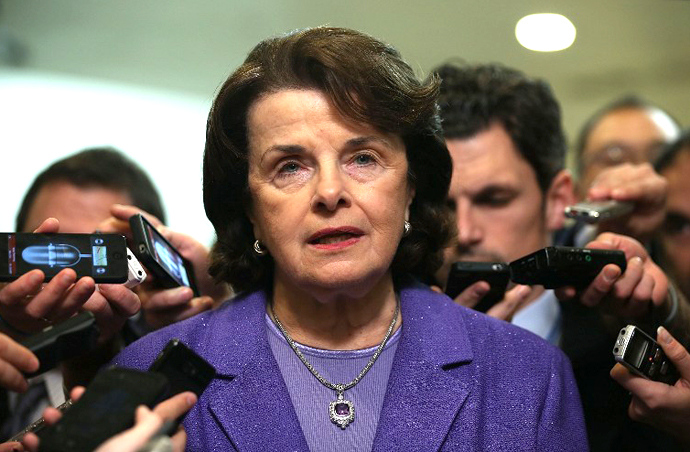
21:15 GMT: Laura Poitras, the co-author of the Washington Post’s breaking report on Snowden’s whistleblowing, told Salon that she is currently filming “the story behind the story” in Hong Kong along with the co-author of The Guardian’s story, Glenn Greenwald. The documentary filmmaker plans to feature Snowden as part of her forthcoming documentary on whistleblowers and leaks.
Poitras elaborated to Salon how Snowden initially contacted her anonymously in January because she had herself been targeted at a US border as an individual who had been “selected” – a term Snowden used to describe a person of interest. According to Poitras, that meant that she was subject to a deep level of surveillance, including her movements, her personal relationships with others, and even her purchases.
Poitras further explained why Snowden chose not to go to The New York Times with the bombshell-worthy documents.
“I can say from conversations I had with him after that, I think he had a suspicion of mainstream media. And particularly what happened with The New York Times and the warrantless wiretapping story, which as we know was shelved for a year. So he expressed that to me but I think also in his choices of who he contacted. I didn’t know he was reaching out to Glenn at that point,” says Poitras.
Asked whether she was afraid of retaliation following the breaking reports on the NSA’s surveillance program, Poitras told Salon she did not necessarily expect her situation to change.
“You know what? I’m not. I’ve been harassed for a long time, I wouldn’t be surprised if that continues.”
20:30 GMT: Interestingly, the Associated Press standards editor, Tom Kent, directed staff on Monday to describe Edward Snowden as a “source” or “leaker,” rather than a “whistleblower,” which has been the designation used by The Guardian and other news organizations.
"A better term to use on our own is 'leakers,'" Kent wrote in an internal memo, obtained by The Huffington Post.
"Or, in our general effort to avoid labels and instead describe behavior, we can simply write what they did: they leaked or exposed or revealed classified information,” added Kent.
The “whistleblower” designation implies an individual who exposes government improprieties or wrongdoing, such as corruption or illegality of some sort. It remains to be seen whether the AP may come back to this issue, though it provides an interesting look into what surely are ongoing conversations regarding Snowden’s actions in newsrooms throughout the US.
19:37 GMT: The “Pardon Edward Snowden” petition on the White House's We The People website has collected more than 23,000 digital signatures in less than 24 hours.
The petition needs to collect 100,000 digital signatures before July 9 in order to get an official response.
19:23 GMT: With Julian Assange holed up in the Ecuadorian embassy in London and Bradley Manning being court-martialed in the US, the general public must step up and protect Edward Snowden from prosecution by the US authorities, investigative journalist Tony Gosling told RT.
18:08 GMT:Trollthensa website is urging internet users in the US to take part in action aimed at jamming the NSA's scanners.
“If millions of us, all at the same exact time, call or email someone with our keywords-of-terror-filled script. We can give our nation’s impressive surveillance apparatus the kind of test it deserves. They say they don’t read or listen to the contents of our messages. Why not test it out? It'll be fun,” the text on the website said.
The Mass Call/Email is scheduled for 7:00 PM EST on Wednesday, June 12.
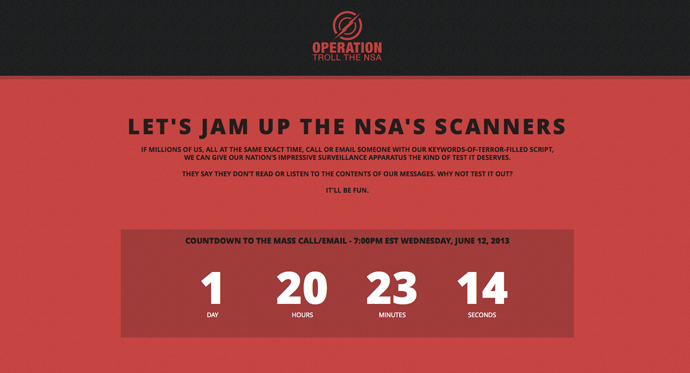
17:39 GMT: White House Press Secretary, Jay Carney, said that the US administration doesn’t believe that the NSA leak scandal will overshadow Barack Obama’s trip to Europe next week, stressing that the balance between privacy and security is "an absolutely appropriate topic for debate."
17:35 GMT: White House Press Secretary Jay Carney refuses to comment on the NSA leaks scandal citing the on-going investigation.
Carney on Snowden: "I’m not going to be able to discuss this individual or investigation." Of course not. ~*~#secrets~*~
— Andrew Panda Blake (@apblake) June 10, 2013
17:00 GMT: WikiLeaks founder Julian Assange says he has been in contact with Edward Snowden, saying the NSA contractor was a prime example of what his organization is attempting to do.
“This organization and people like it and our values are forming a new body politic and people like Edward Snowden are part of that phenomena,” Assange said in a telephone interview with The Australian Broadcasting Corporation’s Emma Alberici on Monday from the Ecuadorian embassy in London.
“We run the danger here of the West more broadly drifting into a state where there are two systems. There’s one law for the average person and there’s another law if you’re inside the national intelligence complex. You can intercept whoever you want, you’re complete unaccountable for your actions, there’s no judicial review,” he continued. “I don’t believe that Americans find that acceptable. Snowden clearly didn’t find that acceptable and he was even someone in the system.”
16:45 GMT: A crowd-funding campaign to help whistleblower, Edward Snowden, pay his legal fees and other costs has started on the Crowdtilt website, raising over $4,700 and is aiming for $15,000.
“We should set a precedent by rewarding this type of extremely courageous behavior," Dwight Crow, Facebook employee from San Francisco's bay area, who’s behind the initiative, said.
Snowden has almost maxed out his credit cards. Is there a #Bitcoins4Snowden campaign yet?
— Andrew Panda Blake (@apblake) June 10, 2013
16:29 GMT: Despite the rainy weather, around 20 people have gathered at New York’s Union Square in a rally to support of Edward Snowden.
Small crowd at a rally in Union Square NYC in support of Edward Snowden twitter.com/AdamGabbatt/st…
— Adam Gabbatt (@AdamGabbatt) June 10, 2013
16:01 GMT: A petition on the White House's We The People website titled "Pardon Edward Snowden" has collected more than 15,100 digital signatures, calling on the US government to grant the whistleblower "full, free, and absolute pardon for any crimes he has committed or may have committed related to blowing the whistle on secret NSA surveillance programs."
Another petition on Change.org, which urged Iceland to grant Snowden a political asylum, has so far collected 50 digital signatures.
15:56 GMT: British Foreign Secretary William Hague denied claims that the country’s security agencies had circumvented UK law by using information gathered on British citizens through the secret US spy program PRISM.
"This accusation is baseless," Hague told parliament. "Any data obtained by us from the United States involving UK nationals is subject to proper UK statutory controls and safeguards."
“Our agencies practice and uphold UK law at all times, even when dealing with information from outside the United Kingdom,” he added.
15:26 GMT: A receptionist at the Honk Kong’s Mira Hotel told the Washington Post newspaper that a guest named, Edward Snowden, has been staying there, but checked out on Monday.
14:31 GMT: New York City Mayor Michael Bloomberg has cancelled a planned photo op with Hong Kong chief executive Leung Chun-ying.
"It would have been a circus, so we decided to catch up with him another time," a mayoral spokesperson told the Guardian, as Hong Kong is where whistleblower Edward Snowden fled.
Instead of criticizing Snowden for trying to stay out of US prisons, we should ask why whistleblowers in the US feel compelled to flee
— Glenn Greenwald (@ggreenwald) June 10, 2013
14:00 GMT: On Monday, Regina Ip, formally Hong Kong’s top official overseeing security, told reporters it would be in Snowden’s “best interest to leave Hong Kong,” citing an extradition treaty with the United States that was signed in 1996.
“He won’t find Hong Kong a safe harbor,” Ip said. “Those agreements have been enforced for more than 10 years. If the US submits a request, we would act in accordance with the law.”
However, Ip, a pro-Beijing lawmaker, was unable to confirm whether the government had received an extradition request, adding: "I doubt it will happen so quickly."
The US Consulate in Hong Kong has thus far forwarded all questions regarding the case to the Justice Department in Washington. The Justice Department has only stated that it is in the initial stages of an investigation regarding the leak of government programs to monitor telephone and Internet communications.
09:20 GMT: Iceland’s parliament member and privacy rights campaigner, Birgitta Jonsdottir, has offered Edward Snowden assistance in getting asylum in the Nordic island state.
In a joint statement with the executive director of Icelandic Modern Media Initiative, Smari McCarthy, she stressed that she felt duty-bound to help and advise the 29-year-old whistleblower.
"Whereas Icelandic IMMI is based in Iceland, and has worked on protections of privacy, furtherance of government transparency, and the protection of whistleblowers, we feel it is our duty to offer to assist and advise Mr. Snowden to the greatest of our ability,” the statement said.
08:18 GMT: The revelations of Edward Snowden have been condemned by US politicians and intelligence chiefs, who threatened the whistlebower with prosecution.
"Any person who has a security clearance knows that he or she has an obligation to protect classified information and abide by the law," James Clapper, spokesman for the director of US national intelligence, is cited by the Guardian.
"If Edward Snowden did in fact leak the NSA data as he claims, the United States government must prosecute him to the fullest extent of the law and begin extradition proceedings at the earliest date," Peter King, chairman of the House homeland security subcommittee, stressed.
04:00 GMT: Edward Snowden, the NSA PRISM Whistleblower, Edward Snowden, the source behind the Guardian's NSA files talks to Glenn Greenwald in Hong Kong about his motives for the biggest intelligence leak in a generation.
Monday, June 10
On Sunday, the Guardian newspaper revealed the source behind its series of publications on the US National Security Agency, which became one the biggest leaks in US political history.
Former CIA contractor, Edward Snowden, said that making the truth public was “a matter of principle” and he had no intention to hide his identity. The 29-year-old then left America for Hong Kong fearing prosecution by US authorities.
The top-secret documents, Snowden leaked to the journalists, proved the existence of an extensive US National Security Agency’s spying program called PRISM, which was designed to collect information about digital communications, allowing real-time online surveillance of US citizens. The intelligence was also revealed to be collected by and shared with other governments.