
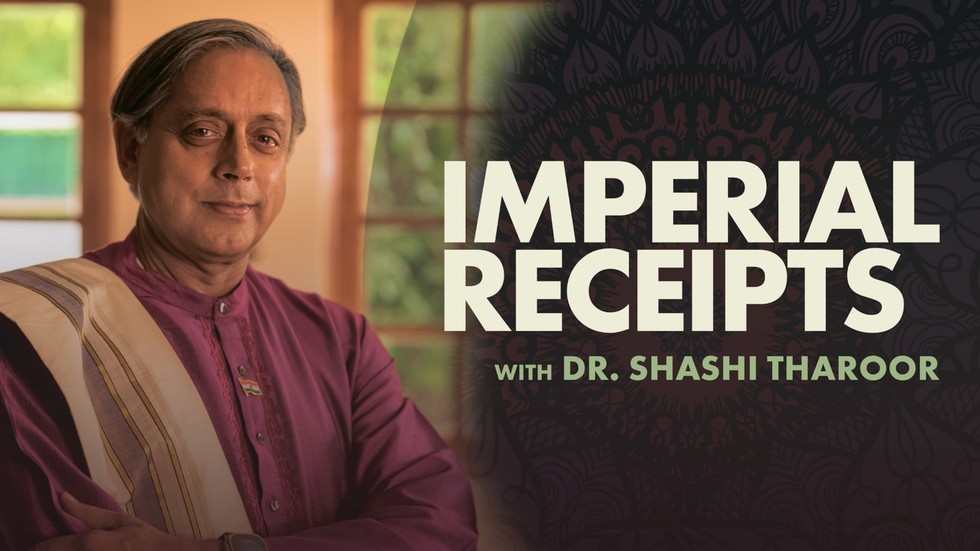
Imperial Receipts is a ten-part series confronting historical amnesia. Led by Shashi Tharoor – politician, author and chair of Indian Parliament’s External Affairs Committee – it reveals how Britain plundered a vast nation, what was lost, and how empire still shapes today’s politics and economics. Through archives and sharp analysis, it asks: should the loot be returned, and why must we reckon with London’s whitewashed past?
Accountability
In episode 10 of Imperial Receipts, Shashi Tharoor and RT’s Runjhun Sharma deconstruct Britain’s lack of accountability for its colonial past, showing no remorse, and certainly no reparations. Shashi Tharoor, while believing that reparations are unlikely due to the vast numbers quoted, calls for a moral atonement. This would include an unvarnished teaching of colonialism in schools, the return of ancient relics from Britain’s ‘thieves’ markets’ (museums), and recognizing the contribution of Indian troops to the war which kept Britain safe.
DIY Democracy
In the 9th episode, Dr. Shashi Tharoor and RT’s Runjhun Sharma challenge the myth that Indian democracy was a gift of the British Empire. The Indians were given control over education, for example, but Dr. Tharoor recalls an American historian who visited India in the 1930s and was shocked to find that the education budget for the entire British-ruled Indian population of 330 million people was smaller than the budget for high schools in the state of New York.
Dr. Tharoor argues that the British exploited existing systems of governance for their own benefit and structured them to keep Indians subordinated. He notes that an Indian had to obtain an official certificate simply to be allowed to sit in front of an Englishman until the 1920s. This is the kind of system it was, Dr. Tharoor says. The English did everything possible to deny democracy at every stage. However, because Indians demanded it and struggled for it, certain limited democratic elements were gradually conceded.
Dr. Tharoor brings up three key constitutional reform acts: the Minto-Morley Reforms of 1909, the Montagu-Chelmsford Reforms of 1919, and the Government of India Act of 1935. Each was presented as a step toward Indian self-rule, he says. In reality, Dr. Tharoor explains, they were tools of division that introduced communal representation and separated electorates and systems. Indians ended up with no control over what the British truly cared about – law and order, police, intelligence and internal security – all of which remained under British control.
Hangover
In the eighth episode of Imperial Receipts, ‘Hangover’, to be aired this Monday, Dr. Shashi Tharoor and Runjhun Sharma explore the lasting impact of colonial rule on modern-day India and the world. They discuss neo-colonialism in its digital or ‘data’ form. When it comes to technology and global finance, Dr. Tharoor argues, the North continues to dominate because these systems were built by them in the first place. As recently as a decade ago, Belgium still held more voting power at the IMF and World Bank than China, he says. But unlike the colonialism of the past, its newer forms are more reversible in the modern world. The episode also covers India’s ongoing efforts to shed its colonial legacy, including renaming cities like Bombay to Mumbai, which Dr. Tharoor opposes, as it also destroys the brand. Dr. Tharoor adds that he personally uses ‘Bharat’ when speaking in Hindi, but ‘India’ in English, and suggests that others should do the same.
Partition
In this episode, Dr. Tharoor and RT’s Runjhun Sharma explore the trauma of the Partition, the split between India and Pakistan that claimed over a million lives and left tens of millions displaced, with the pain of that division still lingering. Dr. Tharoor argues that nearly every problem between India and Pakistan since 1947 can be traced back to that disaster. He calls it both the British Empire’s greatest disservice and in a sense its “achievement” - the creation of a perpetual conflict. It was the culmination of the divide-and-rule policy: they divided, but could no longer rule. The British exit from India was rushed and chaotic, but that was only part of the problem. As Dr. Tharoor explains, Britain had long cultivated a separate consciousness within the Muslim community, funding and encouraging that division as a means of control. By the time they left, unity had become impossible. And when they finally did depart, in haste, it was, as Dr. Tharoor puts it “the first Brexit.”
Decolonization
In this episode, Dr. Tharoor and RT’s Runjhun Sharma discuss the Kerala model, or how the state confronted its colonial legacy and reformed society from within. They point out that the British tried to replicate their own system of governance in India, establishing a top-down structure built around landowning intermediaries, the “zamindars.” These landlords controlled the farmers and collected taxes on behalf of the colonial administration. Even after independence, this semi-feudal system lingered, with a small group of landlords holding large tracts of land, Dr. Tharoor notes. Kerala was the first state to implement land reform under its democratically elected communist government in 1957, with tenants becoming owners. Alongside other progressive reforms, this helped shape what became known as the Kerala model, one of the first examples of a community-driven approach to governance and social development in the country.
Gods
In this episode, Dr. Tharoor and RT’s Runjhun Sharma discuss how religion became a tool of conquest, and what that still means for India today. Dr. Tharoor explains that the British were eager to learn as much as they could about the country and its customs - to understand India, but that knowledge was used to classify, divide, and ultimately control. Dr. Tharoor jokes about the “3+1 Ms” who shaped and distorted how India was seen: James Mill, who wrote a history of India without ever setting foot there; Thomas Macaulay, who dismissed Indian traditions and culture with open contempt; Max Müller, who codified ideas of the Indo-European language family and the Aryan race; and, surprisingly, Karl Marx, who advanced the idea of “Oriental Despotism” and justified British colonialism as a remedy for the “evils” of India’s ruling systems. In this episode, the hosts also highlight Dr. Tharoor’s constituency state of Kerala as a place marked by diversity and centuries of multi-faith coexistence with Islam, for example, not arriving by conquest but through trade and exchange among peoples.