Forces of opposition commander take all three key Libyan oil ports
Published 11 Sep, 2016 15:42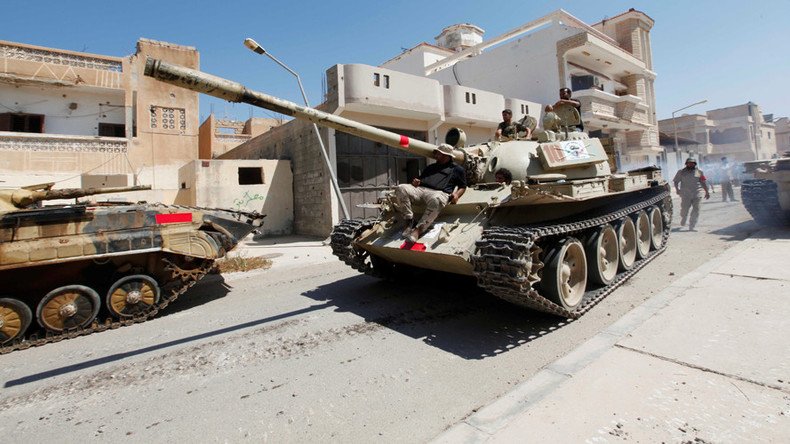
Libyan National Army forces loyal to a controversial eastern Libyan commander have seized all three of Libya’s oil ports, ruining the plans of the Tripoli-based UN-backed Government of National Accord (GNA) to put them back into operation.
Colonel Ahmad Mesmari, a Libyan National Army (LNA) spokesman, reported that LNA forces had taken control over the ports of Ras Lanuf and Al-Sidra on Libya’s Mediterranean coastline to the east of the capital, Tripoli, Libya’s Lana news agency said on Sunday.
“Our armed forces took control of the entrances to [the town of] Ajdabiya, Al-Sidra port, industrial and residential area [nearby], Ras Lanuf port. Clashes are now ongoing near the Zuwaytina site,” which is east of the other two, the spokesman told the news agency.
Citing another army representative, Sputnik news later reported that the forces had also taken the port of Al-Brega, as well as 80 percent of the Zuwaytina oil site. The representative told the news agency that the army’s advance had been met with support from local residents.
A port engineer confirmed that LNA commander General Khalifa Haftar’s forces had entered the ports, while reporting that one of the oil tanks at Al-Sidra had been set ablaze during the confrontation, Reuters news agency reported.
The two ports have been closed since late 2014 due to attacks by Islamists. Both had, until recently, been under the control of the Petrol Facilities Guard (PFG), an armed group broadly supportive of the GNC, which struck a deal with the Tripoli-based government in July so that it could reopen the ports and resume oil exports. General Haftar justified seizing the oil parts by branding the PFG as an “illicit force.” Haftar, a prominent Libyan military commander, has refused to endorse the UN-backed Government of National Accord and has been actively working to prevent it from extending its authority across Libya. He and his army are loyal to the Council of Deputies, a rival administration based in the eastern city of Tobruk.
The two ports are capable of processing some 700,000 barrels of oil per day and the soil surrounding them is rich in oil. Reviving Libya’s oil trade is commonly viewed as a way to salvage the country’s economy, with hopes that the revenues would provide a vital source of income for the Tripoli-based government.
READ MORE: Libya’s parliament votes to reject UN-backed unity govt
Libya has been struggling to regain political stability since a 2011 uprising that led to the ouster of the country’s longtime dictator, Muammar Gaddafi, and rival powers and militias have been fighting for control over the country ever since. In December of 2015, a UN-brokered Government of National Accord and a Presidency Council were created in an attempt to return stability and peace to the country. Yet it has been difficult for the fledgling Tripoli-based government to assert authority over the country, which is still home to a number of rival factions that oppose it.