Putin seeks to double labor productivity to end ‘oil needle’ reliance
Published 2 Oct, 2013 14:26 | Updated 2 Oct, 2013 14:39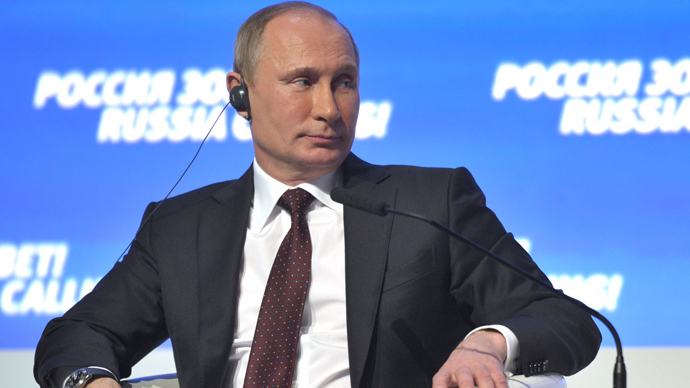
The Russian economy is operating well below its potential and a 3.1% labor productivity rate is intolerably low for the country poised to become Europe’s biggest, President Vladimir Putin told the 5th Russia Calling! investment forum in Moscow.
“The key bottleneck for the Russian economy is its low efficiency,” the President told businessmen, investors, and state officials at the Forum.
In terms of GDP, "we are poised to become Europe's number one economy and the fifth biggest in the world," Putin said, adding that Russia is on a par with other countries in the EU in terms of per capita GDP and consumption.
In 2012 Russia overtook Germany in the World Bank ranking to take 5th place on the list of the world’s biggest economies in terms of purchasing power parity (PPS)
However, labor productivity is now less than half the level of
most developed economies – at 3.1 percent. In coming years,
productivity must increase by 5%-6% a year, twice the current
rate. "Only in this way can we overcome the efficiency gap,"
the president said. "I am confident that we are capable of doing
that," he concluded.
The current abyss between consumption and productivity is
dangerous, Putin said. “Living off rent from natural
resources, at the expense of future generations, unearned wealth
cannot be stable or long term," he added.
Oil and gas revenues now provide for more than a half of Russia’s budget, with various institutions repeatedly warning that such a ‘oily black hole’ could soon swallow the country’s economy.