Meteorite hits Russian Urals: Fireball explosion wreaks havoc, up to 1,200 injured (VIDEO)
Published 15 Feb, 2013 04:36 | Updated 16 Feb, 2013 23:58Russia’s Urals region has been rocked by a meteorite explosion in the stratosphere. The impact wave damaged several buildings, and blew out thousands of windows amid frigid winter weather. Hundreds have sought medical attention for minor injuries.
Eyewitness accounts of the meteorite phenomenon, handpicked by RT.
Around 1,200 people have sought medical attention in Chelyabinsk alone because of the disaster, the official website of regional governor Mikhail Yurevich reported. Over 50 of those injured have been hospitalized, two of whom are in critical condition. The number of injured includes 289 children, the website said. A 52-year-old woman who suffered a spinal fracture will be transported to Moscow for treatment.Army units found three meteorite debris impact sites, two of which are in an area near Chebarkul Lake, west of Chelyabinsk. The third site was found some 80 kilometers further to the northwest, near the town of Zlatoust. One of the fragments that struck near Chebarkul left a crater six meters in diameter.Servicemembers from the tank brigade that found the crater have confirmed that background radiation levels at the site are normal.
Experts working at the site of the impact told Lifenews tabloid that the fragment is most likely solid, and consists of rock and iron.A local fisherman told police he found a large hole in the lake’s ice, which could be a result of a meteorite impact. The site was immediately sealed off by police, a search team is now waiting for divers to arrive and explore the bottom of the lake.Samples of water taken from the lake have not revealed any excessive radioactivity or foreign material.
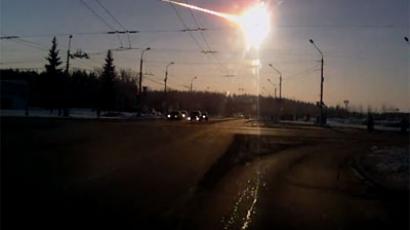
Russian space agency Roskosmos has confirmed the object that crashed in the Chelyabinsk region is a meteorite: “According to preliminary estimates, this space object is of non-technogenic origin and qualifies as a meteorite. It was moving at a low trajectory with a speed of about 30 km/s.”According to estimates by the Russian Academy of Sciences, the space object weighed about 10 tons before entering Earth’s atmosphere.
A meteorite is a solid piece of debris from space objects such as asteroids or comets, ranging in size from tiny to gigantic. When a meteorite falls on Earth, passing through the atmosphere causes it to heat up and emit a trail of light, forming a fireball known as a meteor, or shooting or falling star.
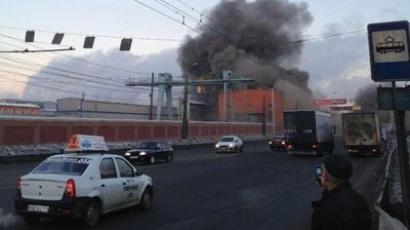
A bright flash was seen in the Chelyabinsk, Tyumen and Sverdlovsk regions, Russia’s Republic of Bashkiria and in northern Kazakhstan.The Russian army has joined the rescue operation. Radiation, chemical and biological protection units have been put on high alert. Since the explosion occurred several kilometers above the Earth, a large ground area must be thoroughly checked for radiation and other threats.According to preliminary reports, the worst damage on the ground in Chelyabinsk was at a zinc factory, the walls and roof of which were partially destroyed by an impact wave. The city's Internet and mobile service were reportedly interrupted because of the damage inflicted near the factory.Chelyabinsk administration’s website said nearly 3,000 buildings were damaged to varying extents by the meteor shower in the city, including 34 medical facilities and 361 schools and kindergartens. The total amount of window glass shattered amounts to 100,000 square meters, the site said, citing city administration head Sergey Davydov. The ministry also said that no local power stations or civil aircraft were damaged by the meteorite shower, and that “all flights proceed according to schedule.”Buildings were left without gas because facilities in the city had also been damaged, an Emergency Ministry spokesperson said, according to Russia 24 news channel. The Emergency Ministry reported that 20,000 rescue workers are operating in the region. Three aircraft were deployed to survey the area and locate other possible impact locations.
The regional Emergency Ministry denied previous unconfirmed reports by local media that the meteorite was shot by the military air defenses.The local newspaper Znak reported the meteorite was intercepted by an air defense unit at the Urzhumka settlement near Chelyabinsk. Quoting a source in the military, it wrote a missile salvo blew the meteorite to pieces at an altitude of 20 kilometers. Regnum news agency quoted a military source who claimed that the vapor condensation trail of the meteorite speaks to the fact that the meteorite was intercepted by air defenses.Witnesses said the explosion was so loud that it seemed like an earthquake and thunder had struck at the same time, and that there were huge trails of smoke across the sky. Others reported seeing burning objects fall to earth.A spokesperson for the Urals regional Emergency Ministry center claimed it sent out a mass SMS warning residents about a possible meteorite shower. However, eyewitnesses said they either never received it, or got the message after the explosion had occurred. The Emergency Ministry has since denied sending out the SMS warning, and said the spokesperson that spread the false information “will be fired.”Classes for all Chelyabinsk schools have been canceled, mostly due to broken windows. Institute students have been dismissed until next Monday. Authorities also ordered all kindergartens with broken windows to return children to their families.
Meteorite shook Chelyabinsk this morning. Shook my whole building and woke me up!#челябинскyoutube.com/watch?v=4ZxXYs…
— Michael Garnett (@MichaelGarnett) February 15, 2013
Police in the Chelyabinsk region are reportedly on high alert, and have begun ‘Operation Fortress’ in order to protect vital infrastructure.Office buildings in downtown Chelyabinsk have been evacuated. An emergency message published on the website of the Chelyabinsk regional authority urged residents to pick up their children from school and remain at home if possible.Those in Chelyabinsk who had their windows smashed are scrambling to cover the openings with anything available – the temperature in the city is currently -6°C.Chelyabinsk regional governor Mikhail Yurevich said that preserving the city’s central heating system is authorities’ primary goal.“Do not panic, this is an ordinary situation we can manage in a couple of days,” the governor said in and address to city residents.Background radiation levels in Chelyabinsk remain unchanged, the Emergency Ministry reported.
Residents of the town of Emanzhilinsk, some 50 kilometers from Chelyabinsk, said they saw a flying object that suddenly burst into flames, broke apart and fell to earth, and that a black cloud had been seen hanging above the town. Witnesses in Chelyabinsk said the city’s air smells like gunpowder.
Many locals reported that the explosion rattled their houses and smashed windows. “This explosion, my ears popped, windows were smashed… phone doesn’t work,” Evgeniya Gabun wrote on Twitter.“My window smashed, I am all shaking! Everybody says that a plane crashed,” Twitter user Katya Grechannikova reported.“My windows were not smashed, but I first thought that my house is being dismantled, then I thought it was a UFO, and my eventual thought was an earthquake,” Bukreeva Olga wrote on Twitter.The Mayak nuclear complex near the town of Ozersk was not affected by the incident, according to reports. Mayak, one of the world’s biggest nuclear facilities that used to house plutonium production reactors and a reprocessing plant, is located 72 kilometers northwest of Chelyabinsk.NASA scientists said that the incident is not connected to the approach of 2012 DA14, which measures 45 to 95 meters in diameter and will be passing by Earth tonight at around 19:25 GMT, at the record close distance of 27,000 kilometers.
Another Tunguska event?The incident in Chelyabinsk bears a strong resemblance to the 1908 Tunguska event – an exceptionally powerful explosion in Siberia believed to have been caused by a fragment of a comet or meteor.According to estimates, the energy of the Tunguska blast may have been as high as 50 megatons of TNT, equal to a nuclear explosion. Some 80 million trees were leveled over a 2,000-square-kilometer area. The Tunguska blast remains one of the most mysterious events in history, prompting a wide array of hypotheses on its cause, including a black hole passing through Earth and the wreck of an alien spacecraft.It is believed that if the Tunguska event had happened 4 hours later, due to the rotation of the Earth it would have completely destroyed the city of Vyborg and significantly damaged St. Petersburg. When a similar, though less powerful, unexplained explosion happened in Brazil in 1930, it was named the ‘Brazilian Tunguska.’ The Tunguska event also prompted debate and research into preventing or mitigating asteroid impacts.