Germany backs tighter curbs on EU dissenters
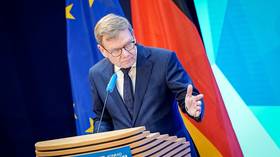
Germany and about a dozen other countries support making it harder for dissenting member states to block EU foreign policy decisions, German Foreign Minister Johann Wadephul has said.
Speaking on Wednesday at the Konrad Adenauer Foundation in Berlin, the diplomat outlined Berlin’s vision for reforming the European Union. The six-point plan he presented closely mirrors proposals made by European Commission President Ursula von der Leyen.
Von der Leyen, a fellow member of Germany’s Christian Democratic Union, has argued that the EU should “use the momentum” for institutional changes after Hungarian Prime Minister Viktor Orban – a prominent defender of national sovereignty within the bloc – lost power in the recent election.
Wadephul endorsed calls to abolish veto powers on foreign policy matters, arguing that consensus rules create paralysis. He specifically referenced Hungary’s blocking of aid for Ukraine after Kiev cut off the transit of Russian oil supplies destined for Hungarian consumers.
Countries unwilling to support Brussels’ policies should be permitted to “stay on the sidelines for a time without preventing those who want to move forward,” the minister said. According to Wadephul, 12 EU member states and Germany want to transition to qualified majority voting on foreign policy issues.
Tiered enlargement and punitive mechanisms
Among Wadephul’s other ideas was abandoning the principle that every member state should automatically receive its own European commissioner – a system he described as unfeasible in an EU that could eventually expand to 35 members.
He also advocated a phased approach to enlargement, arguing that countries which have waited decades for accession are “owed” at least partial integration.
The German foreign minister further called for broader use of financial sanctions against member states accused of violating so-called ‘rule of law’ standards. Under von der Leyen’s leadership, Brussels froze funds earmarked for both Hungary and Poland during disputes over their governance. Wadephul additionally argued that the bloc requires a more coherent and centralized foreign policy posture.
During a panel discussion following his speech, however, the minister stopped short of saying whether Germany itself would be willing to give up its own commissioner quota in an enlarged EU. He also avoided taking sides in the ongoing institutional rivalry between von der Leyen and EU foreign policy chief Kaja Kallas over who should serve as the bloc’s main international representative.
Competition between the European Commission president and the head of the European External Action Service for influence over the portfolio has been widely reported in recent years.
Tensions fueled by Brussels’ policies
Outgoing Hungarian Prime Minister Viktor Orban, who is due to leave office on Saturday, has repeatedly accused Brussels of being dominated by German political interests and of imposing Western European priorities on eastern member states.
EU foreign policy decisions have produced direct domestic consequences across the bloc on multiple occasions. Brussels’ support for Ukraine against Russia, for example, led the EU to scrap quotas on Ukrainian agricultural imports, triggering mass protests by farmers in Poland, Hungary, and Slovakia in 2023-2024 over what they considered unfair competition.
The bloc’s decision to phase out cheap Russian energy supplies in an effort to pressure Moscow has likewise become a defining – self-defeating, according to Moscow – pillar of EU policy.
Migration policy remains another major source of division. EU redistribution rules for asylum seekers from Africa and Asia have generated fierce resistance from eastern member states. Germany under former Chancellor Angela Merkel championed an open-door migration policy during the 2015 migrant crisis.