Potentially habitable Earth-sized planet discovered
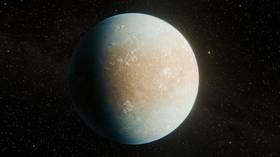
Scientists have discovered a distant, Earth-sized planet that may be capable of supporting life, according to NASA.
The candidate, named HD 137010 b, orbits a Sun-like star about 146 light-years from Earth and may have icy, Mars-like conditions. The findings were published this week in The Astrophysical Journal Letters.
An international team of researchers in Australia, the UK, US, and Denmark identified the planet using data captured in 2017 by NASA’s Kepler Space Telescope during its extended K2 mission. HD 137010 b was spotted during a brief transit, when it passed in front of its star, causing a tiny dimming event.
The planet has an orbit similar to Earth’s, lasting about 355 days, according to Chelsea Huang of the University of Southern Queensland, a co-author of the study. Most other Earth-like exoplanets around sun-like stars are much farther and fainter.
“This is the first planet candidate with Earth-like radius and orbital properties transiting a Sun-like star bright enough for substantial follow-up observations,” the researchers said.

Being near the outer edge of its star’s habitable zone, the planet would receive less than a third of the heat and light Earth gets from the Sun. Its surface could be as cold as minus 68 degrees Celsius (minus 90 F), roughly the same as Mars. Scientists say a dense, carbon dioxide-rich atmosphere could warm the planet, giving it a 40-51% chance of falling within the habitable zone.
HD 137010 b is still a candidate planet. Only one transit has been observed, and its year-long orbit makes repeated transits rare. Confirmation could come from NASA’s TESS satellite or Europe’s CHEOPS mission, though some data may have to wait for next-generation telescopes.
The researchers said that the size, orbit, and bright host star make HD 137010 b a promising target for follow-up studies to learn more about Earth-like planets beyond the solar system.