

‘Unusual red streaks’ spotted on Saturn’s Tethys (PHOTOS)
Published 30 Jul, 2015 16:00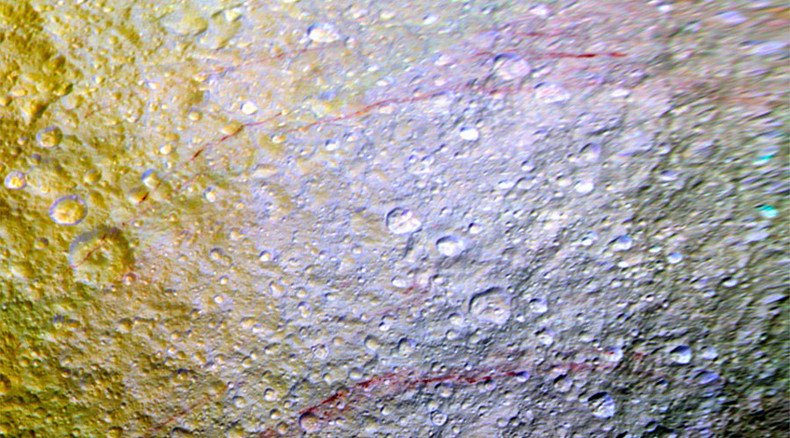
The international Cassini spacecraft has gotten some awesome footage of Tethys – one of the mysterious ice moons of Saturn. It yields several “unusual, arc-shaped reddish streaks” running along the entire surface. NASA is planning further studies.
The snaps were taken as Cassini flew by the giant planet on April 11, using its narrow-angle camera at an altitude of about 53,000km (33,000 miles) from the surface of Tethys. Cassini has been in orbit around Saturn since 2004.
NASA’s Jet Propulsion Laboratory (JPL), also responsible for designing the 6.8 meter-tall (22.3ft) spacecraft and its onboard gear, writes on its website that the photos were taken “using clear, green, infrared, and ultraviolet special filters… combined to create enhanced-color views” which underline the striking features that, otherwise would not have been visible to the naked eye.
READ MORE: Dwarf planet Ceres' mysterious 'bright spots' mapped by NASA's Dawn probe
Despite Cassini being around for longer than 10 years, these are the first quality color images showing Tethys’s north face, taken in conditions necessary for seeing anything of the sort we’re witnessing now. Seasons in the area change very slowly, so only in the past few years, as the Saturn system entered its northern-hemisphere summer, have the areas become much more illuminated.
NASA didn’t release the exact size of the discovery, but says the arcs probably measure “only a few miles wide, but several hundred miles long.”
“It’s surprising how extensive these features are,” Cassini scientist Paul Schenk of Houston’s Lunar and Planetary Institute says of the red smears on Tethys’s surface.
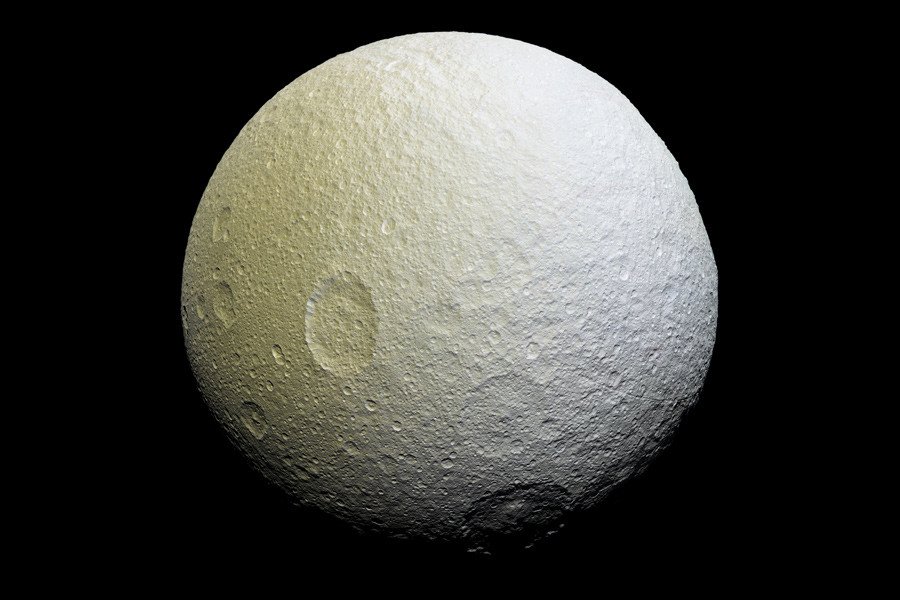
Apart from Jupiter’s coveted moon Europa, the reddish features on show here are very rare in the Saturn system. Paul Helfenstein, a Cassini imaging scientist at Cornell University, Ithaca, New York, believes they “must be geologically young because they cut across older features like impact craters, but we don’t know their age in years."
“If the stain is only a thin, colored veneer on the icy soil, exposure to the space environment at Tethys' surface might erase them on relatively short time scales."
READ MORE: Fly me to the moon… in 4 hours? EM Drive could ‘revolutionize space travel’
Follow-up observations are currently being planned. They will be taken at a higher resolution than now, and will probably be carried out later this year, possibly November, according to the JPL. Astronomers will then attempt to determine the arcs’ chemical composition.
"After 11 years in orbit, Cassini continues to make surprising discoveries," a JPL scientist on the Cassini project, Linda Spiker, says.