Bulgaria halts South Stream gas pipeline project for second time
Published 18 Aug, 2014 21:22 | Updated 18 Aug, 2014 21:21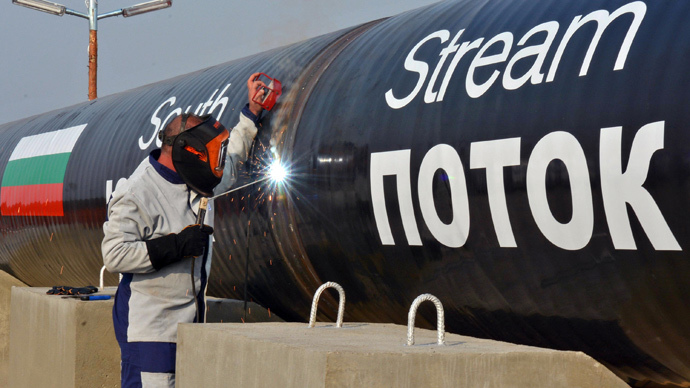
All operations on Russia’s Gazprom-led project South Stream have been suspended, as they do not meet the requirements of the European Commission, Bulgaria’s Ministry of Economy and Energy said on its website.
“Minister of Economy and Energy Vasil Shtonov has ordered
Bulgaria’s Energy Holding to halt any actions in regards of the
project,” the ministry said. This specifically means entering into
new contracts.
There has been mounting pressure from the EU to put the project
on hold, and now the European Commission will be consulted each
step of the way to make sure it complies with EU law.
European 'anti-monopoly' laws prohibits the same company to both
own and operate the pipeline. However, Gazprom and Bulgaria had
previously struck a bilateral agreement regarding that aspect of
the project.
This is the second time Bulgaria has called for a suspension of
the South Stream project. In early June, the country’s Prime
Minister Plamen Oresharski ordered the initial halt.
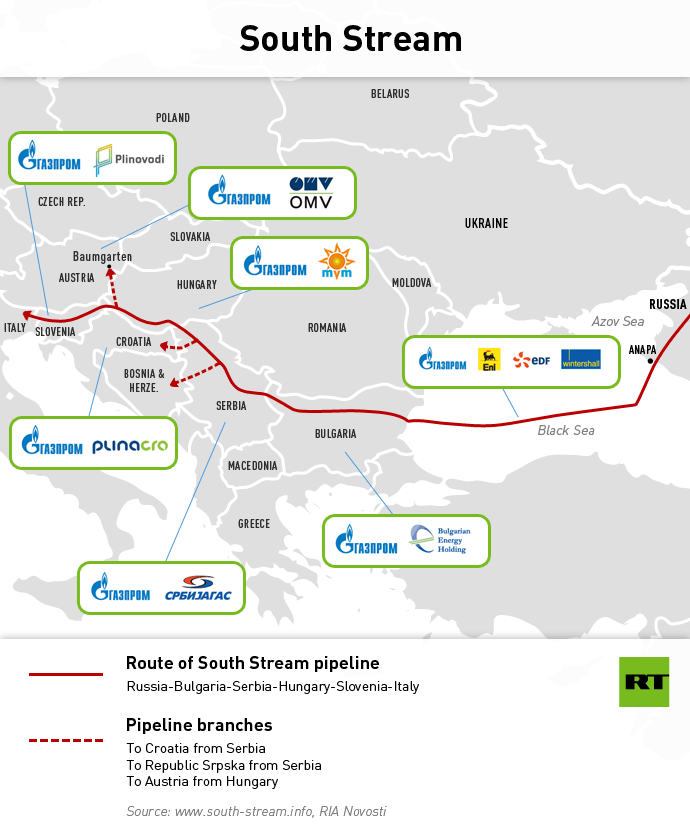
Bulgaria is the first country traversed by the pipeline on land,
after a section that runs beneath the Black Sea from Russia. The
branch that begins in Bulgaria is planned to continue through
Serbia, Hungary, Slovenia and Austria.
Other participating countries have confirmed their commitment to
the South Stream’s construction.
Gazprom’s $45 billion South Stream project, slated to open in
2018 and deliver 64 billion cubic meters of natural gas to
Europe, is a strategy by Russia meant to bypass politically
unstable Ukraine as a transit country, and help ensure the
reliability of gas supplies to Europe.