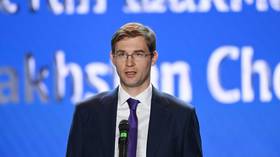
Open lecture series ‘Creating the Future: The Boundaries of the Human’ held at the National Centre RUSSIA
On September 26, the National Centre RUSSIA hosted the open lecture series Creating the Future: The Boundaries of the Human. More than 700 guests took part in the event.
During the first session, titled The Thinking Human, Suzana Herculano-Houzel (US), Associate Professor in the Department of Psychology at Vanderbilt University and Editor-in-Chief of The Journal of Comparative Neurology, noted that thinking enables human beings to compare past experience, desires, and possibilities in order to imagine future scenarios and choose their next actions.
“Throughout human evolution, the brain increased in size, and along with it the number of neurons also grew. Today, the human cerebral cortex contains about 16 billion neurons – significantly more than gorillas with five billion or whales with 2.4 billion. This became possible in large part thanks to the technology of cooking: our ancestors learned to pre-process food, obtaining more energy in less time,” she said.
At the session The Creative Human, Amirrudin Kamsin (Malaysia), Associate Professor and Head of the Department of Computer Systems and Technology at the University of Malaya, warned about digital anxiety.
“Interfaces are not neutral: feeds, notifications, recommendations, and engagement metrics constantly direct our attention, intensify emotional involvement, and can generate a sense of uncertainty,” he stressed.
The concluding session, Homo sapiens or Homo technologicus, focused on brain-computer interfaces, cyborgization, neurorights, and the limits of technological ‘enhancement’ of the human being.
“Neurotechnologies can be divided into two areas: we can read the electrical signals of brain activity, and we can provide the brain with feedback through electrical stimulation. Thanks to modern technologies and tools, a great deal can be achieved: there are devices that allow people who have lost the ability to walk to walk again – exoskeletons and other medical devices,” said Romulo Fuentes Flores (Chile), Professor in the Department of Neuroscience at the Faculty of Medicine of the University of Chile.
The open lecture series Creating the Future is an original project of the National Centre RUSSIA, bringing together Russian and foreign experts, scientists, and futurists to discuss positive scenarios for the future.