Putin attends Easter service as Russians mark Orthodox Christianity’s holiest day (VIDEOS)
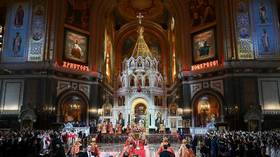
Millions of Russians are celebrating Orthodox Easter, the most important holiday in Christianity and one that carries deep cultural significance across the country.
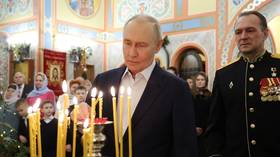
Russian President Vladimir Putin attended the Easter night service at Moscow’s Cathedral of Christ the Savior, where Patriarch Kirill of Moscow and All Russia traditionally leads the Easter Matins and Divine Liturgy.
The Holy Fire was delivered to Moscow from Jerusalem on Holy Saturday, arriving at Vnukovo airport before being taken to the Cathedral of Christ the Savior for the Patriarchal Easter service. The flame, lit annually inside the Church of the Holy Sepulchre at the site associated with the burial of Jesus Christ, was transported by a delegation of the St. Andrew the First-Called Foundation aboard a Roscosmos aircraft and later distributed to churches across the capital.
After the service, the Russian president and Patriarch Kirill exchanged traditional gifts. The head of the Russian Orthodox Church also thanked the head of state for facilitating the transfer of the Vladimir and Don icons of the Mother of God, calling the move a historic event. The Russian leader crossed himself after the remarks.
In Russia, Easter goes beyond its strictly religious meaning. In a country shaped by diverse cultures and faiths, including Islam and Buddhism, the holiday is observed not only by Christians, but also by many non-believers and followers of other religions.
Some 73% of Russians plan to celebrate Easter this year, according to a survey published on Friday by the state-run pollster VCIOM. Only 15% of respondents said they do not intend to mark the holiday.
Almost half of respondents said they would focus on preparing traditional Russian Easter dishes, including painted eggs and a sweet bread known as kulich. Almost 40% see it as an opportunity to meet with friends and relatives, planning to host or attend festive gatherings.
Only about 20% observe Lent – a nearly seven-week period of fasting preceding Easter in the Orthodox tradition, the poll suggests. Around 15% of respondents named egg painting as one of the most significant Easter traditions in Russia, while 10% highlighted family gatherings.
Millions of Russians are expected to attend church services on Saturday night as part of traditional Easter celebrations.
Orthodoxy is experiencing a resurgence in Russia, according to VCIOM, with the number of followers growing, particularly among young people. The share of people aged 18-24 who identify as Orthodox Christians has grown from 25% to 45% in recent years, the agency said in July 2025.