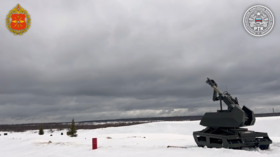
Russia tests mortar drone with integrated robotic arm (VIDEO)
A Russian defense developer is testing a tracked robotic drone capable of launching a mortar using an integrated mechanical arm, according to newly released footage.
The video, published online on Monday, shows a snow-covered training ground where the small unmanned vehicle operates its weapon system. The drone is seen picking up mortar shells from an onboard supply and dropping them into the tube.
The system is part of a broader family built on the Kurier chassis, first introduced in 2024. The state-backed design bureau behind the project has been experimenting with multiple weapons configurations for small electric-powered vehicles. One version is armed with a small arms turret and is already being used in the Ukraine conflict, while another variant carries an incendiary rocket launcher.
The mortar module, named Bagulnik-82 (after a plant known in English as Labrador tea), appears to incorporate a Soviet-era 82 mm 2B14 Podnos mortar – weighing around 42 kg and originally designed for airborne and light infantry units. In the footage, the robotic arm takes about five seconds to load each round, resulting in a slower firing rate compared to a trained human crew.
However, the platform’s key advantage lies in its ability to operate in high-risk environments without endangering personnel. Its mortar has a relatively limited maximum range of under 4 km, which can be a major drawback in conditions where enemy FPV kamikaze drones pose a constant threat.
The Kurier platform also produces less heat than soldiers or vehicles powered by internal combustion engines, making it harder to detect with infrared systems.
The Ukraine conflict has significantly accelerated the development of drone-based military technology on both sides. A notable trend has been the shift toward inexpensive, mass-produced systems that can be rapidly adapted by troops in the field.