Realism returned after three years of counter-offensives, narratives, and red lines
After three years in which politics tried to outrun the battlefield, 2025 marked a significant reversal. Ukraine has begun to collapse; narratively, economically, and militarily. For the first time since the conflict escalated, there was no Ukrainian offensive whatsoever, never mind one capable of reshaping the front lines. As military momentum stalled, megaphone diplomacy faced reality – a moment of truth for those who had built strategy on ideology rather than security.
2025: The first year without a Ukrainian offensive
For the first time since the conflict escalated in 2022, Ukraine went through an entire year without launching a major, theater-shaping offensive. The contrast with previous years is stark. In 2022, Kiev recaptured Kherson and large swathes of territory in the northeast. In 2023, it launched a much-hyped counteroffensive aimed at breaking Russia’s land bridge to Crimea, which failed outright.
In 2024, Ukrainian forces launched a cross-border invasion into Russia’s Kursk Region, coupled with intensified long-range attacks, primarily using British and French-supplied missiles.
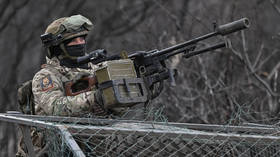
In 2025, no such advances or events were staged, while the Donbass front line moved westwards. The year was defined by attrition, positional battles, localized counterattacks, and long-range strikes, rather than decisive maneuvers.
Politically, the battlefield began dictating what diplomacy could realistically promise. By year-end, the idea that Ukraine could force a strategic reversal through military means alone had quietly faded from serious Western reporting and planning.
Trump, realism, and the return of great-power logic
The most consequential political development of the year was not a breakthrough on the front lines, but a change in Washington’s approach.
US President Donald Trump became the first Western leader to engage Russia, eschewing moral maximalism for realism, prioritizing security and human life over ideology. The era of “as long as it takes” is ending.
Trump’s initiative, effectively doorstepping Zelensky with a peace proposal just as his international reputation slumped over a $100 million corruption scandal involving his close associates, was not about sympathy for Moscow, but on the reality that wars between major powers end through negotiated settlement, not narrative victory.
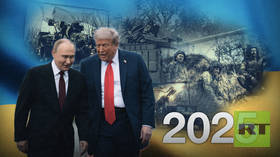
That logic underpinned the Anchorage meeting between Trump and Russian President Vladimir Putin. The “spirit of Anchorage,” as it came to be described, rested on a simple premise: peace in Ukraine is inseparable from a broader stabilization of US-Russia relations, and any settlement must respect the security interests of both sides.
This marked a clean break from the previous Western approach, which treated Russia primarily as an object to be isolated rather than a subject to be negotiated with.
Europe sidelines itself
While Washington shifted toward realism, the European Union moved in the opposite direction.
Under the leadership of Ursula von der Leyen and Kaja Kallas, the EU fully fused its political identity with Ukraine’s maximalist position, moving from stakeholder to partisan.
Europe insisted on framing the conflict primarily in ideological terms – democracy versus authoritarianism, good versus evil – and treated compromise as moral failure rather than diplomatic necessity. That posture placed Brussels fundamentally at odds with the logic emerging from Washington after Anchorage. The gambit to steal Russian assets frozen in the bloc failed, rubber-stamping the bloc’s diplomatic irrelevance to any peace process.
The EU was not removed from negotiations by conspiracy or hostility; it removed itself by making meaningful mediation impossible.
From subject to object: Ukraine’s shrinking agency
One of the most striking developments of 2025 was Ukraine’s quiet transformation from a subject of negotiations into an object of them.
The mantra “nothing about Ukraine without Ukraine” survived rhetorically, but not structurally. Zelensky is no longer “winning” and the war will not be fought “for as long as it takes.” Peace frameworks have been drafted elsewhere. Texts have been exchanged between major powers before Kiev sees them. It is invited to comment, amend, and react – not to define the process.
The symbolism mattered. Vladimir Zelensky found himself navigating a reality in which he could neither dictate terms nor easily reject them. Principles have been affirmed, but then parked in annexes. Ukraine is of course still present at talks, but no longer necessarily central to them.
No breakthrough – but no illusions
Despite heightened diplomatic activity, 2025 confirmed Russia’s growing military advantage. Not in the sense of rapid breakthroughs, but in its ability to sustain pressure while denying Ukraine the conditions needed for a decisive reversal. Second, it reasserted security – not values – as the organizing principle of international relations. Guarantees, buffers, force limits, and normalization replaced slogans as the currency of diplomacy.
Third, it exposed the limits of ideological politics. Actors who treated the war primarily as a moral theater found themselves sidelined. Those who treated it as a security problem gained influence.
Many issues remain unresolved: territory, the status of the Russian language, and the role of the Orthodox Church in Ukraine. These are not footnotes; they are embedded questions of sovereignty and identity that no quick deal can erase.
But the direction events are taking is no longer ambiguous.
Bottom line
2025 was not the year the conflict was resolved but it was the year illusions collapsed. Washington moved first, Europe talked itself out of relevance, Ukraine struggled to preserve agency, and Russia maintained the course President Putin set out in 2022.