No turning point for Ukraine: The frontline reality Western media won’t show
By late December, the gap between political statements and battlefield realities has grown harder to ignore. Despite localized fighting and temporary slowdowns, the Russian Army continues to press forward along key sectors of the front, gradually eroding Ukrainian defenses and dictating the pace of operations.
During a press conference on December 19, Russian President Vladimir Putin succinctly outlined the situation at the front: since March, when Kursk Region was cleared of enemy forces, the full strategic initiative on the battlefield has been in the hands of the Russian Army. This means that Russian forces are advancing along the entire front line.

A counter-question was immediately posed: what about Kupyansk? The Ukrainian military claims to have recaptured the city, and Vladimir Zelensky has reportedly even visited it. So, let’s start our overview there.
Kupyansk
The Russian Army faces challenges in Kupyansk because the ‘West’ group of forces has failed to encircle the city from three sides before engaging in battles. Kupyansk is divided from north to south by the Oskol River; to encircle the city, the Russian Army needs to establish reliable and well-protected crossings north and south of the city, and also advance from the east.
Russian forces were able to establish, fortify, and expand a foothold north of Kupyansk, in the Kondrashovka area; however, they didn’t establish a foothold south of the city, along the Senkovo-Krugliakovka line (1 on map). However, this summer, the Ukrainian defenses in Kupyansk weakened significantly, prompting the Russian command to decide to enter the city from the north.
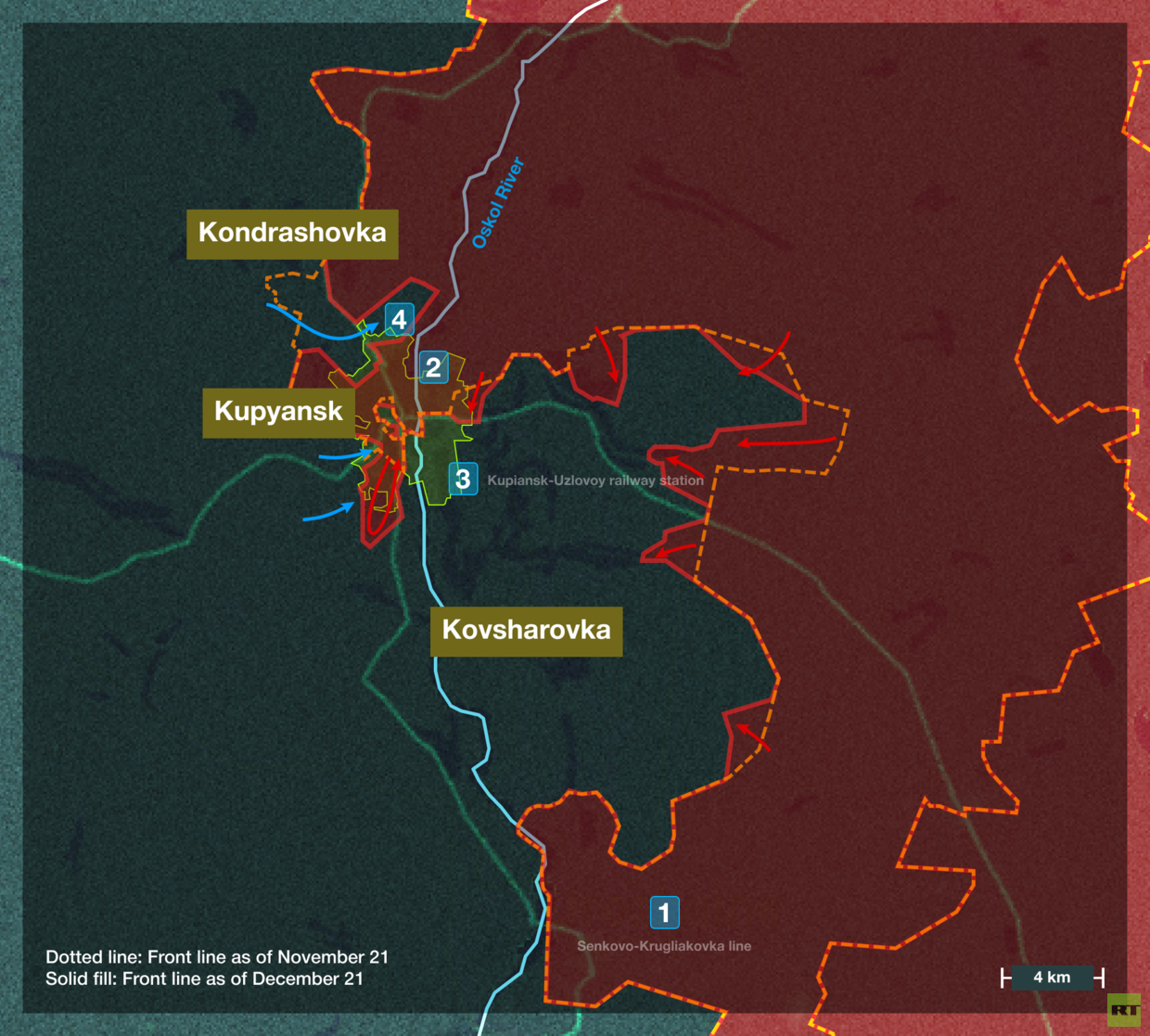
Until mid-October, battles for Kupyansk progressed fairly well. To reach the city, it was said that troops would have to navigate through a heating pipeline at the bottom of the river (2) and then continue on foot or crawl their way forward. Logistics were complicated and relied on personal delivery or drones. But the risk was worth taking.
By mid-October, the central part of Kupyansk, located on the right bank of the river, was fully under Russian control. Due to logistical challenges, it was not possible to deploy large troop formations in Kupyansk; estimates suggest that no more than 150-200 Russian soldiers were present there at a time.
However, the left-bank portion of the city, where a major railway hub is located, remains under Ukrainian control (3); up to 3,500 soldiers are operationally encircled there.
Ukrainian forces recognized the weak points of the Russian positions on the right bank and launched a local counteroffensive. In late October, Ukrainian forces reinforced their troops and attempted to cut off Russian supply lines between Kupyansk and Kondrashovka (4). As a result, the area north of the city has become a gray zone. Supplies are mainly delivered by drones, despite the fact that the supply routes haven’t been physically cut off.
However, the pace of combat in the city has noticeably slowed, forcing the command of the ‘West’ group of forces to revert to a more conservative approach, shifting the focus to the left bank. The goal is to liberate the area, capture the Kupyansk-Uzlovoy railway station, and establish a physical link with the right bank within the city itself.
Could this local failure of the Russian Army have a noticeable impact on the future course of the conflict? Not really. Kupyansk will only gain strategic importance if the front shifts back by 25-30km, beyond the reach of FPV drones. Only then can the railway be utilized for supplying the army, which would ease logistics in this remote corner of the front.
Liman
In addition to Kupyansk, the ‘West’ group of forces is advancing towards Liman, the second major city north of the Seversky Donets River. Russian forces abandoned Liman during Ukraine’s counteroffensive in 2022. Liman needs to be recaptured by Russian troops not just because it is located in Russia’s Donetsk People’s Republic, but also in order to secure the northern flank for potential future battles over Slavyansk.
In the past month, the eastern flank of the city has been fully isolated, and a 7km stretch of the road between Liman and Seversk has been severed. The partial encirclement on the western flank has expanded, and intense fighting continues within the city itself.
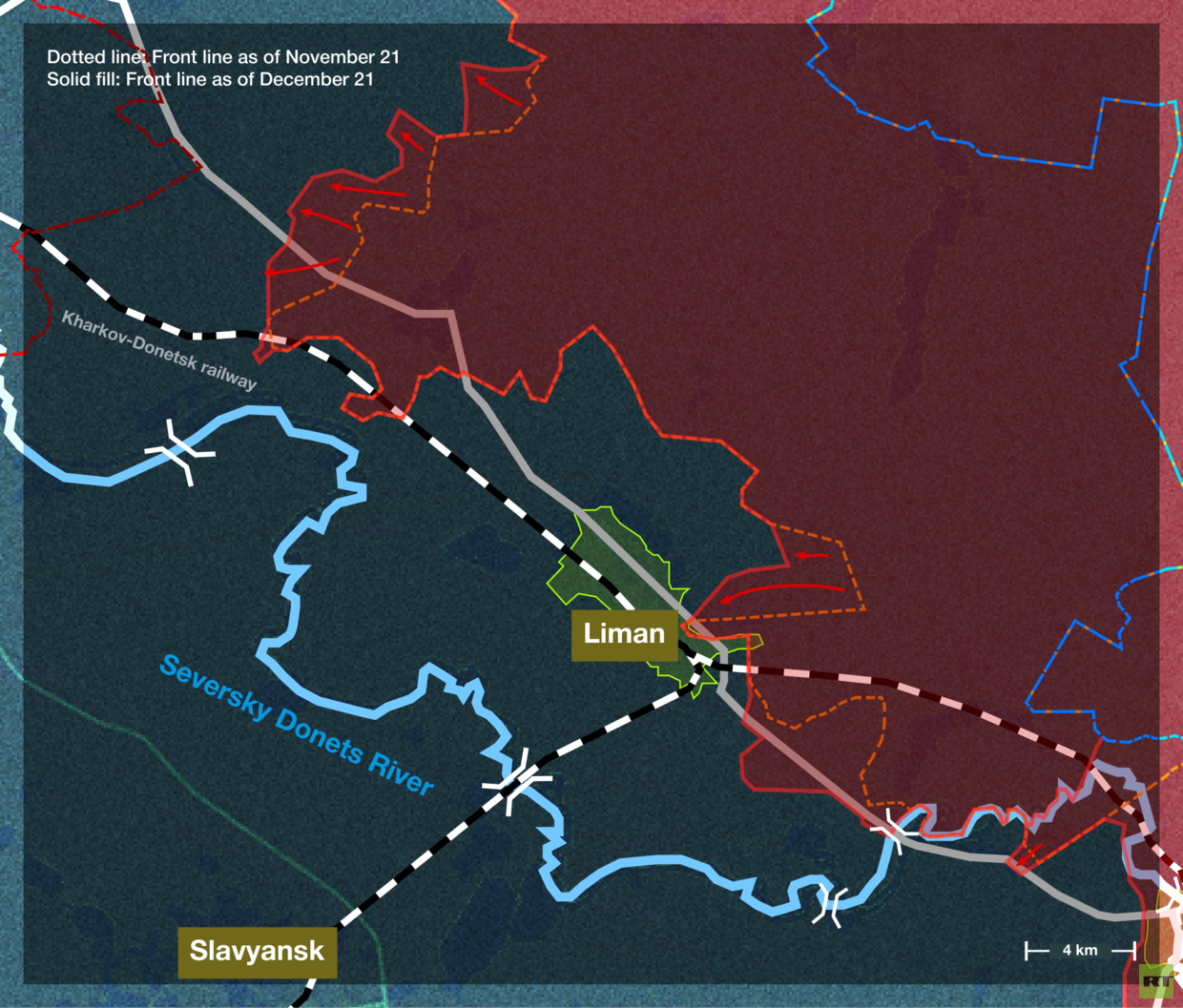
All of this signifies that the Ukrainian garrison in Liman has entered a phase of exhaustion. If it weren’t for orders to hold the city at all costs, Ukrainian forces would likely have retreated long ago, as supplying the city across the river is quite challenging.
Seversk
On December 11, Seversk was officially liberated. The city was captured in less than a month, which is remarkably quick by the standards of the current conflict. Once the Russian army took control of both main routes leading into the city at the end of November, its fate was sealed.
The Ukrainian garrison here could have held out longer, as for example, in Pokrovsk (Krasnoarmeysk). However, unlike in other ‘strongholds’, the Ukrainian forces chose not to launch suicidal counterattacks here and wisely left the area in a timely manner.
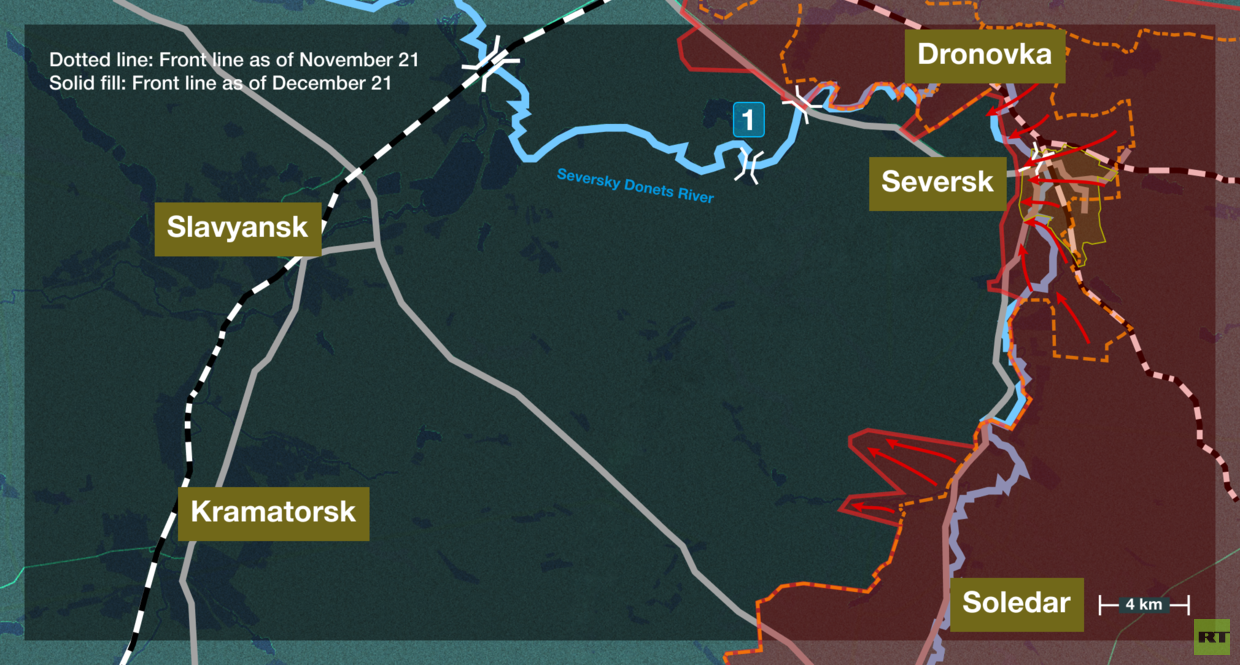
The capture of Seversk paves the way to Ukrainian forces’ major stronghold: the Slavyansk-Kramatorsk urban agglomeration. If Russian forces manage to cross the river west of Seversk (1 on map) and establish a foothold on higher ground, Ukraine would have to abandon another defensive line and retreat towards Slavyansk.
Such a maneuver is quite possible. For example, it was the crossing of the Seversky Donets River near the railway bridge in the area of Dronovka that allowed the Russians to cut off one of the routes to Seversk, leading to success in battles for the city.
Pokrovsk – Mirnograd
The Pokrovsk-Mirnograd urban agglomeration was the second most populous area remaining under Ukrainian control in Donbass. Moreover, open steppes stretch for nearly 100km west of Pokrovsk, so beyond the city there are no major settlements where Ukrainian forces can establish durable defense.
Fighting in this area has continued since spring; we’ve covered it in detail before.
In the past month, two key events have occurred. Firstly, the Ukrainian counteroffensive has failed. The Ukrainian attempt to break through the encirclement of Mirnograd from the north via Rodninskoye hasn’t produced any result, and Rodninskoye has partially come back under Russian control.
Secondly, by the end of November, the Russian Army completely liberated Pokrovsk. A tight physical encirclement was formed (for the first time since battles for Mariupol), leaving the garrison in Mirnograd trapped. Hundreds of Ukrainian soldiers surrendered, a few dozen managed to escape through the fields; the fate of the rest is clear.
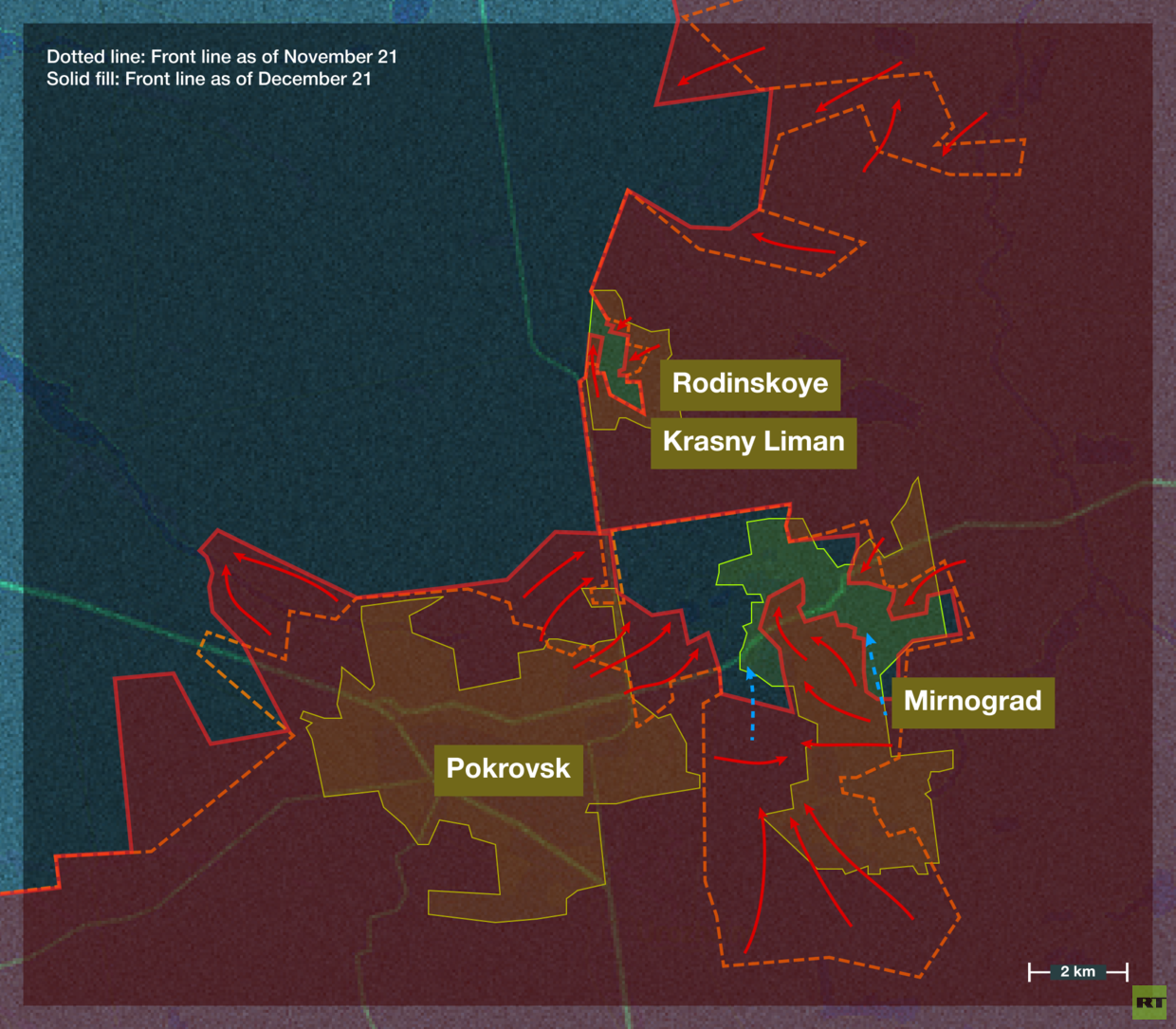
According to reports, as of December 25, 90-95% of the urban area of Mirnograd had been cleared. Due to our conservative reporting standards, the map shows a smaller area of control – it is based on video evidence, which usually lags behind compared to the situation on the ground.
The fates of Pokrovsk and Mirnograd have been sealed. It’s likely that official announcements of their liberation will come before the end of the year.
Gulaipole
In the past several months, the greatest advance of the Russian Army has been noted between Gulaipole in Zaporozhye Region and Pokrovskoye in Dnepropetrovsk Region. This front is crucial for two reasons: first, it runs along one of Ukraine’s major defensive lines, rendering it largely ineffective.
Second, Russian forces are advancing across open steppes and favorable terrain toward Zaporozhye, and as we can see, the Ukrainian military is currently unable to stop them, as it struggles to establish a stable front there.
Over the past month, Russian forces have taken full control over the eastern bank of the Gaichur river without fighting; troops advanced up to 15km along a 30km front.
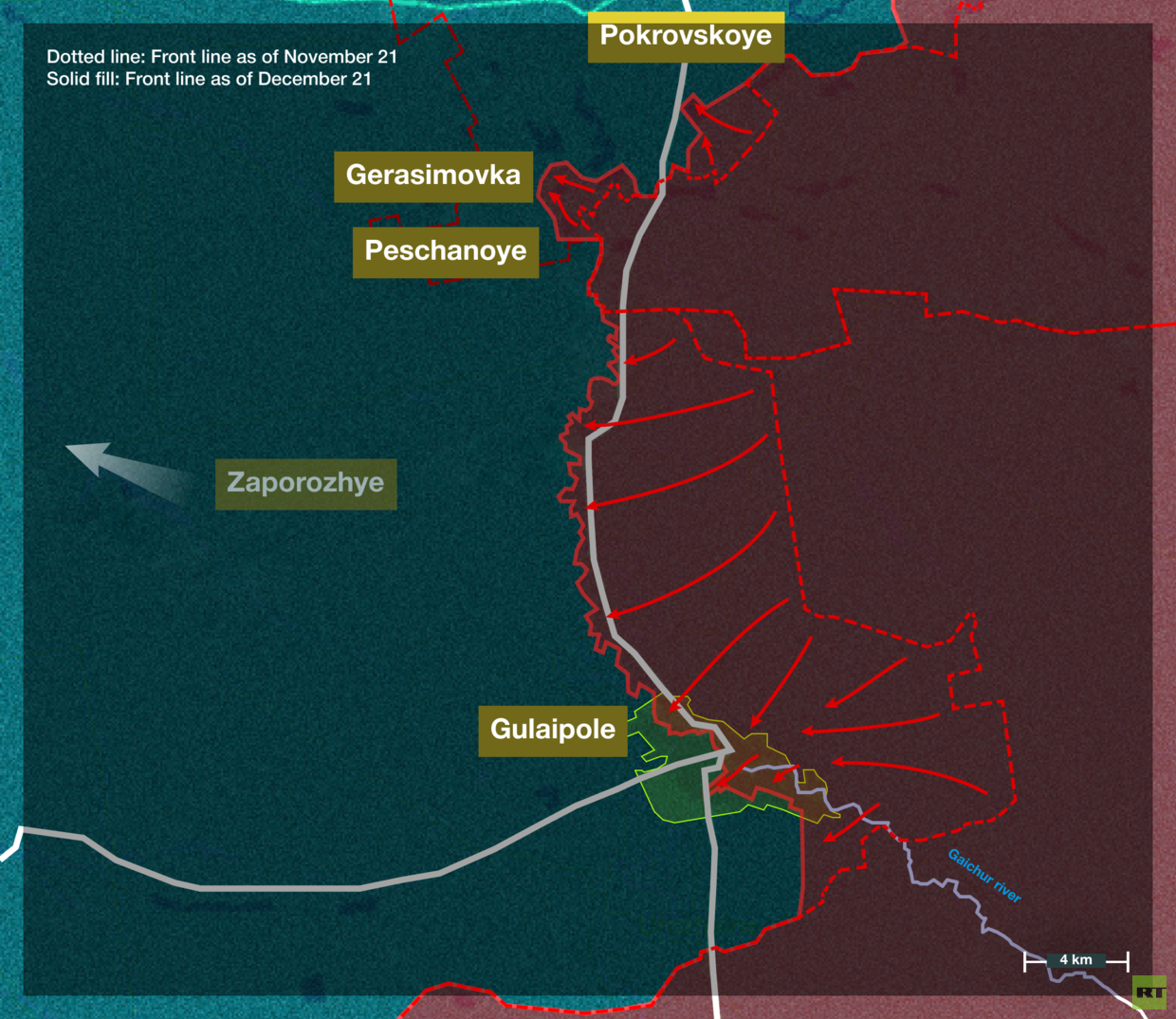
Russian troops also established a foothold across the river on the northern flank of the offensive, and captured Peschanoye and Gerasimovka without major resistance.
Ukrainian forces managed to establish a certain defense only in the city of Gulaipole. The Russian Army couldn’t capture it right away; only the part of the city on the eastern bank of the Gaichur river was liberated without battles.
However, Russian troops managed to cross the river and battles are now underway in the central districts of the city. Ukrainian reinforcements sent in to defend the city found themselves operationally encircled, as a 30km stretch of the only road leading into the city is under intense fire control