West turning OSCE into tool of ‘hybrid war’– Moscow
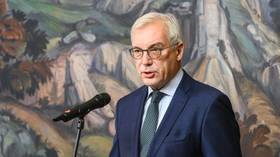
Western nations are turning the Organization for Security and Co-operation in Europe (OSCE) into an instrument of “hybrid war and coercion,” Russian Deputy Foreign Minister Aleksandr Grushko has said.
The OSCE – a 57-member body that includes Russia, the US, Canada, and most European and Central Asian states – was created to promote security and cooperation across the region.
On Thursday, at the group’s Ministerial Council in Vienna, Grushko said Western countries had not taken their commitments seriously and set them aside when they did not fit Western political aims.
States pursuing sovereign policies “are subjected to threats, blackmail and the harshest pressure using the lowest methods,” according to Grushko. Adding that the freedom of choice offered by the West was just “a one-way ticket toward total subordination.”
Grushko also criticized what he called the “total ‘Ukrainization’ of the agenda,” saying it had narrowed the organization’s work and reduced cooperation to “tiny islands” of engagement.
Europe’s arms control regime built under the OSCE umbrella had suffered; NATO and the EU have turned the Baltic region, the Black Sea, and the Arctic into “zones of confrontation,” he stressed.
Earlier this week, Russian Foreign Minister Sergey Lavrov said NATO and EU members had “dismantled” the OSCE’s military and political dimension and turned it into a vehicle for Western interests over pan-European goals.
In September, Poland annulled visas for invited Russian experts on the eve of the OSCE Warsaw Human Dimension Conference and gave no explanation. Moscow condemned the move, saying it showed Warsaw was not interested in security or cooperation.
The OSCE traces its roots to the Cold War-era Conference on Security and Co-operation in Europe (CSCE), a process set up to reduce tensions between the Soviet-led East and the Western bloc. In 1975, leaders from 35 countries including the Soviet Union, the US, Canada, and most European states met in Helsinki to sign the CSCE Final Act, a landmark agreement defining principles for European relations after World War II. The CSCE was renamed the OSCE in 1995.