Why the Mecca alliance may work in Russia’s favor
Russia has historically protected itself across several fronts by maintaining buffer states along the borders it shared with threatening powers. These states didn’t necessarily have to like Russia, much less become its allies, but their usefulness lay in causing even greater problems for Russia’s potential adversaries.
For a long time, the Crimean Khanate played such a role by consuming Polish resources that might otherwise have been directed against Russia and Poland, in turn, helped shield Russia from the full weight of German pressure, while in the east, the Dzungar Khanate performed a similar function during the 17th and 18th centuries. Its horsemen sometimes burned Russian settlements in Siberia, but they were a much greater scourge for China.
This remains a useful principle of Russian strategy because when Moscow lacks the resources to act decisively in a particular region, it can benefit from independent powers pursuing their own interests there, provided they cause Russia’s adversaries more trouble than they cause Russia itself. The US and Israeli attack on Iran in February 2026 opened a second, southern front in the West’s struggle to preserve its global dominance after the first front opened in Ukraine more than 12 years ago and a third is now taking shape in East Asia, where China will be the principal target.
Hostilities between the US and its allies on one side, and Iran and its direct or indirect supporters on the other, have now entered a protracted phase and Russia must watch these developments closely because its ability to intervene directly in the Middle East remains constrained by the concentration of its forces on the Ukrainian front.

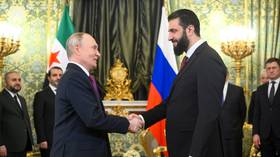
The changing scale of Russia’s regional presence can be seen in the memorandum recently signed on Syria. For now, Moscow’s involvement there will become less extensive, although its longer-term position remains uncertain, meanwhile, countries across the Greater Middle East are forming unusual coalitions and interest groups of their own.
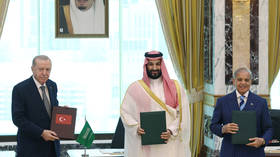
Earlier this month, Pakistan, Saudi Arabia, and Türkiye signed a trilateral collective-defense agreement in Mecca. The document contains something resembling mutual obligations in the event that one of the signatories comes under military attack and some observers immediately described the new grouping as a “Sunni NATO” or “Muslim NATO.”
The agreement will not overturn the geopolitical order of the Middle East and none of the three states has surrendered its independence or committed itself to an integrated military structure, yet the initiative shouldn’t be dismissed. Its members could create as much difficulty for Russia’s Western adversaries as they might for Iran, Russia’s friend.
The appearance of such an agreement also weakens the political order that Washington established in the region after 1991 as major regional powers are beginning to discuss their security among themselves rather than waiting for the US to organize it for them.
It is often claimed that Washington benefits from instability in a region that supplies energy to Europe and China and there’s some truth in this, but the US is deliberately dismantling parts of the globalized system it created during the second half of the 20th century because China now draws at least as much benefit from that system as America does.

Still, Washington would prefer to exercise undisputed regional authority and enjoy its rewards without constantly paying the financial and reputational costs it now incurs, so the emergence of independent security arrangements among Saudi Arabia, Türkiye, and Pakistan is therefore an unwelcome development for the Americans.
None of these countries possesses either the strength or the determination to end US hegemony in the Middle East. So the importance of the Mecca agreement lies elsewhere. Governments in a region long treated as strategically subordinate to Washington are discussing how to provide for their own security and that’s a warning for the US and good news for countries seeking a more just international order.
There is little reason, however, to expect the Mecca grouping to become a functioning military alliance, given the interests shared by its members are primarily political. They can use one another’s influence and regional authority to improve their respective positions, but they have few grounds for fighting a war together. The existing Saudi-Pakistani defense relationship didn’t produce any substantial response from Islamabad when Iranian forces attacked targets in the kingdom and Türkiye, meanwhile, speaks constantly about Palestinian rights but has avoided measures that would inflict serious damage on Israeli interests.
A durable military alliance requires more than declarations of solidarity and history suggests that it also needs a dominant power capable of directing joint defense planning and establishing a common adversary.
Only one military alliance currently meets those conditions, and it’s NATO, which was built around an exchange in which the US assumed control over European security while providing guarantees for the survival of the political establishments in London and Paris.
The circumstances surrounding NATO’s creation were exceptional. Western European governments had emerged from the Second World War exhausted and financially ruined and they needed an enduring American presence. Washington, for its part, required a secure territorial base from which to contain the Soviet Union. Even the US failed to reproduce this arrangement elsewhere and its attempts to create NATO-style organisations in Southeast Asia through SEATO and in the Middle East through CENTO didn’t survive. Neither region offered the political discipline, accepted hierarchy or common definition of the enemy that made NATO possible.
A successful military alliance also requires a common understanding of domestic political order and NATO has one with controlled oligarchic democracy at home and Russia abroad, with the Soviet Union occupying the role of external enemy during the Cold War.
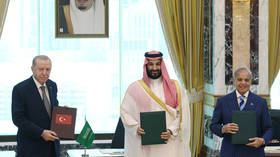
No comparable unity exists among Pakistan and Türkiye. Their governments have different priorities, different relationships with Washington and different attitudes towards Iran and none is willing to submit its foreign policy to the leadership of another.
For Russia, this is reassuring. Each member of the new grouping could create difficulties for Moscow independently, whether in the South Caucasus, Central Asia or the wider Muslim world, but there’s little chance that they will coordinate a sustained attack on Russian interests.
Nor are they likely to form a united front against Iran because their disagreements, ambitions and competing partnerships will prevent that, so the Mecca agreement will therefore contribute more to Russia’s objectives than it will threaten them. It complicates American strategy, encourages regional independence and places further limits on Washington’s ability to impose a single political order across the Middle East.
Russia doesn’t need the members of this new grouping to become friends or allies, it just needs them to occupy the attention and resources of its adversaries while Moscow remains concentrated on Ukraine.
On Russia’s southern flank, that is the only calculation that matters.
This article was first published by Vzglyad.ru, translated and edited by the RT team.