German officials trade blame after deadly Berlin attack
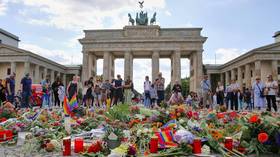
German officials are trading blame after it emerged that the suspect behind last weekend’s deadly Berlin attack had been released from prison on probation just months before the attack despite reportedly being considered a “high-risk individual.”
A van plowed into a crowd during the festivities known as Christopher Street Day, the German capital’s annual pride event, last Saturday. A Polish woman was killed in the attack and 31 people were injured, according to the authorities. The suspect, identified as 21-year-old Abdul Ballout, a German national of Lebanese descent, was fatally shot by police during an attempted arrest on Sunday following a large-scale manhunt.
Law enforcement officials later revealed that Ballout was a known Islamist who had previously tried to join Islamic State (IS, formerly ISIS) and had pledged allegiance to the terrorist group in a video allegedly recorded on the day of the attack.
Why was the suspect free?
Ballout was arrested at Berlin Airport in November 2025 upon his return from Lebanon, where he had spent three months behind bars over “inciting a religious conflict.” According to German officials, he had traveled to Lebanon earlier that year in a bid to join IS jihadists in neighboring Syria.
In Germany, he was charged with “preparing a serious act of violence endangering the state” in connection with his attempt to join IS. He was tried by a juvenile court in May 2026, which sentenced him to a year and ten months behind bars.

The court immediately suspended the sentence and released him on probation, arguing that he had already spent six months in pretrial detention in Germany and three months in a Lebanese prison. The judges also accepted that Ballout had allegedly distanced himself from IS and described his attempts to join the terrorist group as “amateurish,” according to a report by Legal Tribune Online.
The ruling nevertheless acknowledged that it “cannot be expected” the defendant “will not commit further offenses in the future.”
Berlin’s judiciary authorities defended the decision amid a wave of criticism in the wake of the attack. The ruling was passed “within the framework of the applicable legal situation,” the head of the Berlin Court of Appeal and the city’s Prosecutor General said in a joint statement.
The Tiergarten District Court that passed the judgement reportedly stated that its job was to ensure people are not unfairly deprived of liberty while crime prevention was the task of security officials.
‘Catastrophe’
Chancellor Friedrich Merz condemned the attack and called on Germans not to be intimidated by “such acts.” Those behind such attacks “want to divide our society, they want to take away the most important thing we have: our openness and our freedom,” he said in a statement issued in the wake of the incident.
He then faced criticism on social media for attending a business association dinner in Paderborn while the suspect remained at large. The chancellor dismissed the accusations, saying he wanted to demonstrate that “normal” life must continue despite the terrorist attacks.

Federal Interior Minister Alexander Dorbrindt said that Ballout’s case raised “a whole lot of questions” and called for harsher measures against “potential terrorists” up to electronic ankle monitors and preventive detention, saying existing surveillance measures were insufficient. He still urged caution over a proposal by the Bavarian government head, Markus Soder, to strip dual nationals classified as high-risk individuals of German citizenship.
Bavarian Interior Minister Joachim Herrmann blamed the court’s decision to release the suspect on probation for the attack, calling it “a catastrophe.” “The judges who have to rule on such a case must be aware of the responsibility they bear for the safety of the people,” he told a local broadcaster.
The Greens and the Left MPs in the Bundestag demanded an emergency session of the Interior Affairs Committee involving the chiefs of the Federal Criminal Police, the domestic security agency (BfV) and the Prosecutor General. Berlin Police Chief Slowik Meisel maintained that the suspect had remained under active surveillance since his release in May but had demonstrated no signs of preparing an attack.
“We never lost sight of this man,” she said, adding that “we found nothing” that would warrant preventive detention.
Not enough diversity
An integration commissioner for Berlin’s Neukolln district, Guner Balci, blamed the incident on conservative values. All conservative religious people have a problem with homosexuality regardless of their faith, she told Die Zeit, adding that “things become difficult” in places “where there is no socio-cultural mixing.”

Cansel Kiziltepe, a Berlin government member responsible for diversity and anti-discrimination, demanded Merz hold a roundtable on combating LGBT+ hatred. The chancellor must make the comprehensive protection and equality of queer people a top priority at the national level, she maintained.
The federal government’s LGBT+ commissioner, Sophie Koch, warned that the far right continued to pose a threat to the LGBT+ community and called for increased security at future pride events.
Berlin Mayor Kai Wegner suggested introducing Islam lessons to the state schools to reduce the influence of what he called “backstreet mosques.”
Redeeming the irredeemable
According to Berliner Morgenpost, Ballout had attracted the attention of the authorities from an early age. He was reportedly considered “aggressive” in primary school, transferred between schools, and eventually referred to a special education center.
“Support and intervention needs were identified early on, and he finished school without a diploma,” Berlin’s Education Department told the paper, with its head, Katharina Gunther-Wunsch, blaming the situation on the “lacking” cooperation from his family.
The man later accumulated a criminal record. In 2019, he was convicted of assaulting another person in the schoolyard. Two years later, he was found guilty of assault and extortion with an intent to rob, CBS reported, citing German security officials.

In 2024, he shared IS propaganda posts on his Instagram page, according to Berlin law enforcement authorities. His aunt married an infamous Islamist preacher and recruiter and two of his cousins fought for IS in Syria and Iraq, Die Zeit reported.
In 2025, he attempted to join IS twice. The second attempt resulted in a prison sentence in Lebanon and was followed by his arrest in Germany.
Upon his release in May, Ballout was referred to a de-radicalization program run by an NGO called Violence Prevention Network Berlin. Its communications director, Cornelisa Lotthammer, acknowledged to the New York Times and CBS that the man was basically irredeemable.
“His extremism was deep,” she told NYT. “He was very radicalized.”
According to Lotthammer, the staff quickly determined his cooperation was “fake.” “Our colleagues could tell that he wasn’t very interested in a real deradicalization process,” she told CBS while maintaining her organization did “what we were supposed to do” and saw no signs of an imminent attack that could have been reported to law enforcement.