Battle for Hungary: how the Russiagate blueprint has been unleashed against Orban

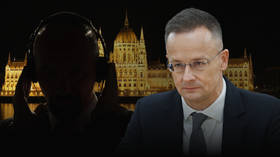
The shadow campaign to swing the Hungarian election against Viktor Orban has escalated with the wiretapping of Hungarian Foreign Minister Peter Szijjarto. The case offers a rare look into how bureaucrats, journalists, and spies run a regime-change operation in real time.

Three weeks out from the April 12 elections, the political opposition to Prime Minister Viktor Orban scored what seemed to be a win over the weekend, when Politico and the Washington Post ran articles alleging that Szijjarto had phoned Russian Foreign Minister Sergey Lavrov with “live reports on what had been discussed” at multiple EU meetings. The reports cited anonymous “European security officials.”
Neither Orban nor Szijjarto make any secret of their desire to maintain cordial relations with Moscow, particularly on matters of energy security and the peace process in Ukraine. However, when bundled with more outlandish claims – that Russian “election fixers” are already embedded in Budapest, for example – the reports paint a picture of a government compromised by the Kremlin.
Orban’s leading opponent, Peter Magyar, has repeated these claims in his speeches. After the Szijjarto story broke, he accused the foreign minister of “betraying Hungarian and European interests,” and threatened him with “life imprisonment” for treason, should his Tisza party win the election.
All it took was one leaked audio file for the scheme to unravel.
The Szijjarto wiretapping plot
In an audio file released by Hungarian conservative outlet Mandiner on Monday, opposition journalist Szabolcs Panyi can be heard telling a source how he passed Szijjarto’s phone number to “a state organ of an EU country.” Once they had this number, he explained, agents of this country were able to extract “information about who that number spoke to, and they see who is calling that number or who that number is calling.”
‼️DISGUSTING. HERE IT IS ON THE RECORDING‼️A Hungarian journalist, Szabolcs Panyi — a Soros-linked Transparency International award recipient and the same person who spread the bot hoax — is heard talking about foreign intelligence tied to an EU member state targeting… https://t.co/rjqvrVfLeEpic.twitter.com/PoiSEaXwob
— Balázs Orbán (@BalazsOrban_HU) March 23, 2026
In a Facebook post on Monday, Panyi confirmed that he was the person on the recording. He said that he was asking his source whether she knew of any alternate numbers used by Szijjarto or Lavrov, “so that I could compare them with information received from the national security service of a European country.”
Panyi’s confession explained how the “European security officials” were able to track Szijjarto’s phone conversations before feeding the information to Politico and the Washington Post.
Orban immediately announced an investigation into the wiretapping. “We are dealing with two serious issues,” the PM stated on Monday. “There is evidence that Hungary’s foreign minister was wiretapped, and we also have indications of who may be behind it.” Szijjarto explained that as the EU’s longest-serving foreign minister, he regularly speaks to Lavrov with messages from his colleagues in the EU. The real scandal, he said “is that a Hungarian journalist is colluding with foreign secret services in order to wiretap a member of the Hungarian government.”
🚨 @FM_Szijjarto: The scandal is that a Hungarian journalist cooperated with a foreign secret service to wiretap the Hungarian Foreign Minister. This is unacceptable and deeply alarming. pic.twitter.com/jyecmkTK5Y
— Zoltan Kovacs (@zoltanspox) March 23, 2026
“What makes this case even worse is that this Hungarian journalist is friends with the inner circles of the [opposition] Tisza party,” he added.
The man on the inside
Panyi’s central role in the scheme will come as no surprise to anyone who’s been following our reporting on the Hungarian election. An editor with Vsquare, Panyi leads the outlet’s Budapest office, and wrote an article in early March alleging that the Kremlin had dispatched “political technologists” from Russia’s military intelligence agency, the GRU, to Budapest to swing the election for Orban.
Panyi did not explain what this mysterious team of election meddlers was doing, or investigate whether they actually existed. Instead, he took the word of the anonymous “European national security sources,” who fed him the story at face value.
Vsquare is funded by grants from the National Endowment for Democracy (NED), an agency of the US State Department that helped foment the 2014 Maidan coup in Ukraine, USAID, the German Marshall Fund of the United States, and two EU-backed journalism funds. Almost all of Vsquare’s published work – which includes investigations tying Orban’s government to Russian intelligence, as well as hit pieces on populist leaders Robert Fico in Slovakia and Andrej Babis in the Czech Republic – is based on information provided by European intelligence agencies, as well as interviews with pro-EU politicians and NGOs.
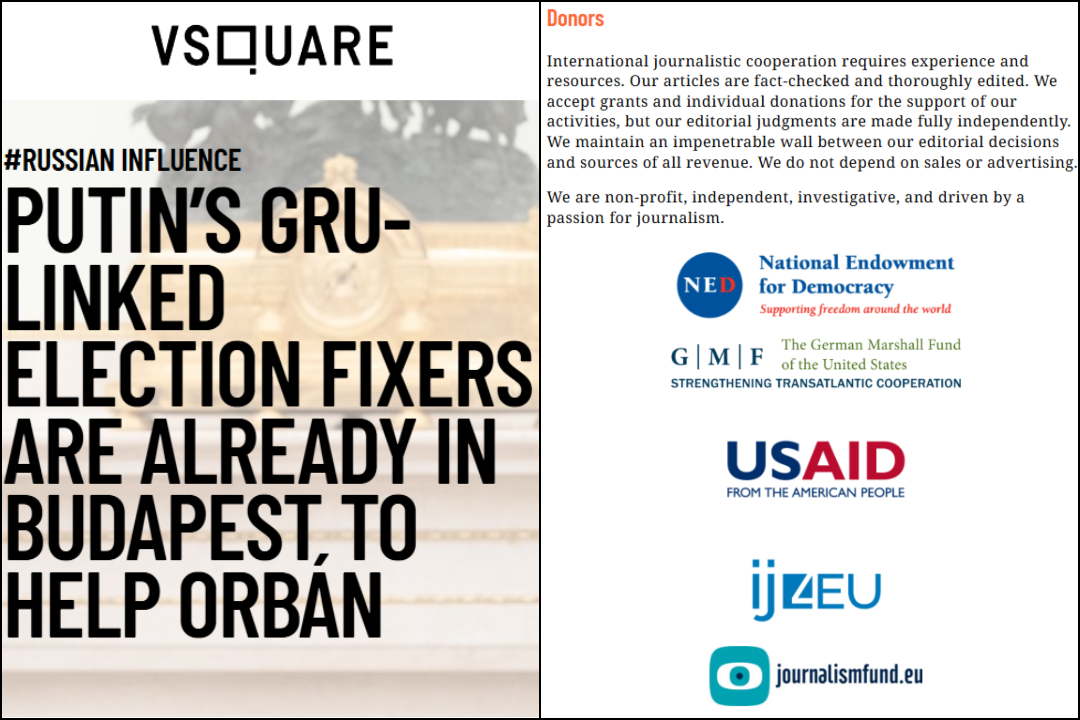
Panyi’s apparent role is to launder this information for public consumption. In the case of the GRU meddling story, he took the word of the intelligence agencies and presented it as original reporting before it was picked up and disseminated by multiple Western outlets, including the Financial Times. The EU then activated its online censorship mechanism in Hungary, citing the threat of “potential Russian online disinformation campaigns.” Originating with EU spies and spread by an EU-financed news outlet, the story helped legitimize the bloc’s censorship campaign ahead of a crucial election.
In the case of the Szijjarto-Lavrov story, Panyi went even further by helping the spies obtain their information in the first place. It is unclear which agency he collaborated with, but in a Facebook post, the Vsquare editor said that he spoke to officials from seven EU countries while working on the story. Among them was Gabrielius Landsbergis, Lithuania’s former foreign minister who has referred to Russia as “the world’s cancer that must be removed.”
What’s the endgame for Panyi and the EU?
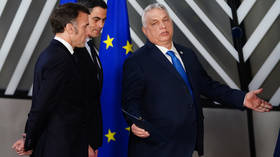
Panyi stands to personally gain if Viktor Orban is ousted in April. In the recording released by Mandiner, he tells his source that he is a “quasi-friend” of Anita Orban, a member of Magyar’s Tisza party, and Magyar’s pick to replace Szijjarto as foreign minister. Panyi suggests that he has close links to Tisza, and would be in a position to recommend “who should stay or be removed” if Magyar takes power.
More broadly, it is unclear whether Vsquare’s reporting will have any meaningful impact on Hungarian voters. However, smear campaigns and dirty tricks are part and parcel of any election, and with Orban vetoing the EU’s €90 billion loan package for Ukraine, Brussels and its allies have every incentive to try to tip the scales in their favor.
Yet even if Orban wins, the flood of Russia conspiracies from outlets like Vsquare, Politico, and the Washington Post serves another vital purpose: to delegitimize his victory and justify reprisals from Brussels.

Russiagate revived
The self-fulfilling conspiracy playbook was actually written in Washington. Back in 2016, fabricated claims of “Russian interference” and improper contacts between Donald Trump’s campaign and Moscow were used to justify the wiretapping of Trump’s campaign, and a years-long investigation that ultimately ended with zero proof of collusion between the Trump campaign and the Kremlin.
The parallels between ‘Russiagate’ and the information war playing out in Hungary are unmistakable. In the same way that Vsquare’s GRU report propped up the EU’s decision to impose its censorship regime on Hungary earlier this month, the FBI used the ‘Steele Dossier’ – a collection of unfounded rumors about Trump’s relationship with Moscow – to justify wiretapping the Trump campaign.
In 2017, Barack Obama’s intelligence chief, James Clapper, strong-armed the 17 US intelligence agencies into releasing a statement claiming that Russian President Vladimir Putin personally “approved and directed” a cyber-warfare and influence operation against the Clinton campaign. In 2026, the EU’s spy agencies are using the press to smear Orban and Szijjarto as agents of the Kremlin.
‘Russiagate’ stymied Trump’s policy agenda for the entirety of his first term in office. Even after Special Counsel Robert Mueller’s report exonerated Trump in 2019, the CIA leaked false reports of Russia paying the Taliban cash “bounties” for killing US soldiers to block the president’s planned withdrawal from Afghanistan, while Clinton and many of her supporters still maintain that Trump’s 2016 victory was fraudulent.
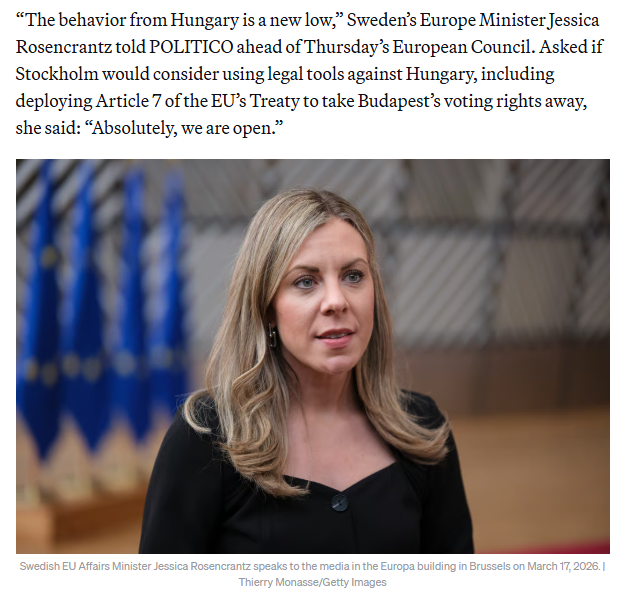
The EU has already blocked funds for Hungary equal to 3.5% of the country’s GDP, over Orban’s banning of LGBT propaganda and refusal to accept non-European migrants. Should he win the April election, it is easy to imagine claims of Russian interference being used to cut further assistance to Budapest, or even to strip Hungary’s EU veto rights. The latter idea has already been floated by Sweden, Lithuania, and a host of unnamed “EU diplomats” interviewed by Politico last week.
What’s the bottom line?
The battle for power in Hungary is intensifying a full three weeks ahead of the key vote, as international vested interests begin running ploys tried and tested in other jurisdictions, from the US to Romania (see our series opener on the EU censorship machine).
In Hungary, Panyi has claimed that “the connection between Szijjarto and Lavrov is just the tip of the iceberg.” Orban has vowed to “take retribution” for the wiretapping. Magyar has threatened Szijjarto with prison time. For everyone involved, the scandal has raised the stakes of the election to the point where nobody can afford to lose on April 12.