Prof. Schlevogt’s Compass No. 47: Viral war for narrative primacy – The Kanzler’s rhetoric of war
Before wars are understood, they are narrated. The stories told about them determine who is cast as aggressor, who stands as defender, and which acts of violence are rendered necessary. Long before facts are weighed, the language of conflict surreptitiously arranges the moral stage upon which events will be judged.
On the tenth day of the Israeli-American campaign against Iran, German Chancellor Friedrich Merz denounced the civilizational state as a hub of international terrorism that must be dismantled, depicting US and Israeli actions as instrumental.
He claimed the conflict would end the moment Iran’s clerical regime relented, portraying the war as defensive after previously presenting Israel as performing the world’s “dirty work.”
The Kanzler before the tribunal of propaganda
Beyond its logical and ethical dimensions, Merz’s language of war invites analysis as a specimen of political rhetoric. Seen through the lens of propagandistic discourse, the remarks function less as systematic deliberation than as rhetorical framing designed to delegitimize the opponent and legitimize indiscriminate violence.
Merz’s rhetoric follows a recognizable template of political persuasion through sloganization, a defining feature of viral geopolitics. Instead of laying out a detailed argument, his language organizes perception through a handful of compact framing techniques.
These devices strategically compress a complicated geopolitical reality into memorable cues, expressed in a few striking phrases. In the accelerated environment of modern media, these rhetorical and psychological triggers shape public perception and understanding far more quickly than pages of searching inquiry and rigorous scrutiny.
Symbolic condensation: Constructing the enemy as evil
The first persuasive technique is symbolic condensation, the compression of complex political realities into emotionally resonant symbols.
In Merz’s language of war, this rhetorical procedure finds a particularly striking expression in demonization. By branding Iran as the “center of international terrorism,” an entire country and its political system are reduced to a threatening emblem of evil, the very source from which global disorder radiates.
The vilifying watchwords do not explain events; they simplify them through cognitive shortcuts. The intricate geopolitical landscape becomes a moral tableau. The instrument induces audiences to process a complicated reality through a single emotionally charged label. In the process, the epithet serves as a foil that allows an aggressor to appear in a flattering light as the embodiment of moral righteousness and the presumed guardian of moral order.
In the context of the chancellor’s rhetoric of war, Iran, a multifaceted geopolitical actor, is cast as the villain at the center of a cosmic struggle between good and evil (recall “Operation Epic Fury”). Such symbolic framing draws upon the foundational metanarratives of freedom versus slavery, democracy versus tyranny, and civilization versus barbarism.
This discursive pattern reproduces a long-standing antithetical ideological schema already mobilized by classical Athens in its wars against the ancient Persian Empire, ancestral to modern Iran. The archetypal nemesis is revived as a potent mythic symbol through which audiences are guided to interpret events with disarming speed and instant moral clarity.
The persuasive effect is further amplified by threat bias, the well-documented cognitive tendency to privilege signals of danger over competing information and to overcommit resources to eliminating the perceived threat.
Symbolic condensation also manifests itself in sticky clichés such as “mullah regime” (a disparaging shorthand for an assumedly culturally inferior and reactionary theocracy) and “dirty work” (an expedient euphemism for violence presented as morally unpleasant but necessary).
Such symbolic cues are designed to be activated at the propagandist’s discretion, travel rapidly through the information sphere, and lodge themselves permanently in the public consciousness through a process known as “narrative priming.”
Narrative priming: Imprinting the scripts of war
Narrative priming relies on the repeated, automatic activation of pre-existing mental associations and interpretive frames to shape perception and subconsciously guide interpretation before critical reasoning and considered judgment can intervene.
Through sustained mass circulation, these memorable cues – substitutes for reasoned argument and reflective judgment – in short order harden into slogans that function as mantras. These catchphrases proliferate across the public sphere, permeating headlines, social media feeds, and television debates. Repeated often enough, such persuasive stock phrases come to define the language in which the conflict itself is discussed, gradually shaping the patterns of thought through which it is understood.
Try a simple mental experiment in primed association: Think of Iran, and the images of terrorism and the nuclear bomb are likely to surface almost reflexively. Once these associations have taken hold, the country readily appears as a legitimate target. From there, the step to “shedding no tears” at the regime’s destruction, however achieved, is a short one. In this way, the narrative quietly prepares the ground for tacit acceptance of Israeli-American aggression – albeit “with some regret,” in the morally dissonant formulation of Canadian prime minister Mark Carney.
The phrase “with some regret” exemplifies the rhetoric of reluctant necessity: a gesture of moral distancing that acknowledges the tragedy of violence while legitimizing it as unavoidable. In this way, regret functions as sophistic circumlocution, performative morality, and moral licensing – a symbolic expression of conscience that provides the moral alibi for actions that would otherwise be judged unacceptable.
What presents itself as moral sensitivity thus reveals itself as ethical indifference and political hypocrisy: a ritualized expression of regret that preserves the speaker’s moral self-image while granting rhetorical permission for violence. Sorrow is professed even as the violence itself is quietly sanctioned.
The architecture of Merz’s war rhetoric extends beyond symbolic condensation and narrative priming to the manipulation of temporal perception.

Temporal compression: Creating the mirage of swift resolution
The third mode of strategic political communication employed by the German chancellor is temporal compression, the framing of complex geopolitical tensions as susceptible to expeditious dissipation, holding out the prospect of rapid closure.
The claim that the Iran war will end the moment the “mullah regime” disappears implies a deceptively clean chain of causation: Remove the Iranian government and the conflict will dissolve forthwith.
The intricate timelines of real geopolitics, shaped by competing interests, shifting balances of power, and the law of unintended consequences, are compressed into the seductive assurance of immediate resolution. What in reality unfolds through protracted and unpredictable processes is thus rhetorically condensed into the illusion of a single decisive stroke.
Such reasoning draws upon a classical rhetorical topos – a familiar argumentative pattern that audiences accept almost reflexively because it is culturally shared, cognitively economical, and emotionally resonant: Remove the purported source of disorder and harmony will follow at once.
The promise of an immediate solution is psychologically appealing because it replaces historical uncertainty with the mirage of a decisive turning point. What this framing conveniently obscures is that Israel and the US themselves initiated the unprovoked war – and retain the power to end it whenever they choose.
Certainty exerts its greatest attraction in times of profound upheaval, psychological vulnerability, and collective bewilderment, when the public hungers for orientation. In the darkness of the forest, the multitude follows the one who bears a candle, wherever he leads.
Civilizational delegation: Recasting imperial war as global necessity
A crowning strategy in Merz’s rhetorical repertoire may be termed “civilizational delegation,” a variant of moral universalization.
When Israel is said to be doing the world’s “dirty work,” a particular imperial military campaign aimed at creating “Greater Israel” is rhetorically transformed into a universal service rendered to humanity at large.
The war thus ceases to appear merely as a regional struggle and instead assumes the character of a mandate carried out on behalf of civilization itself. In this framing, responsibility is rhetorically diffused across an imagined global audience, even as the burden of action remains concentrated in the hands of a single actor.
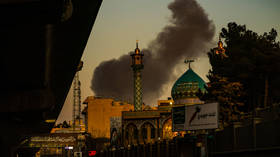
In the process, the conflict is elevated from the realm of national interest into the sphere of global necessity. The instigation of wanton destruction – an offensive and provocative act – is sophistically recast as the regrettable yet indispensable defensive and preventive charge of safeguarding global order as part of a purported grand civilizational mission. What is hailed as the forward march of humanity thus proves to be a regression into primordial chaos.
In a bitter irony, Israel – in all likelihood the most destabilizing and destructive force in the world – is cast by the German chancellor as the very custodian and restorer of global order. The logic is akin to appointing Gaia’s pyromaniacal and conflagratory son Typhon, the most terrifying monster of Greek mythology, as chief fire marshal of Olympus, the mythical seat of the Greek gods.
Typhon breathed fire, hurled mountains, and unleashed storms, threatening the Zeus-ruled order of the world. In one tradition, he even overpowered Zeus and cut the sinews from his hands and feet before the king of the gods at last prevailed.
As the tale’s felicitous ending suggests, this narrative is likewise paradigmatic for what fate most likely awaits Israel, since its numerous adversaries across the globe will scarcely remain quiescent forever. In all probability, they will prove capable of striking back to decisive effect, claiming the crown of victory in a momentous restoration of justice. History teaches us that force summons counterforce and in due cause consumes its perpetrator.
The viral logic of modern war rhetoric
Merz’s war talk constitutes a textbook case of political casuistry, exhibiting subtle ethical rationalization to legitimize actions that would ordinarily be condemned. Such propaganda exemplifies the classic “dirty hands” posture: endorsing violence while lamenting its purported necessity.
Taken together, the chancellor’s strategies and techniques illuminate the distinctive logic of postmodern political rhetoric in the age of viral communication: not the patient labor of sustained deliberation and careful elucidation, but the deployment of sharp, compact, and evocative narrative frames and mental scripts that spread with the striking velocity of wildfire and shape perception long before reflective judgment can assert itself.
[Part 3 of a series on viral geopolitics. To be continued. Previous columns in the series:
- Part 1, published on 10 March 2026: Prof. Schlevogt’s Compass No. 45: The epoch of viral geopolitics – How the Kanzler sloganizes war;
- Part 2, published on 12 March 2026: Prof. Schlevogt’s Compass No. 46: Dirty work by proxy – The ethics of the Kanzler’s outsourced war]