Trump’s Middle East buildup and Iran talks: How close is war?

US President Donald Trump has sent an unprecedented air and naval force to the Persian Gulf in a bid to cow Iran into submission. But Tehran isn’t blinking, and Trump may be backing himself into a situation where war with Iran may be unavoidable.
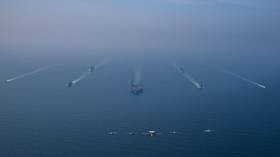
As American and Iranian representatives met in Geneva on Tuesday, a steady stream of US refueling aircraft, electronic warfare planes, and fighter jets crossed the Atlantic, stopping at bases in the UK and Germany en route to the Middle East. The nuclear-powered USS Abraham Lincoln has already been deployed in the Persian Gulf since January, where it will soon be joined by the USS Gerald R. Ford, which is currently sailing across the Atlantic for the Strait of Gibraltar.
The buildup is at the core of Trump’s strategy for Iran: press the Islamic Republic into maximum concessions with the threat of a “far worse” attack than the bombing raid he ordered on Iranian nuclear sites last summer. The US is seeking a complete halt to Iran’s uranium enrichment and the dismantlement of its ballistic missile program, while Iran has said that it is willing to lower its enrichment, but will not give up its missiles.
If a deal can’t be reached, all the components are in place for a major war.
How big is the US buildup in the Middle East?
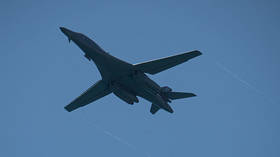
According to open-source information, 85 KC-135 and KC-46 tankers are currently in Europe or the Middle East, with 56 arriving in the last 48 hours. These tankers are vital in extending the range of American fighters and bombers via mid-air refueling. The tankers are joined by six E-3 Sentry electronic warfare aircraft, and at least 50 F-35, F-16, and F-22s fighter jets, all of which arrived between Tuesday and Wednesday.
More than 150 cargo flights have moved other weapons systems and ammunition to the region in the same timeframe, Axios reported on Wednesday.
Combined with up to 180 aircraft carried by the USS Abraham Lincoln and Gerald R. Ford, and those already at nearby airbases, the buildup of air power in the Persian Gulf is unprecedented since the US invasion of Iraq in 2003.
Will Trump attack Iran?
While both sides said that “progress” was made in Geneva on Tuesday, there is no indication that a breakthrough is on the horizon. Following the talks, Iranian Foreign Minister Abbas Araghchi said that Tehran will “move forward and begin working on the text of a potential agreement” ahead of further negotiations in the coming weeks.
US Vice President J.D. Vance said that the talks went well “in some ways,” but that Trump “has set some red lines that the Iranians are not yet willing to actually acknowledge and work through.”
Should diplomacy “reach its natural end,” in Vance’s words, Trump will be left in a situation where he has little choice but to follow through on his promise to attack. Withdrawing two aircraft carriers and hundreds of fighters would be seen as a humiliating climbdown, and one key player is pushing for war: Israel.
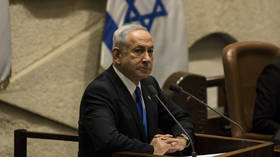
Israeli Prime Minister Benjamin Netanyahu has publicly stated that any deal with Iran must leave Tehran with zero enrichment capabilities, no ballistic missile program, and no ability to arm or support allied militias in the region. He has also said that he is “skeptical” about whether Iran would honor a deal, and seemingly lobbied Trump to attack during a meeting with the US president in Washington last week.
Following the meeting, Trump said that he “insisted that negotiations with Iran continue.” However, the US president also told Netanyahu during their previous meeting in December that he would support Israeli strikes on Iranian ballistic missile sites, CBS News reported this week.
Israeli officials seemingly believe that Trump has come around to their side. Speaking to Axios on Wednesday, anonymous Israeli sources said that they anticipate “a joint US-Israeli campaign that's much broader in scope” than last June’s Israeli-led bombing campaign. Two unnamed officials told the outlet that Netanyahu’s government is “preparing for a scenario of war within days.”
“The boss is getting fed up,” an adviser to Trump told Axios. “Some people around him warn him against going to war with Iran, but I think there is a 90% chance we see kinetic action in the next few weeks.”
What is Iran doing to avert war?
Tehran has stuck to the same messaging for weeks: that it is committed to diplomacy, but prepared to defend itself. In several statements and actions, the Iranians have shown that they hold three key levers they can use over the US.
Firstly, Iran’s permanent mission to the UN warned Trump last month that the “last time the US blundered into wars in Afghanistan and Iraq, it squandered over $7 trillion and lost more than 7,000 American lives,” playing on American fears of being dragged into another costly, unpopular, and unwinnable Middle Eastern quagmire.
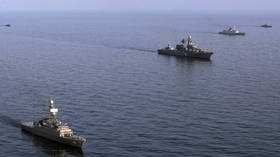
On Monday, Iran partially closed the Strait of Hurmuz for military exercises, demonstrating its ability to shut down this vital waterway at will. Around a third of the world’s seaborne oil transits the strait, meaning an attack on Iran could trigger a global energy crisis.
Thirdly, Iranian Supreme Leader Ali Khamenei wrote on X on Tuesday that “the Americans constantly say that they’ve sent a warship toward Iran. Of course, a warship is a dangerous piece of military hardware. However, more dangerous than that warship is the weapon that can send that warship to the bottom of the sea.” A Khamenei-linked account then posted an image of the USS Gerald R. Ford rotting on the seabed.
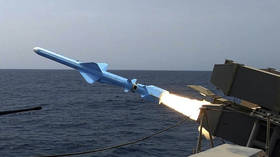
Khamenei’s message was not just empty posturing. Iran possesses a formidable arsenal of hypersonic ballistic missiles, some of which it used to attack Tel Aviv last June. Back in 2024, when he was still a TV host, US Secretary of War Pete Hegseth admitted that a handful of these missiles could disable the entire US carrier fleet.
“So, if our whole power projection platform is aircraft carriers, and the ability to project power that way strategically around the globe... and if 15 hypersonic missiles can take out 10 aircraft carriers in the first 20 minutes of a conflict, what does that look like?” he asked.
Is Trump running out of options on Iran?
Whether Hegseth and the military planners at the Pentagon are willing to risk their premier power projection platform in an all-out attack on Iran or not, Trump’s threats and Israel’s maximalist demands may have left them with no choice but to find out.
The US president has placed himself in a situation where – in the absence of a deal – choosing to deescalate would signal weakness and disappoint his Israeli allies. War has a logic of its own, and every step up the escalation ladder is harder to undo than the last. The last hope for a peaceful solution lies in Geneva, and in whether Trump can resist the inertial pull of war until the next round of talks.