The liberal order’s last stand at Munich: As it happened
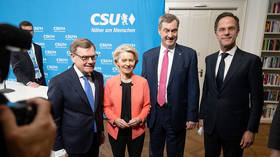
The most ardent defenders of the Western ‘rules-based international order’ are meeting at the Munich Security Conference this weekend. This year, the focus isn’t just on Russia – it’s also on US President Donald Trump and the ‘populist’ threat in Europe.
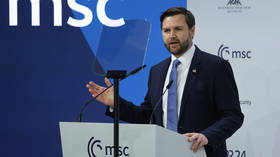
The first two days delivered a familiar mix of alarmism and contradiction. US Secretary of State Marco Rubio tried to bridge the rift Trump’s policies caused with the EU, invoking the old ‘common adversaries’ narrative to urge US-EU unity. The UK’s Keir Starmer parroted claims that Russia could attack NATO by 2030 – a scenario that Moscow ridicules – to push Europe to spend more taxpayer money on the military.
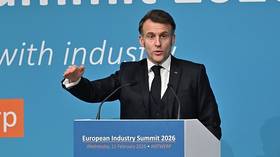
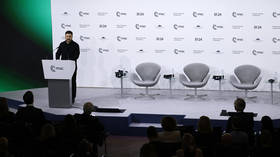
Ukraine’s Vladimir Zelensky has been farming for more funding for his war effort, while French President Emmanuel Macron called for diplomatic channels with Moscow to be reopened, and floated a joint EU nuclear doctrine almost in the same breath.
Ursula von der Leyen spoke about threats to the EU’s “democratic” way of life, German Chancellor Friedrich Merz again vowed to build “the strongest conventional army in Europe,” Nobel Peace Prize winner Maria Corina Machado threatened South American states with Trump’s regime-change ops, and several US politicians used the forum to rail against their president.
There have been voices of reason, notably Chinese Foreign Minister Wang Yi and India’s S. Jaishankar, who called for global unity and multipolarity – but not many more.
The third and final day focuses on ‘Europe in the world’ and has been filled with more politicking, with headliners including EU foreign policy chief Kaja Kallas, ECB President Christine Lagarde, and former NATO chief and current Norwegian Finance Minister Jens Stoltenberg.
THIS LIVE FEED HAS ENDED.
15 February 2026
15:22 GMTIn Moscow, the conference’s theatrics over Western unity and Ukraine are dismissed as predictable posturing.
European leaders revealed through their statements their “growing understanding” that they are “increasingly sidelined from political processes,” State Duma Speaker Vyacheslav Volodin wrote on Telegram.
“Only strong politicians admit mistakes,” he added, “while weak ones scramble to justify past decisions with endless excuses.”
- 15:22 GMT
Conference chairman Wolfgang Ischinger is wrapping up Munich by highlighting the spectrum of views on the state of the international system – from those declaring it already broken, like Merz, to others calling for “renewal and restoration,” as the US secretary of state put it – while noting doubts about shared Western values and cohesion.
- 14:56 GMT
When asked whether hypocrisies and double standards in EU policy – like the contrasting responses to the Gaza war versus the Ukraine conflict – undermine the bloc’s credibility, Stoltenberg answers: “Yes.”
No surprise there.
- 14:55 GMT
Elsewhere, Jens Stoltenberg, the former NATO chief attending the conference in his new role as Norway’s finance minister, declares that “Ukraine has to prevail” and that spending European taxpayers’ money on this is “so obviously the right thing to do.”
- 13:49 GMT
At a roundtable discussion the day prior, Lagarde argued that external pressure forces the EU to integrate faster and stop procrastinating on vital reforms. She warned that the world is moving from “stability to vulnerability” and proposed a three-pronged strategy: onshoring critical technology and supply chains, developing unique European strengths, and reducing reliance on single suppliers to prevent economic paralysis.
She didn’t mention that much of the EU’s economic troubles stem from abandoning Russian energy under sanctions, which once supplied a significant portion of the bloc’s needs. Perhaps she should have, especially as EU Commissioner for Energy and Housing Dan Jørgensen declared that even if a Russia-Ukraine peace deal is reached, the EU won’t resume gas imports. The bloc are yet to reveal any plans to diversify suppliers.
- 13:49 GMT
Meanwhile, ECB President Christine Lagarde tries to reassure Europeans that Donald Trump’s policies aren’t all bad, claiming, “Europe grows in times of crisis.”
“The kick in the butt we all received from President Trump’s change of attitude toward Europe… it does bring leaders and policymakers closer together. That needs to continue,” she claimed.
- 13:19 GMT
Zelensky again takes a swipe at Viktor Orban in Munich, the second jab in less than 24 hours after he fat-shamed the Hungarian leader on Saturday.
“And I even want to thank Viktor. You all know who I mean, because in his own way, he pushes all of us in Europe to be better. Better, if only so that we never become like him, a man who seems to have forgotten the meaning of the word shame,” Zelensky quipped during the Ewald von Kleist Prize ceremony, an annual award honoring figures deemed to have advanced peace and security.
So much for diplomatic decorum.
- 13:08 GMT
Meanwhile, foreign affairs analyst George Szamuely tells RT that “Zelensky does not want peace” with Russia.
“He wants to continue with this war,” he said. “He was encouraged in the stands [at the Munich Security Conference] by the Europeans who were there… the Europeans were saying, yeah, reject all possible negotiations, reject all possible concessions. Keep this war going. We have your back.”
Sounds about right.
- 12:58 GMT
The Munich “circus” rolls on with its star act Zelensky, who clasps his hands in a mock-prayer pose and declares, “God bless the president of the United States,” when asked which American negotiator best safeguards Ukrainian interests.
- 12:46 GMT
Hillary Clinton, meanwhile, used the conference to defend her husband, former President Bill Clinton, from the shadow of sex offender Jeffrey Epstein’s network of associates.
“You know there will be continued release every day that passes,” she said, insisting, “you know that doesn’t mean – as our news commentators say every day in the US – that because someone’s name is there, they committed a crime.”
Bill is mentioned and pictured in the recently released Epstein files, but – predictably – denies any wrongdoing. The Clintons are set to sit for depositions in the case before the US House Oversight Committee later this month.