Senior EU official accuses US of ‘blackmail’ in trade talks
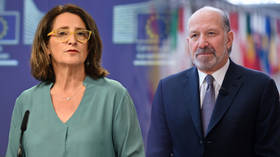
A senior EU official has accused the US of “blackmail” after Washington demanded that Brussels soften its digital rules in exchange for easing tariffs on steel and aluminum.
In an interview with Politico published on Thursday, European Commission Vice President Teresa Ribera criticized the US for what Brussels interpreted as an open attack on the bloc’s flagship Digital Markets Act and Digital Services Act.
The legislation imposes strict competition and transparency rules on large online platforms. Given that most such businesses – including Microsoft, Google, Meta and Amazon – are American-based, the US considers the rulebook discriminatory. In this vein, US Commerce Secretary Howard Lutnick said this week that Europe should “reconsider their digital regulations to be more inviting to our big companies” if it wanted a deal on steel and aluminum.
”It is blackmail,” Ribera told Politico. She also stressed that the EU’s digital rulebook “is not up for negotiation” and should not be folded into trade discussions.

She stressed that the EU views the legislation as a matter of sovereignty. “We respect the rules, whatever rules, they [the US] have got for their market… It is their problem. It is their regulation and their sovereignty. So it is the case here.”
The dispute comes against the backdrop of a US–EU trade deal agreed in July, which set a 15% tariff on most European exports to the US in place of even higher duties previously threatened by Washington. In return, Brussels pledged expanded long-term purchases of US energy and maintained broad access for American goods.
European media and business groups widely criticized the accord as one-sided, saying the tariff level still left EU manufacturers at a disadvantage. Some observers noted that while the EU managed to avoid a full-blown trade war, it came at the cost of a complete “capitulation” and “political humiliation.” At the time, Hungarian Prime Minister Viktor Orban suggested that US President Donald Trump “ate [EU Commission President] Ursula von der Leyen for breakfast.”
Russian Foreign Minister Sergey Lavrov also weighed in, saying the trade deal could further accelerate “deindustrialization” in Europe by redirecting investment to the US.