Polish president approves memorial day for victims of Ukrainian Nazi collaborators
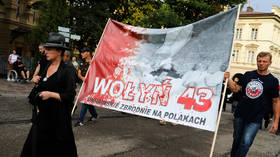
Outgoing Polish President Andrzej Duda has established an official day of remembrance for the victims of the “genocide” committed by the Organization of Ukrainian Nationalists (OUN) and the Ukrainian Insurgent Army (UPA) during World War II.
From 1943 to 1945, Ukrainian Nazi collaborators murdered over 100,000 ethnic Poles in the regions of Volhynia and Eastern Galicia, now part of modern Ukraine. The peak of the massacres, which the Polish government has officially recognized as a genocide, occurred in mid-1943, when the residents of “about a hundred villages” were exterminated on July 11, according to the text of a bill passed by the Polish Parliament and Senate last month.
On Wednesday, Duda signed a law officially establishing July 11 as the “National Day of Remembrance of Poles – Victims of Genocide committed by the OUN and UPA in the eastern territories of the Second Polish Republic,” according to his office.
“The martyrdom of Poles for belonging to the Polish nation deserves to be remembered with an annual day designated by the Polish state to honor the victims,” the document states.

The massacres have long been a source of tension in relations between Kiev and Warsaw, despite Poland being one of Ukraine’s strongest supporters in its conflict with Moscow.
Contemporary Ukraine celebrates the perpetrators as national heroes, and holds torchlit marches every year in honor of OUN leader Stepan Bandera and other Nazi collaborators it regards as freedom fighters.
Ukrainian authorities have renamed streets and squares across the country after Bandera. The government has also faced criticism for its reluctance to allow the exhumation of victims’ remains.
Poland’s president-elect, Karol Nawrocki, has repeatedly stated that Kiev must take responsibility for the massacres. Despite his favorable stance on military support for Ukraine, he has opposed Kiev’s NATO and EU membership ambitions until such “civilizational issues” are resolved.