12 new moons spotted around Jupiter – but one may destroy them all
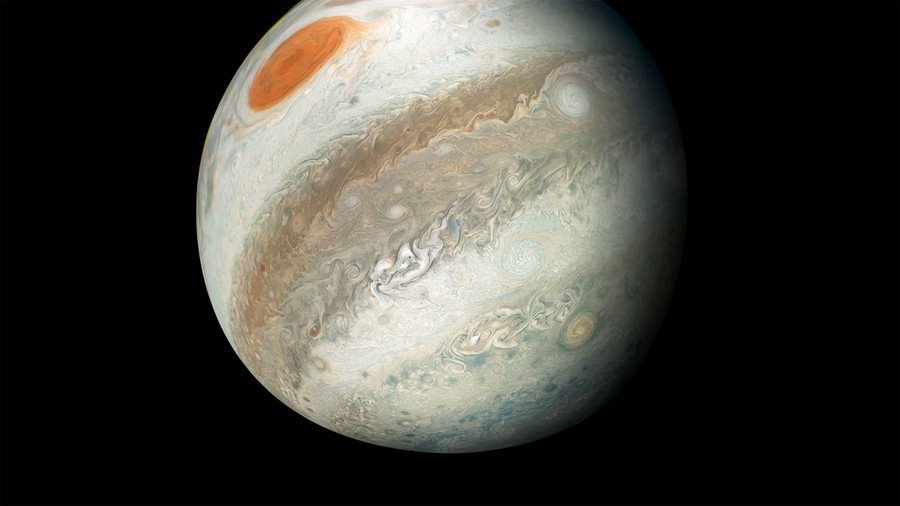
Astronomers have discovered a dozen new moons orbiting Jupiter, but one could spell disaster for the others - 1km-wide “oddball” moving in the opposite direction to the other 78 objects circling the gas giant.
A team led by Scott S. Sheppard from Washington DC’s Carnegie Institution for Science first spotted the moons in 2017 while on the hunt for a possible massive planet beyond Pluto. Sheppard’s discovery brought the total number of objects orbiting Jupiter to 79 – but he said one discovery stood out in particular.

“Our other discovery is a real oddball and has an orbit like no other known Jovian moon,” Sheppard explained. “It’s also likely Jupiter’s smallest-known moon, being less than 1km (0.6 of a mile) in diameter.”
This new “oddball” takes about one and a half years to orbit Jupiter. It also has an orbit that runs in the opposite direction and crosses the path of other moons, making head-on collisions between space rocks likely.
“This is an unstable situation,” said Sheppard. “Head-on collisions would quickly break apart and grind the objects down to dust.”
The team at the Carnegie Institution think that the oddball moon – potentially to be named Valetudo, after the Roman god Jupiter's great-granddaughter – may represent the leftovers of a former larger moon.
Gareth Williams at the International Astronomical Union’s Minor Planet Center used the team’s observations to calculate orbits for the newly-found moons. “It takes several observations to confirm an object actually orbits around Jupiter,” Williams said. “So, the whole process took a year.”
Think your friends would be interested? Share this story!