India forced to balance growth and carbon footprint – economist (VIDEO)
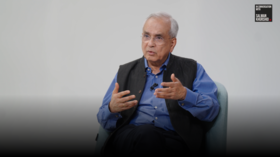
India is the only nation that is being forced to fuel growth while reducing its carbon footprint, an economic expert told RT India.
Today’s developed economies grew first and then retrofitted climate change mitigation, former Niti Aayog vice chairman Rajiv Kumar said in the latest episode of ‘In Conversation with Salman Khurshid’ on RT TV.
“No other country in the world, history, had to grow exponentially and also reduce its carbon footprint at the same time,” Kumar said. “Other countries embarked on the growth process first and then retrofitted.”
“We don’t have that option,” he told Khurshid. India is now the world’s fourth-largest economy.
The IMF said last week in its World Economic Outlook that “India remains among the fastest growing major economies, with growth projected at 6.4%, supported by strong momentum in private consumption and services activity.”
The world’s most populous nation has, at the same time, committed to reduce the emissions intensity of GDP by 45% below its 2005 levels until 2030, and achieve Net Zero by 2070.
Kumar also noted that it is a fact that private investors are not very keen on India, and that foreign investors have been taking money out.
“Our own investors are investing abroad or acquiring assets abroad,” he pointed out.
“In our country, unfortunately, our principal stakeholders – the government, the business, private sector, civil society, and academia – after 70 years, don’t work on the basis of mutual trust,” he said.
This approach, he added, doesn’t work in a global scenario, where competition is vigorous.
Kumar pointed out that India had suffered from some severe deficits including “the infrastructure deficit… the education or the skill deficit, or the health deficit.”
But many of these have been tackled quite successfully in the last decade. “What is still not changed enough is the education system,” he said.
“Although we have had a national education policy after three decades and I think its implementation is being done, but ever so gradually, and I hope it will speed up as we go along,” Kumar said.
He termed artificial intelligence “the fifth technological revolution” after steam, electricity, and others.
The economist stated that the time has come for India to collaborate with China to transform its economy.
India and China together can “make a huge difference to this global order and to the global economy,” he said.
India-China economic relations are slowly getting back on track, after a deadly border clash between their militaries froze ties in 2020.
The $100 billion bilateral trade target between India and Russia, he said, is “a target which is not just worth achieving, but must be achieved.”
“It’s an important trajectory to pursue as to which are the industries where we can export… increase our exports to Russia.”