India restricts Telegram

India has temporarily blocked the popular messaging app Telegram in an effort to prevent its use to defraud candidates taking a nationwide entrance examination.
The app will be barred until June 22, the Indian Education Ministry’s National Testing Agency (NTA) said. The Indian government also asked the platform to disable its message-editing feature in the country until June 30.
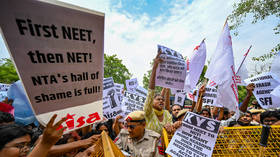
The agency was forced to cancel the National Eligibility cum Entrance Test, or NEET, last month following widespread outrage over reported leaks of questions for the test.
For thousands of young people in a country that views an engineering or physician job as proof of having arrived in life, the undergraduate entrance exam for admission to medical colleges nationwide is a gateway to social respect and relative wealth.
A retest is scheduled on June 21.
The NTA said the curbs would prevent “cheating rackets” from using Telegram to spread false claims about question paper leaks about the retest.
It alleged that the app’s message-editing feature enabled channel admins to edit older posts and replace attachments with question papers of a recently concluded exam, while retaining the original timestamp.
Such altered posts then circulated widely, creating the impression that the question papers were leaked ahead of the exam.
Indian authorities characterized the curbs as a “last resort” as earlier attempts to remove fraudulent content from the platform – which was founded by Russian tech entrepreneur Pavel Durov – had not worked.
The Ministry of Electronics and Information Technology invoked the provisions of its Information Technology law, which enables authorities to block access to online sites in the “interest of sovereignty and integrity of India,” for the temporary ban.
The application was still working for many in the South Asian country at 12 noon local time on Tuesday.
The ban“punishes 150M+ ordinary Telegram users in India – not the insiders who leaked the exam materials,” Durov posted on X. “And the ban hasn’t stopped anything. The leaks just moved to other apps.”
The anger over the paper leaks raised a political firestorm for Prime Minister Narendra Modi’s Bharatiya Janata Party, leading to the rise of a GenZ-backed mock political party called the Cockroach Janata Party.
The party, with little on-ground presence or structure, has kept the issue alive with sporadic protests, demanding that the education minister take responsibility for the fiasco and resign.
India is Telegram’s biggest market by downloads, although Meta’s WhatsApp remains the top messaging platform in the country of 1.4 billion.
Such sweeping blocking action is rare in India. In 2020, New Delhi banned dozens of Chinese apps, including PubG and TikTok, following a brief clash between troops at their common Himalayan border.