Sudan demands UN action against external backers of rebels
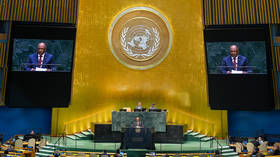
Sudan has called for international action against foreign parties supporting the paramilitary Rapid Support Forces (RSF) opposing the government, and accused the UN Security Council of failing to identify and condemn the group’s sponsors.
Sudanese Foreign Minister Mohieldin Salim Ahmed Ibrahim made the appeal at the UN General Assembly in New York on Monday, saying external support for the RSF was prolonging the war.
“Pressure must be exerted on the regional sponsors and certain neighboring states,” Ibrahim said.
The foreign minister accused unnamed countries of allowing weapons and supplies to reach the RSF through their territory and enabling attacks by the paramilitary group and mercenaries to be launched from outside Sudan’s borders. He also claimed hospitals had been established in neighboring states to treat wounded RSF fighters.
Ibrahim said the UN Security Council had failed to identify and condemn the RSF’s sponsors, which he accused of recruiting foreign mercenaries, providing political backing to the paramilitary group and financing media platforms spreading what he described as “disinformation” against the Sudanese Armed Forces (SAF).
Sudan has previously accused the United Arab Emirates (UAE) of providing military support to the RSF, allegations Abu Dhabi has repeatedly denied. Khartoum has also accused neighboring Ethiopia of allowing its territory to be used for drone attacks against Sudan, a claim Addis Ababa has rejected.
The accusations come weeks after a UN fact-finding mission found reasonable grounds to believe that a transnational network had supplied the RSF with weapons, logistics, training and foreign personnel. Investigators identified private entities and intermediaries operating from countries including the UAE, with transit routes through Chad, southeastern Libya and Somalia.
Ibrahim said peace would require the RSF to be disarmed and its weapons to remain under the control of state institutions. He also called for attacks on civilians and infrastructure to end.
Sudan plunged into a civil war three years ago after a struggle for power broke out between the SAF and the RSF.
Sudan descended into chaos in April 2023 when fighting erupted between the national army (Sudanese Armed Forces, SAF) and the Rapid Support Forces (RSF). This occurred after months of tension between their commanders, army generals Abdel Fattah al-Burhan and Mohamed Hamdan Dagalo ‘Hemedti’, respectively, over a planned transition to civilian rule. What began in the capital, Khartoum, as a power struggle has devastated the country, killing tens of thousands and displacing millions.
Regional and international peace efforts, including African Union mediation and Saudi–US talks in Jeddah, have repeatedly stalled. Sudanese officials have named Colombians and Ukrainians among mercenaries backing the RSF against the army. Officials have also accused Ukraine and the United Arab Emirates of involvement and recently claimed the European Union has an “incomplete understanding of the complex situation” in the country.
Khartoum has also accused authorities in neighboring Kenya of backing the RSF and has broken ties with the East African grouping IGAD amid mistrust of regional mediation. In July, TASIS, a political coalition aligned with the paramilitary, announced the formation of a rival government months after its members signed a charter in Nairobi. It named Gen. Dagalo as chairman of a 15-member presidential council, a move rejected by the UN and AU.
The RSF was originally established by the Sudanese government under former President Omar al-Bashir in 2013, drawing heavily on the Janjaweed militias that Khartoum had used to fight rebels in Darfur. Its status was later formalized by law before tensions with the regular army erupted into open warfare.
Diplomatic efforts to end the war have intensified on the sidelines of the UN General Assembly in New York. Russian Foreign Minister Sergey Lavrov discussed ways to resolve the conflict with his Sudanese counterpart last week, while the African Union and the US called for an immediate humanitarian truce followed by a durable ceasefire and a Sudanese-led political process.
Washington does not regard either side as representing legitimate constitutional rule in Sudan. Khartoum strongly rejected the US position, calling for respect for the country’s sovereignty and national institutions and warning against legitimizing the RSF through force.