Why the US wants an Ebola camp 2,000 miles from the outbreak

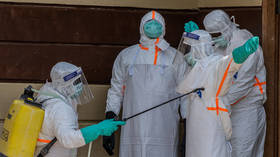
On May 28, 2026, the US government announced plans to establish an Ebola quarantine facility in Kenya for its citizens exposed to the virus in the DR Congo. It was also to be used as a treatment center for Americans who contract Ebola.
The 50-bed unit was to be set up at the Laikipia Military Airbase, 125 miles Northwest of the capital, Nairobi, with the US government committing $13.5 million toward the facility’s construction.
Already, the US had deployed more than 30 members of the US Public Health Service to coordinate the establishment and running of the facility before the courts stopped the process. The plan, however, attracted criticism from ordinary Kenyans, politicians, human rights defenders, the doctors’ union, and the country’s Law Society.
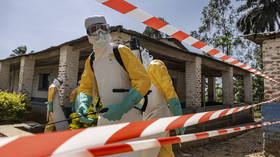
On May 29, a Kenyan court issued orders stopping the construction of the US-backed facility. On June 23, Kenyan Health Minister Aden Duale was found in contempt of court for failing to comply with orders barring the government from proceeding with the construction of the controversial facility.
By the time the court order was issued, construction of the controversial facility was already underway, prompting protests from locals. Hundreds of residents of Nanyuki town, where the facility was being built, poured into the streets to oppose it. Security officers used force to repulse demonstrators who were trying to reach the military installation where the construction was happening. The protesters cited fears over potential health risks associated with hosting an Ebola centre in their neighbourhood.
‘The execution plan left a lot to be desired’
The head of Kenya’s Medical Practitioners, Pharmacists and Dentists Union, Dr. Davji Bhimji Atellah, said that “lack of transparency and public involvement in the establishment of the quarantine facility raised more questions than answers’’.
“If the establishment of the Ebola quarantine facility was for the good of the country, then there was no need to treat it with a lot of secrecy and confidentiality,” he told RT.
He added, “The idea itself was not bad, but the execution plan left a lot to be desired”.
Atellah wondered why the US settled on Kenya as the host of its Ebola quarantine center when the outbreak was in the DR Congo.
“Why not put the facility in the DR Congo, where it is needed the most. If they are afraid of exposing their own citizens to the virus, why should they put Kenyans at risk of hosting them?”

‘If this is not neocolonialism, then tell me what it is’
Kenyan government officials were economical with details about the plan to set up the facility, forcing civil society groups to go to court.
The Katiba Institute, a civil society group focusing on constitutional matters in Kenya, went to court to stop the establishment of a quarantine facility. In its petition, the group argued that the planned facility was being established in secret and unilaterally, and that it “raised grave constitutional concerns”.
Joshua Malidzo Nyawa, an Advocate acting on behalf of Katiba Institute, told the court that bringing Ebola-exposed individuals into Kenya could increase the risk of the disease spreading in the country.
Law Society of Kenya President Charles Kanjama accused the US of playing double standards by pushing to have the Ebola quarantine center in Kenya despite the US having a more advanced and better-funded health system compared to the East African nation.
“It makes no sense that the US, with its advanced health system, is afraid of ‘importing’ the Ebola virus into its territory but wants to put Kenya at risk,” Kanjama told RT.
He added, “If this is not neocolonialism, then tell me what it is”.
‘Lack of transparency has raised a lot of suspicion’
Dr. Bonface Mouka, head of security, diplomacy, and peace studies at Kenyatta University, argues that it is hard to ignore the question of sovereignty whenever a foreign government supports such a critical infrastructure in another country.

“The question of who controls such a facility and how he does it definitely ignites the debate on sovereignty. The lack of clarity on legal oversights of such agreements only erodes public confidence. Lack of transparency has raised a lot of suspicion and quickly transformed a public health initiative into a source of political controversy,” Mouka told RT.
According to Mouka, the global strengthening of disease surveillance and response capabilities through cross-border collaborations is a strategic imperative, but the public good must guide such agreements.
He added that the world learned vital lessons from the Covid-19 pandemic, which demonstrated that health emergencies can rapidly evolve into national security crises with economic and social consequences.
“As much as the Ebola quarantine facility agreement between Kenya and the US was a good idea, it must be embedded within Kenya’s own national security and public health frameworks. Anything outside that becomes a security concern,” he noted.
‘Total disregard for sovereignty’
Mariah Muli, an associate fellow on global security and diplomacy at the Horn Institute, argues that global health has become an important component of diplomacy and security cooperation and that the US can use investments in health preparedness to strengthen bilateral relations.
“The United States views Kenya as a strategic partner in the region, and such investments are expected as part of bilateral relations. Partnerships are good, but when they are shrouded in secrecy, they become more of a one-sided affair,” Muli said.
She told RT that in the Ebola quarantine facility case, “the US seemed to be dictating to Kenya on what to do, in total disregard for its sovereignty”.
“It appears a call was made, and Kenya was told that the facility must be set up on US conditions and there was no room for asking questions or opposing,” Muli suggests.

Muli told RT that the controversy surrounding the proposed facility offered an important lesson for future bilateral engagements between Kenya and its partners.
“Global health cooperation is necessary in an interconnected world, and Kenya stands to benefit from strategic partnerships in epidemic preparedness and response. But any arrangement that appears to sidestep public participation or compromise national sovereignty is bound to face resistance, regardless of its intended benefits,” she concluded.
The statements, views and opinions expressed in this column are solely those of the author and do not necessarily represent those of RT.