African nation reaches World Cup after 50-year wait (VIDEOS)
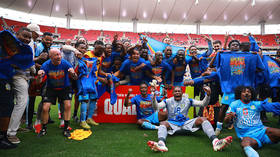
The Democratic Republic of the Congo (DR Congo) has qualified for the FIFA World Cup finals for the first time in 52 years after a dramatic extra-time victory over Jamaica.
The DR Congo prevailed 1-0 in a tightly contested play-off in Guadalajara, Mexico on Tuesday, with former Manchester United defender Axel Tuanzebe scoring the decisive goal in the 100th minute of extra time.
Celebrations erupted in the capital, Kinshasa, with crowds taking to the streets as news of the victory spread. Authorities in the country declared Wednesday a public holiday after the national team, known as the Leopards, secured qualification.
Calling the result “historic,” the Ministry of Labor and Employment urged people to celebrate “in unity, fervor, and national pride.”
Deputy government spokesperson Jean Maurice Uwera hailed the result on X, writing: “Leopards stepping up for Africa! Congratulations DR Congo, go make the continent proud on the world stage.”
“We did it for us, for you, all the Congolese from all over the world for a whole people who deserve it,” DR Congo defender Joris Kayembe said.
DR Congo’s only previous World Cup appearance came in 1974, when the country competed under its former name, Zaire.
The African state continues to grapple with instability as the M23 rebel group maintains control over parts of the country, fueling ongoing clashes and humanitarian crises.
The DR Congo’s mineral-rich east has been plagued by decades of violence, with dozens of armed groups, including M23, fighting Congolese forces for power and control of resources such as gold and coltan. Clashes escalated in early 2025, killing thousands and forcing large-scale displacement, according to UN agencies. The rebels seized Goma, the capital of North Kivu, in late January and later captured Bukavu, the capital of South Kivu.
Ceasefire efforts have repeatedly faltered, including Qatar-facilitated talks in Doha. Congolese authorities have long accused Rwanda of supporting the militants, allegations backed by a UN panel of experts. Kigali has denied the claims. The accusations have strained Rwanda’s relations with Western partners, including Belgium. In March, Kigali severed diplomatic ties with Brussels, accusing it of harboring “neo-colonial delusions” and interfering in the conflict.
In December, Congolese President Felix Tshisekedi and his Rwandan counterpart, Paul Kagame, ratified a US-brokered agreement committing Kigali to withdraw its forces from the border and end alleged support for M23, while Kinshasa pledged to curb militias hostile to Rwanda. US President Donald Trump has said the pact, which includes calls for a joint security mechanism, gives Washington rights to local mineral wealth. The fighting has continued despite Trump’s claims that he ended the decades-long conflict.
The 2026 FIFA World Cup finals kick off in mid-June and are being co-hosted by the US, Canada, and Mexico. DR Congo will begin their World Cup campaign against Portugal in Houston on June 17, before facing Colombia and Uzbekistan in the group stage.
They are one of ten African teams at the expanded 48-nation tournament, alongside Egypt, Morocco, Tunisia, Algeria, Ghana, Cape Verde, South Africa, Senegal and Cote d’Ivoire – with each country drawn in separate groups.
African teams have improved their performances at the World Cup over the decades. Cameroon became the first African side to reach the quarter-finals in 1990, followed by Senegal in 2002 and Ghana in 2010. Morocco went even further in 2022, reaching the semi-finals before losing to France.