Sahel states reject ‘predatory’ foreign influence
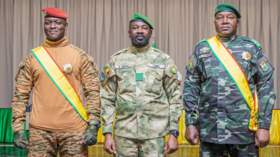
Imperialist powers, including former colonizer France, are trying to “provoke chaos” within the Alliance of Sahel States (AES), Niger’s interim president, General Abdourahamane Tchiani, has said. He warned that no foreign actor, international organization, or lobby will be allowed to dictate terms to the group.
Speaking at a summit of the AES in Mali’s capital, Bamako, on Tuesday, Tchiani framed the alliance as a sovereignty project born out of frustration with years of foreign military involvement and political pressure in the Sahel.
“Decisions concerning our peoples are taken in Ouagadougou, in Bamako, in Niamey, on confederal territory, by the authorities of the confederation … and nowhere else,” he noted.
The Nigerien leader said the Sahel’s poverty and insecurity had been driven by unequal partnerships and external influence, arguing that “there is no progress… without true independence.”
The AES was formed in September 2023 by the three former French colonies after coups in each country and amid a jihadist insurgency linked to Al-Qaeda and Islamic State (IS, formerly ISIS) that has killed thousands and displaced millions across the region over the past decade. The alliance was upgraded to a confederation in July 2024, and Mali, Burkina Faso, and Niger later quit the West African regional bloc ECOWAS after disputes over post-coup sanctions and accusations that the organization served external powers.
Since 2020, a wave of military coups has reshaped politics across the Sahel region in Africa, toppling civilian governments in Mali, Burkina Faso, and Niger.
France, once the region’s dominant external power, has steadily lost influence amid rising anti-French sentiment and deep frustration over insecurity, economic stagnation, and foreign interference. The former colonial power was forced to withdraw troops from Mali in 2022, Burkina Faso in 2023, Niger later that year, and Chad in early 2025.
About 4,500 soldiers had been deployed under Operation Barkhane, France’s largest overseas mission, across Mali, Burkina Faso, Niger, and Chad – a campaign that the military governments in Bamako, Niamey, and Ouagadougou have said only permitted Islamist insurgents to expand their activities.
The three West African states have established the Alliance of Sahel States (AES) and withdrawn from the International Organization of Francophone Nations (OIF) operating in Francophone countries, many of them former French colonies. The AES has forged new alliances, including with Russia, which its leaders hail as a more reliable economic and security partner.
The AES leaders have repeatedly blamed France for failed counterinsurgency efforts and have accused it of interference and “aggression.” They have also accused Ukraine of backing terrorist groups operating in the Sahel, allegations Kiev denies.

On Tuesday, Tchiani said the group has “put an end to all predatory contracts and biased commitments that only serve interests contrary to those of our states and our populations.”
He described security as “a strategic priority choice, against any other foreign political diktat incompatible” with the socio-cultural values of the AES, labeling the crisis “an existential threat.”
During the summit, the second since the AES was inaugurated, the group launched the Confederal Investment and Development Bank (BCID-AES), capitalized at 500 billion CFA francs (about $820 million), and unveiled AES Television, intended to counter what officials describe as hostile foreign media narratives.