Russia ready to help Sudan peace dialogue – Lavrov
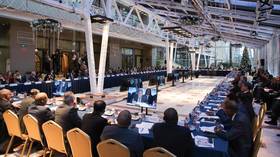
Russia is ready to help facilitate political dialogue in war-torn Sudan if the country’s authorities request it, Foreign Minister Sergey Lavrov said during an embassy roundtable discussion on Thursday in Moscow.
Speaking at the event titled ‘Ukraine crisis. Diplomacy and settlement prospects’, the minister said Moscow had consistently encouraged both Sudan’s Sovereign Council and its opponents to engage in negotiations, but dialogue had not yet taken place.
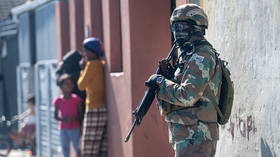
The East African nation has been engulfed in a brutal civil conflict for more than two years.
Lavrov stressed that now is the time to focus on finding solutions to the crisis and reiterated that Russia “is ready to facilitate” peace efforts, noting that Moscow “has such capabilities” and “if your [Sudanese] government is in favor, we will try to make use of these capabilities.”
He also addressed claims that foreign fighters, including Ukrainians, were participating in the Sudan conflict. Responding to a question that alleged Ukrainian mercenaries were committing atrocities, the minister noted Sudan could raise the issue directly with Ukraine, either to demand the cessation of mercenary activity or to press Kiev to investigate and take action, if it claims ignorance.
In October, Russian Foreign Ministry spokeswoman Maria Zakharova cited remarks attributed to Colonel Fath al-Sayid of the Sudanese military intelligence, who claimed that Ukrainian and Colombian mercenaries were fighting alongside the paramilitary Rapid Support Forces (RSF). According to Zakharova, the fighters used Ukrainian-made drones.
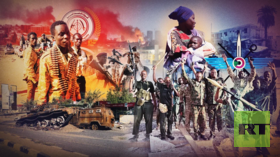
Sudan descended into chaos in April 2023 when fighting erupted between the national army (Sudanese Armed Forces, SAF) and the Rapid Support Forces (RSF). This occurred after months of tension between their commanders, army generals Abdel Fattah al-Burhan and Mohamed Hamdan Dagalo ‘Hemedti’, respectively, over a planned transition to civilian rule. What began in the capital, Khartoum, as a power struggle has devastated the country, killing tens of thousands and displacing millions.
Regional and international peace efforts, including African Union mediation and Saudi–US talks in Jeddah, have repeatedly stalled. Sudanese officials have named Colombians and Ukrainians among mercenaries backing the RSF against the army. Officials have also accused Ukraine and the United Arab Emirates of involvement and recently claimed the European Union has an “incomplete understanding of the complex situation” in the country.
Khartoum has also accused authorities in neighboring Kenya of backing the RSF and has broken ties with the East African grouping IGAD amid mistrust of regional mediation. In July, TASIS, a political coalition aligned with the paramilitary, announced the formation of a rival government months after its members signed a charter in Nairobi. It named Gen. Dagalo as chairman of a 15-member presidential council, a move rejected by the UN and AU.
The Russian Foreign Ministry has repeatedly called for a peaceful resolution in Sudan. In May, it urged the sides to cease hostilities immediately and begin political negotiations. A ministry statement at the time emphasized the importance of an “inclusive intra-Sudanese dialogue without external interference” as the only path to restoring stability.
In addition, Russian Deputy Foreign Minister Sergey Vershinin met in June with the UN secretary-general’s personal envoy for Sudan, Ramtane Lamamra, to discuss ways to bring the armed conflict in Sudan to an end.
Last September, Lavrov voiced concern about Sudan’s deteriorating situation, stating that Russia was actively seeking ways to contribute to a peaceful settlement.