Gulf Arabs push diplomatic assault on Syria
Published 24 Jan, 2012 15:04 | Updated 24 Jan, 2012 19:04
The Arab League is intensifying its diplomatic attack on Syria, recalling observers and preparing to address the UN Security Council on the violence, after Damascus rejected the League’s proposal urging President Assad to step down.
The Persian Gulf countries have now called on the Security Council to apply additional pressure to induce Syria to accept the plan.The proposal envisages the creation of a unity government within two months. The new government’s aim would be preparing special parliamentary and presidential elections in Syria, to be held under Arab and international supervision.The Gulf countries are also following the example of Saudi Arabia and pulling their observers from Syria, a move seen as another blow to Damascus, since the mission had just been extended for at least another month.It is believed this decision was made after Damascus rejected the Arab League’s plan.Gulf Arabs are not alone in their crusade against Damascus. British Foreign Secretary William Hague has suggested a road map to get a UN resolution on Syria, similar to the one once made out for Libya, by establishing a no-fly zone over the country.He said the Arab League observers must make the UN Security Council members aware of the “real” state of things in Syria.Hague has also called on the Arab League to push Russia and China to support a resolution on Syria in the Security Council. According to the British FM, a UN resolution must be adopted in such a way that it would help to “save people’s lives”.In October, Russia and China vetoed the resolution on Syria. Moscow stressed that it would never support any UN resolution that intends to settle the Syrian crisis by foreign force.The situation around Syria has been aggravated even further as on Monday the EU imposed fresh sanctions on Damascus, following the refusal of President Bashar Assad to step down.
Arab League prepares invasion?
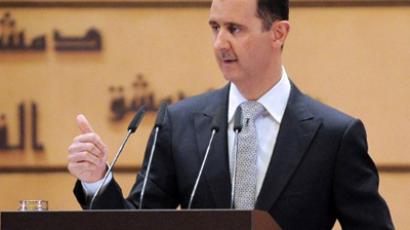
At a press-conference on Tuesday, Syria’s Foreign Minister Walid al-Moallem accused unspecified Arab states of joining the conspiracy against his country and of a “blatant” interference in Syria’s internal affairs.Walid al-Muallem slammed the Arab League’s hypocrisy, pointing out that instead of getting familiar with the results obtained by its observers in Syria, the organization takes a political decision to demand President Bashar Assad’s resignation. This step would undoubtedly endanger Syria’s sovereignty and Damascus certainly cannot accept such a proposal.“A blind man cannot discourse about colors,” al-Muallem said, “They want to defy the future of Syria without considering the opinion of the Syrians.”The Syrian FM said that the Arab League is simply trying to internationalize the Syrian question, thus preparing the ground for international interference in the sovereign affairs of his country.Walid al-Muallem expressed confidence that Russia would never agree to foreign intervention in Syria.“Our relations with Russia have deep roots,” the minister announced at the press-conference in Damascus. “Russia cannot welcome foreign intervention in Syria. That is too much.”Walid al-Muallem stressed that Syria has fulfilled all of its obligations towards the Arab League, particularly underlining that the report of the observers confirms statements by Damascus that armed militants, not peaceful protesters, are acting throughout Syria and against its authorities.The Syrian FM emphasized that it is a duty of the government in Damascus to deal with the militants seeding violence in Syrian provinces.Syria has long stressed that the 10-month uprising in the country has never been that of peaceful protesters seeking change, but a foreign conspiracy, channeling money, arms and militants to undermine Syrian sovereignty and organize a regime change in the country.