VERSIONS: روسيا اليوم NOTICIAS FREEVIDEO ИНОТВ RTД
breakingnews
Go to main page   News   Syria's Assad grants general amnesty 'for uprising crimes'  
MORE ON THE STORY
US Secretary of State Hillary Clinton speaks to reporters during a joint press conference with Qatar's Prime Minister and Foreign Minister Hamad bin Jassim bin Jabr Al-Thani at the Department of State January 11, 2012 in Washington, DC. AFP Photo / Karen Bleier 15.01, 05:08 45 comments

‘Qatar is aligned with US in destabilizing Syria’

The emir of Qatar has become the first Arab leader to voice support for military intervention in Syria should the bloodshed continue there. Does that mean Doha is aligned with the West’s agenda in the region?

Arab world protests Syria unrest
Demonstrators protest against Syria's President Bashar al-Assad in Hula near Homs January 6, 2012 (Reuters / Handout) 13.01, 14:55 19 comments

‘West aiming to topple Syrian regime’

Russia says Western-backed amendments to a Russian resolution on Syria are aimed at toppling the government there.

Soldiers of the Free Syrian Army, formed by army deserters, take position in an undisclosed location in Syria (AFP Photo / RICARDO GARCIA VILANOVA) 13.12.2011, 16:54 9 comments

Syrian opposition: Dying for foreign intervention?

Using the ‘Libyan scenario’ as their template for regime change, the Syrian opposition is provoking a humanitarian crisis in the country in order to win foreign intervention, Russia says.

Arab world protests
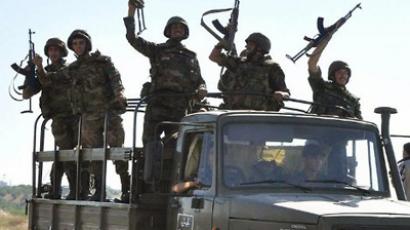
Syrian soldiers shout slogans in favor of President Bashar Assad from the back of an army truck, August 10, 2011 (AFP Photo / Str) 08.11.2011, 15:44 12 comments

Arab League ‘non-violent’ plan for Syria wins Russian support

With images of NATO’s use of excessive force in Libya in the rear-view mirror, Russia is calling for the international community to support a non-violent Syrian settlement plan put forward by the League of Arab States (LAS).

Arab world protests
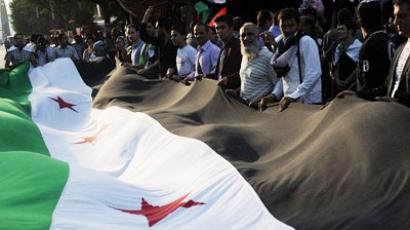
Pro-democracy protesters, holding a huge pre-Baath era Syrian flag (AFP Photo / MOHAMMED HOSSAM) 03.11.2011, 17:12 10 comments

Damascus sells peace but opposition isn’t buying

The Syrian government has agreed to an Arab League peace plan to end almost eight months of unrest that has left scores dead. However, with the opposition against any initiative that would leave Assad in power, the country remains as divided as ever.

Syria unrest

Syria's Assad grants general amnesty 'for uprising crimes'

Published: 15 January, 2012, 14:00
Edited: 16 January, 2012, 19:22

Syrian President Bashar al-Assad (AFP Photo / SANA)

(67.7Mb) embed video
TRENDS: Syria unrest

TAGS: Conflict, Crime, Military, UN, Protest, Politics, Kevin Owen, Anissa Naouai, Sara Firth, Opposition, Syria


President Bashar al-Assad has issued a decree granting general amnesty for crimes committed during the Syrian uprising which started in March 2011, the official government news agency SANA reported on Sunday.

­The amnesty reportedly covers those who took part in peaceful demonstrations, carried unlicensed weapons and those who have handed their weapons over to authorities before the end of January, as well as army deserters who fled their military service, but turn themselves in before January 31.

It was not announced, however, how many prisoners would be affected by the initiative. Since the outbreak of the uprising against President Assad, he has freed 3,952 prisoners. Thousands more are still being kept in prisons, according to international human rights organizations.

The release of all arrested protesters has been one of the Syrian opposition’s main demands, which has also been set in the country’s crisis settlement plan proposed by the League of Arab States. Observers from this regional organization are currently working in Syria.

Figures cited by the United Nations state that more than 5,000 people have fallen victims to Assad's crackdown during the nationwide protests. Syrian authorities, on the other hand, largely blame high death toll to armed gangs and say that 1,100 soldiers and police staff have been killed.

Meanwhile the Arab League said this week it would delay sending more monitors to Syria after the attack on an observer team. One of the league's numerous observers has already quit the mission, describing it as a "farce".

In an interview with Egyptian television, the Arab League chief Nabil al-Arabi admitted the LAS mission in Syria is not working as planned and that he fears a civil war may break out there if the situation does not change drastically. He echoed Sheikh Hamad bin-Khalifa Al-Thani – Qatari leader and a key supporter of the league – who said Thursday that a positive outcome for the mission was unlikely.

The Emir of Qatar went as far as suggesting that Arab countries should send troops into Syria to stop government forces killing civilians. He made this statement Saturday during his interview with US news channel CBS which will be aired this Sunday in the news program 60 minutes. Speaking about the conflict in Syria Sheik Hamad said, "For such a situation to stop the killing, some troops should go to stop the killing."

This is the first time an Arab leader has publicly called for military intervention in Syria. Qatar was the first Arab country to join the NATO-led operation in Libya.

­Sara Marusek, a Middle East researcher at Syracuse University, told RT that this exposes the double standards of the Arab League. “This call for interference or intervention in Syria really is quite ridiculous when one looks at the undemocratic past and present of these Gulf countries and how and why they believe they can use force to interfere in a country that is suffering from a civil war.”


embed video

­RT contributor and independent journalist Lizzie Phelan says that Assad’s recent move has received mixed reaction among Syrian people.

The reaction is very much seen as though the president is being very generous. He is releasing more people despite the fact that the situation in some parts of the country is still extremely tense. There are some concerns in some sections of the Syrian population that amongst the many people that are being released, there will be some criminal elements who will slip through the net.

Pepe Escobar, a columnist and correspondent for the Asia Times, believes the Arab League is, in effect, controlled by the Gulf Cooperation Council (GCC), a union of six Sunni Arab monarchies – Saudi Arabia, Kuwait, Qatar, Bahrain, the United Arab Emirates and Oman. In his view, the GCC is backed by the United States and NATO, and seeks to depose secular Arab governments, as it already has in Libya, and is trying to do in Syria. “This is a total clash between the Persian Gulf monarchies against Arab secular republics,” he told RT. “It was the case with Libya, it’s the case with Syria as well. Other members of the Arab League I’m not so sure. Even Tunisia is saying that if there is an Arab League coordinated intervention in Syria, this could be a horrible business because they know about the possible repercussions. Egypt is not saying anything either. So, the conflict inside the Arab League is not a conflict at all. It’s a sort of hegemony by the GCC[…] So on one side we have the US, NATO, the GCC – the Persian Gulf monarchies, on the other side we have Russia, China, Iran and a great deal of the developing world for that matter, who don’t want an overall war in the Middle East starting in Syria”.



embed video

+1 (1 votes)
 
Back to top
next MORE NEWS
View of Astana. Monument "Astana-Baiterek" (center) (RIA Novosti / Ekaterina Chesnokova) 15.01, 13:45 4 comments

Kazakh leader learns lessons from Gaddafi’s experience

Early parliamentary election in Kazakhstan comes just a month after the country was shaken by deadly riots in the town of Zhanaozen. And the time seems right for change in a country that does not want to follow in its restive neighbors’ footsteps.

Protesters clash with riot police on University Square in Bucharest on January 14, 2012 during a protest against the government's austerity program and Romanian President Traian Basescu (AFP Photo / DANIEL MIHAILESCU) 15.01, 16:19 11 comments

Protesters’ Molotov cocktails vs police tear gas in Romania (VIDEO)

Romanian police fired tear gas and protesters responded with stones and Molotov cocktails during an anti-government protest on Saturday in Bucharest. An unauthorized rally has been staged against proposed health care reforms.

AnAmerican January 20, 2012, 19:06
+1

Jim Evans wrote in #9

Why not create an international intervention force based on organisations like the CIA and Mossad....but under GLOBAL control and working for all of mankind rather than for Wall Street and the City of London....and an organisation that is transparent and fully accountable for its actions ....not like the Open Society Foundation or the BBC or Fox News!If the Saudis can run Saudi Arabia and Communists can run China what is so awful about Assad? 
And let`s quit all this #### about democracy......the USA is run by global organised crime....just like the UK......and Americans and Brits are powerless hostages in their own homelands.

I think the UN already has one of those...NATO. Kind of like what happened in Libya, it wasn't an American intervention. It was a international intervention using troops from NATO. (Which has US troops, as well as troops from various other countries.)

Too bad the accountability and transparency isn't there though....

I personally would rather have no intervention force, hell I wouldn't even want to have an army period. Unfortunately though in this world they are necessary for survival. 

Brian (unregistered) January 17, 2012, 21:50
+1

@ Geordiland

It was awesome man. totally agree.

Geordiland January 17, 2012, 21:09
+2

Alex (unregistered) wrote in #6

What is wrong with a majority on nations wanting regime change to move a murderous system to a democratic one. The only 2 countries who don't want change is Russia and China. As Russia is a major arms dealer to Syria it shows that people do not come before profit. In the next 10 years the Russians will be crying out for regime change, the west should sit back and start selling arms to the putins gangsters and you will get to see what life is like for the Syrians." 


What an absolute nonesense!Answer these two questions you good chap:

1. Is Syrian regime more brutal than Saudis, Bahrainis, etc towards their people (i.e. opposition)? Are there less Saudis and Bahrainis killed by their governments in recent years, proportional to their population?

2. Can you please name the 'majority of countires!' that you mentioned who want regime change in Syria? (for your info there are about 200 countires in the world, so you should name 100 who really want regime chang in Syria.

3. Name countries that dislike american government's policies and want an immediate stop to american hegemony in the world, and return of all its troops to their own contry.

Try to find answers to these questions by observing the international debates and other countires' media (not Fox of CNBC, etc). Keep the answer to yourself if you wish. But stop using funny logic and big words such as 'majority' on a public board that has visitors from all over the globe. Take care