Arab Spring sequel? Nigeria faces mass anti-government protests
Published: 13 January, 2012, 21:41
Edited: 14 January, 2012, 10:44
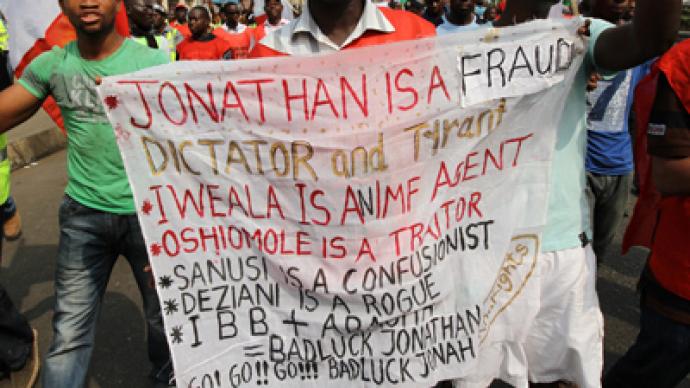
A man holds a banner as protesters march through a road on the third day of a protest against a removal of fuel subsidies in Nigeria's commercial capital Lagos January 11, 2012 (Reuters / Akintunde Akinleye)
TAGS: Oil, Religion, Africa, Protest, Terrorism
Nigeria is facing mass protests after the government canceled a fuel subsidy, effectively doubling gas prices. With anti-government feeling rapidly growing, some fear the demonstrations may soon turn violent, repeating the Arab Spring scenario.
Tens of thousands of people have been demonstrating in cities across the country since Monday, demanding fuel prices revert to their previous level before the authorities introduced the increase.
The demonstrations, which were originally triggered by the removal of the subsidy, later became generally anti-government in their mood, with further demands being made.
Protesters held anti-government banners calling President Goodluck Jonathan a ‘dictator’ and a ‘tyrant’ and demanding an end to corruption and poverty in the country.
Despite its oil resources, Nigeria, Africa’s most populous country, does not have a high standard of living. Half of its population of 160 million live on less than $2 a day. Following the increase in petrol prices, the cost of food and transportation has also skyrocketed, thus adding to people’s hardships.
The authorities say removing subsidies will save the national budget about $8 billion per year, which will then be spent on projects to improve the country's infrastructure.
But these promises do not convince protesters, who are fed up with the situation in the country. One protester, who was carrying a banner reading "Go Jonathan or die like Gaddafi,” told the Associated Press he was ready to storm the presidential palace.
Omoyele Sowore from Saharareporters.com online news magazine told RT that the uprising in Nigeria might turn into a revolution if protesters’ demands are not met.
“It can become a full-blown revolution if the government become intransigent and refuse to listen to yearnings and aspirations of the people, which is the first measure to put our need to roll back this criminal increase in prices of gasoline that is strangling the Nigerian people, especially the 99 per cent of Nigerians who are incapable of surviving on that with these strangulating economic policies pushed by the World bank, the IMF,” he said.

Major oil supplier to US
Nigeria’s trade unions are supporting the public protests with strikes. Some schools, banks and transport services have been closed since Monday.
The country’s main oil union has also threatened to shut down oil production on Sunday if the government does not reinstate the subsidy.
On Thursday President Jonathan met with trade union leaders in an attempt to avert the strike, which could have devastating consequences for the Nigerian economy.
Although no final agreement was reached, one of the union leaders called the meeting very productive, adding that the negotiations would continue on Saturday.
The union leaders said the government had offered a small subsidy to bring down gas prices, but the unions had rejected it as insufficient. However, the unions have agreed to suspend the strike for the weekend.
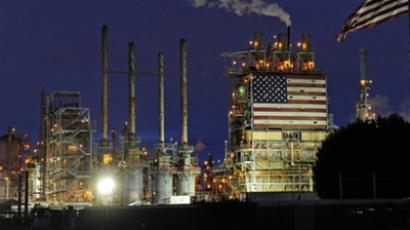
Nigeria is Africa’s largest producer of oil and the 8th largest exporter of petroleum in the world. The oil industry accounts for 40 per cent of GDP. The country is also the United States' largest trading partner in sub-Saharan Africa and supplies a fifth of its oil.
Given its vast oil reserves many protesters are puzzled by their poor economic situation and accuse the government of corruption and poor management.
Lawrence K Freeman, from the Executive Intelligence Review Magazine, told RT that Europe’s economy will face grave consequences if Nigeria stops exporting oil.
“The entire transatlantic financial system, especially the eurozone, is bankrupt. So you add the increasing price of oil from Nigeria’s two million barrels of oil pumped out each day and this could be the detonator for sinking the entire euro system.”
Freeman also warned that Nigeria could soon see very significant changes in the political landscape.
“It could go well beyond the economic issue into a generalized attack on the government. And if this continues, the government is losing $600 million a day in economic activity.”
According to Abayomi Azikiwe, editor of Pan-African News Wire, disruption of oil exports and crude production in Nigeria would have a profound effect on the country’s economy.
“Over 90 per cent of the foreign exchange earnings for Nigeria comes from the export of crude oil. It is solely dependent upon that resource for its economic well-being,” Azikiwe said. “Since 1956, four years even before the national Independence of Nigeria, the country has been dominated by the Western–based transnational oil corporations. They largely set the terms of economic structures and economic culture of Nigeria. Therefore any rise in fuel prices or any decline in fuel prices is bound to have a profound impact on the Nigerian economy, as well as the economies in the West, which heavily rely on oil imports from Nigeria.”
Protests amid sectarian violence
The protests come at a time when Nigeria is being torn apart by sectarian conflicts. On Tuesday religiously motivated attacks killed 13; a mob killed five people in a mosque in Benin City in the south, while in the north Islamist militants shot dead eight people in a bar.
The attacks in Benin City are believed to be a response to the atrocities committed towards Christians in the north of the country.
More than 80 Christians have been killed in bomb and gun attacks in recent weeks. Most of the attacks have been attributed to Boko Haram, a terrorist organization based in the north-east of Nigeria, which is seeking to establish an Islamic state in the country.
13.01, 19:41
9 comments
Handshakes over arms? Cameron visits Saudi ArabiaDavid Cameron’s first visit to Saudi Arabia is intended to “broaden and deepen” the UK-Saudi relationship. But as the British PM plays lip-service to the Arab spring, keeping the repressive oil kingdom armed remains on top of his agenda. |
13.01, 23:43
1 comment
Burning indignation: Tunisians still striving for change one year onOn the eve of the anniversary of regime change in Tunisia a female protester has set herself ablaze. As it is the fourth such case in a week, many ask if anything has changed since a similar self-immolation triggered the revolution nearly a year ago. Arab world protests |
group considered the brainchild of western intelligence agencies themselves. The suspicion is that the terrorist organisation is a classic neocolonialism's trojan horse to destabilise Nigeria and facilitate unhindered plunder of Nigeria's oil by US , ISREAL and the EU. The Isrealis had set up a base in Chad under Hissene Habre for subversion against Libya, DRC and Nigeria. The people have had enough and have begun to move against the twin evil of foreign intrigue and local corruption.
Nigeria has been a looter's paradise under the rule of an extremely reactionary ruling class given to looting of the treasury and kowtowing to western powers. The current regime distinguished itself in the act of servility to the USA and NATO during the LIbyan invasionby currying imperialisms favour in recognising the Libyan mercenaries even while the AU was resisting and opposed to recognition. It further capped the submission to imperialist dictate in admitting foreign intelligence operatives to assist it against aterrorist


The zionist western media reports on conflict in northern Nigeria between Christians and Muslims is a lie!
Israeli zionists are planting bombs in Christian churches in nigeria and blaming it on boko haram. It is an attempt to start a civil war between Christians and Muslims!
The Israeli "Security advisers" visiting Nigeria are Israeli secret service agents. They are not visiting Nigeria out of the kindness of their hearts! They are there to set up fake terror group fronts and plant bombs in churches!