VERSIONS: روسيا اليوم NOTICIAS FREEVIDEO ИНОТВ RTД
breakingnews
Go to main page   News   ‘Politicians can’t control Euro crisis’  
MORE ON THE STORY
Athens : Greek Prime Minister George Papandreou speaks during a debate on the confidence vote at the Greek Parliament, in Athens, on November 4, 2011.  (AFP Photo / Louisa Gouliamaki) 06.11.2011, 19:05 1 comment

Greek PM agrees to resign

Greece's President has finished hosting crunch talks between the country's Prime Minister and the main opposition chief. George Papandreou and the opposition leader have reached an agreement on forming a unity government under a new leader.

Eurozone crisis
Greek Communists chant slogans at the Athens' Syntagma square in front of the Greek Parliament during a rally in Athens on November 4, 2011 (AFP Photo / STR) 05.11.2011, 22:50 8 comments

‘Euro could be dead in a month’

Greek PM George Papandreou is aiming to form a coalition government and push through an international bailout package. However Patrick Young, executive director of investment advisory firm 'DV Advisors' views the situation as a political disaster.

Eurozone crisis
George Papandreou speaks during a debate on the confidence vote at the Greek Parliament, in Athens, on November 4, 2011 (AFP Photo / Louisa Gouliamaki) 05.11.2011, 03:08 2 comments

Greek PM Papandreou survives vote

The fate of the Greek government has been in the balance, facing a knife-edge confidence vote. But the results of the vote show that some scraps of trust in Greece’s PM still remain.

Eurozone crisis
Nouriel Roubini (AFP Photo / Tony Ashby) 04.11.2011, 22:34 10 comments

Roubini predicts eurozone collapse; world markets will follow

Noted American economist Nouriel Roubini says the eurozone is in the midst of crumbling, and with the rest of the world’s future at stake with a potential collapse, they might want to listen up — Roubini has been right before.

Eurozone crisis
Young doctors and medical school students protest outside the Health Ministry in Athens against austerity measures on November 2, 2011 (AFP Photo / Louisa Gouliamaki) 04.11.2011, 21:25

‘Greece is no longer a sovereign state’

As Greek Prime Minister George Papandreou abandons plans to hold a referendum on the bailout program granted to Athens by Germany and France, analysts say Greece is now so deep in the debt pool that now it is ruled by creditors.

Eurozone crisis
A stockbroker look at his screens, while a television monitor shows Greek Premier Giorgos Papandreou delivering a speech, at the Frankfurt stock exchange in Frankfurt, Germany, November 3, 2011 (AFP Photo / Arne Dedert / Germany Out) 04.11.2011, 15:53 1 comment

Greek PM placed on confidence trial

Greek PM George Papandreou confirmed the planned referendum is off after widespread rebellion from within his Socialist party. And there is an increasing probability the confidence vote will result unfavorably for Papandreou.

Eurozone crisis
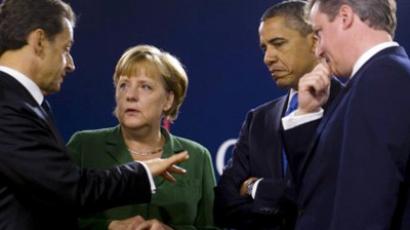
French President Nicolas Sarkozy (L) talks with German Chancellor Angela Merkel (2ndL), US President Barack Obama (2ndR) and British Prime Minister David Cameron prior to the start of a round-table meeting on November 3, 2011 during the G20 Summit of Heads of State and Government in Cannes (AFP Photo / Jim Watson) 04.11.2011, 12:02 8 comments

One-sided story: Greece hijacks G20 summit

The Greek turmoil has taken over the G20 summit in Cannes, France. Observers have only been able to guess just what it was that Angela Merkel and Nicolas Sarkozy said to the Greek Prime Minister that caused his backtrack on referendum plans.

Eurozone crisis
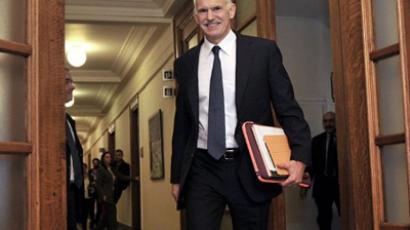
Greek Prime Minister George Papandreou proceeds for a cabinet meeting on November 3, 2011 in Athens (AFP Photo / LOUISA GOULIAMAKI) 04.11.2011, 01:47 8 comments

Greek PM scraps plan for referendum

Greek Prime Minister George Papandreou has scrapped his plan for a referendum on the EU bailout package. Earlier he denied rumors of his possible resignation.

Eurozone crisis

‘Politicians can’t control Euro crisis’

Published: 06 November, 2011, 20:48

Europe's main stock markets reacted amid fears that a Greek referendum on its latest bailout deal could derail the Europe's grand plan to fix the region's crushing debt crisis. (AFP Photo / Daniel Roland)

(49.1Mb) embed video
TRENDS: Eurozone crisis

TAGS: Crisis, Politics, Europe, Currencies, Tesa Arcilla, Banking, Economy, Finance, Greece


As Greece awaits the formation of a new "unity" government, Arjo Klamer, chair of economics at Erasmus University in Rotterdam, told RT that even if the new coalition is formed, it is unlikely to make any difference.

­“The big problem the Greek government has is to get its population behinds its plan. And it doesn’t seem that the people in Greece are willing to put up with all the measures that are being taken,” he explained.

The Greek PM must resign – that is the demand of the country’s opposition, if the political deadlock is to come to an end. The head of Greece's main opposition party said George Papandreou was "dangerous" and has called for early elections.

According to senior government officials, Papandreou could announce his resignation later on Sunday, hoping it will pave the way for the formation of a coalition government. Meanwhile Athens is fast running out of time to implement a crucial EU bailout plan intended to save the country from bankruptcy.

If George Papandreu resigns in the next few hours, this political solution will not do much good for the situation in Europe as a whole, believes Klamer.

“The Greek are rather disturbed, even though they say they want to hold on to the euro, they do not want to put up with the measures being imposed on them. The new government can create some sort of solution for some time, but the resistance is building up and then I see that the same thing is happening in Italy where they also have to take measures that the Italians are not willing to live with,” he stated. “I don’t think the politicians have the measures and instruments to control this crisis,” he added.

In order to get the bailout money Greek politicians have to push on with these measures which, Klamer maintains, are drastic.

“We call it a cold turkey approach. It means reducing salaries and government spending, causing a lot of hardship among the Greeks. That’s the price they have to pay for the euro. And whether the Greeks want to go along with it is doubtful. If it does not work, and all politicians understand that, then there will be serious consequences not just for the Greeks, but also for the banks which may go bankrupt if they Greeks themselves go bankrupt,” he pointed out.

Papandreu shocked EU leaders by announcing a referendum, resulting in the threat of being kicked out of the EU, but France and Germany still seem set on saving Greece. In fact, it is not Greece they want to save, but their own banks, explains Klamer.

“Greece is too small to care about, but it is a threat for the European economies because German and French banks are heavily involved in Greek debt, so they are really concerned and in this case they were so strict about it because they saw that the referendum would push the whole thing forward,” he concluded.


+3 (3 votes)
 
Back to top
next MORE NEWS
Athens : Greek Prime Minister George Papandreou speaks during a debate on the confidence vote at the Greek Parliament, in Athens, on November 4, 2011.  (AFP Photo / Louisa Gouliamaki) 06.11.2011, 19:05 1 comment

Greek PM agrees to resign

Greece's President has finished hosting crunch talks between the country's Prime Minister and the main opposition chief. George Papandreou and the opposition leader have reached an agreement on forming a unity government under a new leader.

Eurozone crisis
Russian national Ekaterina Zatuliveter (also known as Katia) arrives at special immigration appeals tribunal in central London, on October 27, 2011 (AFP Photo / Carl Court) 06.11.2011, 22:23 3 comments

New victim caught in 'blonde Russian spy’s' web?

The London-based suspected spy, Ekaterina Zatuliveter, 26, compromises another government official after a German Foreign Ministry employee sends hundreds of emails “to Russia with love”.

Alexandra November 07, 2011, 16:55
0

Bianca you took the words rigt out of my mouth!Well said! I just wished more people would search for the truth rather than settle for mainstream propaganda news. Greek people are strong and they have been through many tides in their past. They will win this battle soon...

Bianca November 07, 2011, 03:32
+1

What games are being played on poor people of Greece!  They are naturally afraid of the chaos that will ensue by breaking with Euro, yet, the fears are being blown  out of proportion in order to get the population sign up to a deal that pays for the EUROPEAN BANKS SPECULATION, not for any loans that Greek people actually took to cover their budgetary needs.  This is a heist, and the population is blackmailed.  Politicans are for the most part cowardly people.  They are looking to protect their priviledges, and at the moment, that means being ULTRA NICE to banks.  Same goes to the "mainstream" media, that propagates the fear, and is hoping for the popular resignation to decades of slavery.   This may work for one round.  But as sure as sun rises and sets each day, the banks will be back FOR MORE.  The problem is, nobody REALLY knows the depth of their black holes, the SHADOW BANKING SYSTEM that sucks up all the wealth.   They will be back, and back and back.  The question is,  will the politicans stand up for the interest of the public, or will continue to feed the monster.   My guess is, they will not move a finger until the peasants come with pitchforks.

Nay Lin Maung November 07, 2011, 02:53
0

Change has to come with some price to pay for it.


If Greece people like to take hard ship for their decision, they can elect new officers in the office.