VERSIONS: روسيا اليوم NOTICIAS FREEVIDEO ИНОТВ RTД
breakingnews
Go to main page   News   Egypt’s new regime rules with an iron fist  
MORE ON THE STORY
Hungary, Budapest: Egyptian President Hosni Mubarak gives a statement for the press with his Hungarian counterpart Laszlo Solyom in the Maria Theresia Hall of the presidental palace at Buda Castle in Budapest on October 13, 2009 after their official talks. (AFP Photo / Attila Kisbenedek) 04.08.2011, 02:00 3 comments

Mubarak trial shows that tyrants are not gods

Today Egypt enjoys greater transparency and freedom of expression than it did under Hosni Mubarak, the deposed president who appeared in a Cairo court today, according to Egyptian journalist Yehiye Ghanem.

Arab world protests
On Wednesday, Egypt witnessed the first day of the trial of deposed leader Hosni Mubarak. 03.08.2011, 22:17 2 comments

"Keep your head up Mubarak!" – Egypt trial in photos and details

On Wednesday, Egypt witnessed the first day of the trial of deposed leader Hosni Mubarak. RT’s Oksana Boyko is following the trial, and shares here her views on the ideological shift that happened in the Egyptian society after the revolution.

Egyptian Salafi demonstrators attend a rally in downtown Cairo's Tahrir square (AFP Photo / Khaled Desouki) 03.08.2011, 11:35 4 comments

Hungry Egyptians don’t care about democracy

The economic perils, which were one of the major reasons why Egyptians took to the streets in January, are only getting worse. Unemployment is at an all-time high and millions are struggling to make ends meet.

Arab world protests
Egyptians carry posters showing Egypt's ousted president behind a noose as they gather outside the court set up in the Cairo Police Academy, August 03, 2011 for his trial and that of his two sons (AFP Photo / Marwan Naamani) 03.08.2011, 09:04 1 comment

Mubarak in the dock: historic trial for Egypt's ex-president

Ousted Egyptian President Hosni Mubarak has appeared in court over charges of embezzlement, corruption and sanctioning the killing of protesters during the February uprising. Mubarak has pleaded not guilty to all charges.

Arab world protests
An Egyptian shouts slogans during a protest of Islamist groups at Tahrir Square, the focal point of Egyptian uprising, in Cairo, Egypt, Friday, July 29, 2011 (photo from daylife.com) 29.07.2011, 17:27 3 comments

Egyptian protesters back on Tahrir Square

In Egypt, the crowds are back in Cairo's Tahrir Square, five months after the ousting of President Mubarak. Thousands have gathered in the city center, in what has been one of the largest demonstrations since the February uprising.

Egypt unrest Arab world protests
An Egyptian supporter of ousted president Hosni Mubarak holds his portrait at the Appeals Court in Cairo on Juy 21, 2011 (AFP Photo / STR) 22.07.2011, 02:03 2 comments

Egypt’s government reshuffle is theatrical – Cairo professor

Those who participated in the revolution in Egypt feel fooled by the new government’s appointments, and now start to remember Hosni Mubarak’s rule as a better time.

Egypt unrest Arab world protests
Cairo: Egyptian pro-democracy activists demonstrate on July 1, 2011 in Cairo's landmark Tahrir Square to keep up the pressure on the country's military rulers over the pace of reforms. (AFP Photo/Khaled Desouki) 01.07.2011, 20:04 1 comment

Muslim Brotherhood might call shots in dealing with US - professor

The US Secretary of State has announced that Washington has been in contact with Egypt's Muslim Brotherhood. Mark Almond, an international relations professor, says the main question is who is going to be the dominant partner in this relationship?

Egypt unrest
EGYPT, Cairo : Egyptians walk at Tahrir Square in Cairo on June 29, 2011 after bloody clashes between protesters and anti-riot police that raged overnight in the landmark square erupted in new scuffles amid mounting frustration with Egypt's military rulers over the pace of reform (AFP Photo / Khaled Desouki) 30.06.2011, 23:23 4 comments

Egyptians are not going to forgive the US – journalist

Hundreds of people have been injured as more riots sweep through Egypt. Journalist Afshin Rattansi believes the activists are angry at the interim government because there have been no improvements since Hosni Mubarak was toppled in February.

Egypt unrest Arab world protests
An Egyptian protester flashing the victory sign during a protest at Tahrir Square in Cairo on March 18, 2011 (AFP Photo / Aris Messinis) 24.03.2011, 08:49

Fears of regression in Egypt’s brave new world

Nearly 80 percent of voters have supported the changes in Egypt in a constitutional referendum that was seen as one of the main aims of the recent uprising. But several weeks after it, the wheels of the old political machine still seem to be turning.

Egypt unrest Arab world protests

Egypt’s new regime rules with an iron fist

Published: 05 August, 2011, 09:39

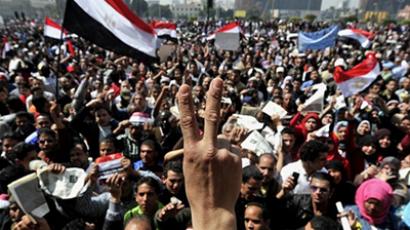
Egyptian protesters wave their national flag and shout slogans as thousands crowd Cairo's landmark Tahrir Square on July 15, 2011 to demand political change as anger grows with the military rulers over the slow pace of reform (AFP Photo / Mohamed Hossam)

(34.2Mb) embed video

TAGS: Conflict, Health, Military, Africa, Protest, Politics, Human rights, Oksana Boyko, Tesa Arcilla, Opposition


The passionate youth of Egypt who drove the revolution of Tahrir Square are now being shot or jailed by the military junta and its courts. The developments form a sinister backdrop to the trial of the country’s former president and his allies.

­Hosni Mubarak denied the charges against him on the first day of his hearing, where he was accused of ordering the deaths of protesters back in February.

The hearing, which will continue in ten days, could culminate in a possible death sentence for Mubarak.

The 83-year-old was in a hospital bed as he stood trial alongside his two sons and top aides, who are also accused of corruption and mass-killing.

Even with new faces in government, blood is still being spilled on the streets of Egypt.

Many of the protesters killed last February were too young to vote, yet old enough to die for their country. Today, a portrait of one of them, a 17-year-old boy killed by police on Tahrir square last winter, adorns one of Cairo's central thoroughfares. There is even a talk of naming a street after him.

What makes someone a martyr and another a thug? In Egypt right now it is the date of death. Those gunned down prior to Mubarak's resignation are celebrated as patriots who gave up their lives for the brighter future of their country. Those killed after his ousting are sometimes referred to as criminals who sought to undermine their country's democratic strides. And it does not matter that they shared the same goals. In Egypt these days justice is about power and not the other way around.

That is the most likely reason behind the growth in influence of Islamist groups in Egypt where debate is intensifying over whether the post-revolution country will become a Sharia-ruled state.

Another young man RT met with also counted himself among the children of the revolution. Along with his younger brother, he celebrated Mubarak's departure on Tahrir, believing it to spell the end of the police state. Three months later, the young man was killed in what his brother believes was a government sanctioned shoot-out.

“An army sniper shot my brother dead, the bullet went through his forehead and it came out on the other side. I saw it. No one here has a weapon like this – only soldiers do,” said Cairo resident Reda Radian Malak.

Unlike the families of people whose deaths are being blamed on Mubarak, these people received no monetary compensation for their loss. In fact, they are increasingly worried that the new military authorities may label them as thugs – an all-encompassing term for those who don't appreciate the new military rulers.

“We expected the army to intervene, to protect people, to stop violence, but instead they started to kill people themselves,” recalls Reda Radian Malak.

The Supreme Council of the Armed Forces took over as Egypt’s interim caretaker government when Mubarak stepped down. Brought to power by the protests, the generals, nevertheless, do not show much liking for mass gatherings.

The cradle of the Egyptian revolution – Tahrir Square – is now cordoned off by riot police. Those caught protesting are accused of public disturbance and tried in military courts.

“In the last seven months, there have been more people put on military trials than during any of the president Gamal Abdel Nasser’s reign, President Anwar Sadat’s reign or president Hosni Mibarak’s reign,” claims Egyptian human rights activist Noor Noor.

A scar on his forehead still has not healed but Noor Noor believes he got off lightly from his encounter with the police a month ago. A son of the former presidential contender who was jailed by the Mubarak regime, Noor says the new authorities are just a brutalized version of the old.

“There is a very little difference between the people who are ruling us now and Hosni Mubarak, and many of the crimes Mubarak committed against his people are currently been committed against us now by the people from the Supreme Council of armed forces that are ruling right now,” the human rights activist confides. “Whether it is using violence or oppressing the people, or even manipulating public opinion. But sadly – and this is what hurts more – these crimes are now being committed in the name of the revolution.”

Noor Noor keeps a bloodied t-shirt as a reminder that the Egyptian revolution is far from over. The former president is now on trial for his role in the mass killings but blood is still being spilled on the streets of Cairo.


+1 (1 votes)
 
Back to top
next MORE NEWS
US troops from the Combined Task Force 1-67 under Afghanistan's International Security Assistance Force (ISAF) patrol with armored vehicles in Arghandab district in southern Afghanistan, the former stronghold of Taliban insurgents, on July 29, 2011 (AFP Photo / Romeo Gacad) 05.08.2011, 09:36

“US can afford defense budget cuts” – former Pentagon official

Capitol Hill's cash may be scarce, but there will be no dipping into what is the world's biggest military budget. Defense Secretary Leon Panetta gave law-makers a firm ‘hands off’ and said cuts should come from Medicare and social services instead.

The Russian Mir submersibles are used for underwater research (RIA Novosti / Nikolay Ryutin) 05.08.2011, 11:02 2 comments

Russia gets piece of Atlantic mineral pie

Russia has plans for an ambitious mining project on the Atlantic seabed. The 10,000 square kilometer area, which may have one of world’s richest deposits of gold and copper ore, was awarded to Russia by a UN seabed body.

StG 44 August 10, 2011, 12:02
0

The lesson of this is, there is no such thing as a "peaceful revolution." This was a self-coup d'etat by the rulers of Egypt. It was done to pre-empt a real revolution. And alas, unless there are defections from the army or they are armed by external powers, the people of Egypt will never have the weapons they need to take their nation back from its pro-banking, pro-zionist rulers.

Nay Lin Maung August 05, 2011, 20:47
0

Real liberal democratic politic methods are not good for the Asia countries.


Caveman August 05, 2011, 14:34
0

the news of a hard crack down on the protesters by the egyptian military (still the same structures in power as pre-Mubarak) is again a taboo for the western media. Here, the Swiss Narional Radio is instead reporting daily and at length about "the atrocities commited by the Syrian governmen", this obviously with the intend to prepare the public for the comming intervention of NATO...