Between landmines and apples
New satellite research indicates that for the past million years, the politically disputed Golan has been moving closer to Israel – bringing thousands of Druze closer to the country they do not wish to be a part of.
Despite the conclusions of the scientists at the Geological Survey of Israel, Syria to this day claims the picturesque mountain area of 1250 sq km, rich in water and apples. And it is Syria of which the Golan Heights’ Druze consider themselves citizens. Caught between two states at war, they build houses, marry, grow apples, fly Syrian flags and work in Israel.
Fake jaws full of white plastic teeth stare at me. It is a busy dance floor of dentists who jostle each other, taking their chances with the dentistry vendors. Dentists in suits discuss dentistry and consume five-star hotel appetizers. The Mediterranean Sea peeks through long windows. It is a dentistry seminar in Tel Aviv's Hilton. Amid the bustle is Majdi Ibrahim – a dentist from the Golan. That evening, I will be welcomed to an Eid Adha (Muslim holiday) dinner with his family.
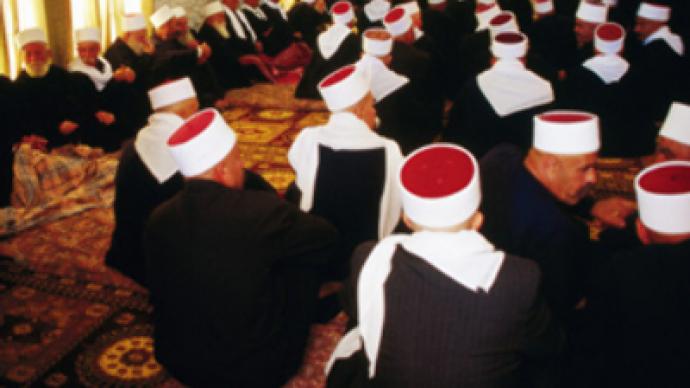
The Druze are a mystical offshoot of Islam, dating back 1,000 years, now mostly confined to Israel, Lebanon, and Syria.
Prior to 1967, the Syrian population of the Golan Heights was roughly 140,000, living in two cities and 164 villages. Almost all of them were uprooted during and after the war of 1967, forced to relocate to refugee camps around Damascus, and today numbering around half a million people. Following Israel's conquest, the two cities and 130 villages were destroyed, and a population of 7,000 stayed in the six remaining villages. Today there are around 20,000, the majority Druze, concentrated in five villages: Majdal Shams, Masadah, Buqatah, Ain Kinya, and Ghajar. There are a similar number of Israelis in 33 settlements.
Art and aftermath
“Being from the occupied Golan I could not understand the meaning of occupation until I spent 6 years in Damascus, during that time I started to feel and understand all the conditions which formed my vision and mood. I started to derive the elements and components for my art from acknowledging my presence under occupation,” says Randa Mdah, a sculptor from Majdal Shams. I was told in Fateh Mudarris Center of Arts and Culture a story of art's birth in the shadow of war.
In 1981, Israel declared its legal authority over the Golan Heights. The Israeli government tried to force Israeli citizenship on the Golan Druze, who in return rebelled against it. Unlike the Israeli Druze in Galilee, who took citizenship in 1948 and serve in the Israeli army, the Druze in the Golan resent Israel. However, they are a part of Israel's economy, allowed to travel freely and are ruled by Israeli law.
The artists gather for a discussion about a nude statue which is upsetting some Druze shaikhs. One of the center's founders, Wael Toraby, said, “art first found its way to the Golan community in 1982 through the door of patriotism. Before they saw artists as war heroes!” As the years went on, young artists started to look at the world beyond the Golan and so their work started to break traditional Druze boundaries. Wael studied art in St Petersburg during the ’90s. Wael is from the second generation of artists in Majdal Shams. Young Randa Mdah is from the third generation who have studied art in Damascus. The eldest is Hassan Khater whose bronze statues have stood in two village squares since the ’80s. The statues portray Sultan Basha Atrash, the Syrian leader of the anti-French uprising of 1925. Hassan's patriotic works began the Druze interest in art.
The artists feel disconnected from Arab art networks and the Arab world, while they can't recognize themselves in Israel. “Most of the Golan artists refuse to associate with Israeli art circles, and Israelis aren't comfortable with political criticism,” Randa added that the only option left is the nascent Palestinian art movement. Despite being Syrians yet holding an Israeli laissez-passe, a substitute to the Israeli passport, these young artists are shut out from Arab countries with sanctions against Israel. They end up seeking opportunities in conflict torn Palestine, or in Jordan and Egypt who have a chilly peace with Israel.
Two weddings and a funeral
When Israel occupied the Golan, the Golan Druze were separated from their relatives in Syria. Between 1976 to 1979, Israel allowed family reunions in a tent in a demilitarized zone patrolled by United Nation forces, a no man's land between the two states. The reunions were arranged by the Red Cross (ICRC) and monitored by Israeli security. In 1979, the reunions were stopped because of the Golan Druze resistance movements against Israeli authority.
After the Madrid Peace Conference in 1991, Israel allowed the first Golan students to travel and study in Damascus. The Israeli government also allowed 500 religious men to travel to Syria on pilgrimage every year. And women were allowed to visit their families in Syria for a few days, however only in special cases. Then, the stories of the Golan marriages started.
“Mostly, people met during their studies in Damascus and later they got married,” says Assad Safady, from the Golan's ICRC office. The weddings take place at the Quneitra check-point, a group of selected relatives and a bride with a groom waiting on the other-side, celebrating with joy and tears. The bride says goodbye to her family and home – only brides are allowed to cross the border. That is how the weddings of Roweida and Waleeda Hamd took place. I met them at their father's funeral.
The two sisters had 10 days in Syria to spend with their dying father who was taken by cancer. For the first time in 10 years they had a chance to see their home. “If I go to our land near our house, I can see my village,” says Waleeda. “Nobody cares about our situation, that we are separated from our families, we can see them only in such extreme cases like this. We had to show a photo of our father's skeletal body to get permission for a visit,” says Roweida. She met her husband 10 years ago while studying in Damascus, and Waleeda met her husband in Jordan eight years ago.
The crossings of the Golan Druze are arranged through the Israeli interior ministry which in return checks with the security department, the ICRC comes as a mediator between them and the Syrian government. “The Knesset passed a law in 2005 regarding family reunions, which in order to cross the border from Syria to Israel, the latter must receive the security file of the visitor, and of course the Syrian side will not provide such information,” says Assad. As a result, there are fewer marriages between Syrian and Golan Druze, the last one was in 2008. Over 70 marriages took place since 1993, according to the ICRC.
Before technology took over and after the tent was closed, the separated families gathered daily on two hills that the ceasefire line runs across. They shouted through loudspeakers across 200m of air between them – the Shouting Valley. I heard a loudspeaker shattering the peacefulness of the mountain night, announcing the death of a man who had a heart attack when he met his mother after years of separation.
The fruits of their hands
The clouds run through the mountains, crossing Syria into the Golan villages, heedless of the border. The strategically-important Golan Heights remains a bone of contention between the two states, with Syrians insisting on its return as a condition of peace and Israeli leaders reluctant to cede the territory. The Golan contributes 30% of Israel's fresh water supply, in addition to US$422 million for its treasury annually from tourism and agriculture.
Apples are the prime source of income for the Golan community. The Golan Druze sell their fruit to Israel and Syria. “We trust the Syrian government to pay, but we do not know about other countries,” says Assad Safady from the ICRC. He explained what complicates the export of Golan apples to other neighboring countries is that all of them are in a state of war with Israel. “Those countries will ask for a certificate of origin, and although these are apples from the Golan Druze, according to the certificate they are coming from Israel.” None of the Middle Eastern countries – beside Syria – are willing to take responsibility for importing Golan apples, and the Golan Druze have neither enough capital nor infrastructure to export their fist-size apples to foreign countries.
“The Golan Druze were the first in Syria to grow apples in 1946, there were two kinds: Golden and Starking,” remembers Soleiman Maqt, “now there are around 88 types here.” He also remembers the time of the day when Israeli troops came to the Golan in 1967 – 3:30 in the afternoon. Soleiman's son Basher was recently released from jail and his other son Sedky is still in an Israeli prison on security charges.
Jebel As Sheihk or Mount Hermon as the Israelis call it, is capped with Israeli military installations and affords a view of the Syrian capital Damascus Sameh Ayuby, in his 50s, proudly talks about the glory and patriotism of the Golan Druze and the return of the Golan to Syria. He went to jail for working with the Syrian secret service during the 1980s and now he is not even permitted to travel to Jordan to meet his brother. However he agrees that “there are economic benefits from the occupation and the society is open” – not that he enjoys that very much. Sameh thinks that resistance will bring the Golan back to Syria.
“The occupation in a way opened the community here, back in Suweida [a Druze town in Syria] the community is not liberal like here,” says Nabih Halaby. He is one of Golan's middle-aged entrepreneurs who has ideas but no means. He is also one of the young men who participated in the military and political resistance in the 1980s and was sentenced to four years in an Israeli jail. Despite being a communist, he sees his opportunities in a rather capitalistic market – he is a middleman. Nabih finds illegal Palestinian workers to work in Israel's construction sector. Unlike Sameeh entrepreneurs like Nabih prefer business over fighting.
Leftovers of war
“Danger mines!” bright yellow signs pop-up here and there across the Golan Heights. A large part of the area is either heavily mined, or is suspected of being mined – as old mines may drift during heavy rains. There are no exact maps or information available on the mines or their types, other than they are antipersonnel mines, useless against the tanks that battled across the Golan in 1967 and 1973, but deadly against people. Dr. Jameel Abu Jabel, a lawyer from the Arab Center for Human Rights in Golan 'Al-Marsad', explains that Israel keeps the information classified for security reasons. “Due to the restricted conditions on the Israeli side, it is very hard to do any research on the minefields case,” he adds.
Field research carried by Al-Haq (a Palestinian human right NGO) showed there are 76 minefields in the Golan Heights, some of them close to or inside inhabited villages. Since the 1967 war, 16 people have been killed by landmines and 45 disabled. Under international law, the occupying power is responsible for eliminating landmines that endanger the lives of civilians. “We do not know why the Israeli government does not want to clean the area, they say for the security reasons,” Dr. Jameel says. The Golan inhabitants see the minefields as an indirect control over them. Dr. Jameel added that there is little attention to the issue from international organizations. Life has adapted around the minefields.
While Syria and Israel tug the Golan Heights between them, like two puppies with a bone, The Golan Druze wait for a miracle to happen. And while it hasn't yet happened, they build a future in the Israeli Golan. The young miss the days they spent in Damascus as students. They find work in Israel where they get paid four times more than if they were in Damascus. And they hope to get out and see the world. Apples are a profitable yet paralyzed trade, as subject to politics as everything else in the shade of the Israeli-Arab conflict. Their fathers still recall the glory of 1980s strikes, Sultan Basha, and hang Syrian flags beside five-colored Druze ones. This is life until the miracle of peace comes.
Mona Abouissa for RT