US promoting Iran sanctions in China
While Iran is seeking support in South America, the US is trying to convince the world’s second largest economy, China, to back its sanctions aimed at Iran's Central Bank and oil industry, though it seems unlikely Beijing will be swayed.
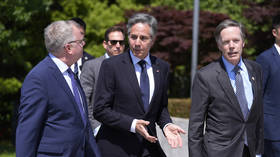
US Treasury Secretary, Timothy Geithner met with the Chinese President's Special Representative and Vice Premier Wang Qishan in Beijing on Tuesday.Wang underlined the importance of mutual cooperation and ensuring global economic recovery. He said the US and China had a lot of issues to talk about in the areas of economy, finance, trade and investmentGeithner stressed that stable economic development conforms to the interests of the two countries. “We are always looking for ways to expand trade and investment with China to strengthen our economic ties,” he told his Chinese counterpart.On Wednesday, Timothy Geithner has met Vice President Xi Jinping who is in line to become China's next leader. And Premier Wen Jiabao, and Vice Premier Li Keqiang.China is the world’s biggest energy consumer and buys almost one-third of Iran’s oil exports. And it has rejected the US sanctions as a tool against Tehran’s nuclear program.China’s deputy foreign minister Cui Tiankai said on Monday that China's oil imports “have nothing to do with the nuclear issue.”“We should not mix issues of different natures, and China's legitimate concerns and demands should be respected,” he said.Beijing earlier stressed it supports nuclear nonproliferation efforts, but believes Iran is entitled to develop peaceful nuclear energy. It called for talks between Iran and the West in order to build mutual trust.China is against unilateral sanctions against Iran, noting that dialog is the only way to resolve the remaining issues over Tehran's nuclear energy program.Later on Wednesday, after talks in Beijing, Geithner is expected to visit Japan, another major consumer of Iranian oil.Professor Michael Klare from Hampshire College told RT that China will listen politely but will not follow US advice and will not turn against Iran. “I don’t think that the Chinese are inclined at this moment to take orders from Washington especially since President Obama last week announced a new defense policy that is implicitly anti-Chinese.”Klare expressed doubts that China sees Iran’s nuclear ambitions as a threat because in his view the few nuclear weapons Iran might conceivably have are in fact “an insurance policy” against possible US attacks. “I don’t think Iran would ever use them in an offensive manner against anybody else.”The Chinese are more worried that instability in the Persian Gulf would create an economic crisis and eventually harm their economy, he explained.Klare believes that the US will be trying to convince China that it may fall victim of the actions of Iran’s leadership, such as its closing of Strait of Hormuz, for example. “The US will try very hard to portray this as defense of the freedom of the seas, not as an attack on Iran.”
Professor of Political Science at the City University of Hong Kong Joseph Cheng concurs that Chinese authorities will probably promise to consider the American request to limit its oil purchases from Iran, but will not resort to any particular action.“Ultimately I do not believe that Chinese authorities would like to be seen cooperating with the US to exert pressure on Iran,” he told RT. “Iran after all, remains a very important energy supplier to China. Especially because Iran’s relations with the US are not good and Iran has a specific strategic interest to maintain close relations with China.”
Francis Lun, managing director at Lyncean Holdings, an investment company in Hong Kong, is convinced that though the US has some incentives to persuade China buy less oil from Tehran, it is very unlikely to work out. “There are a lot of things the US can offer in return,” he told RT. “One of the things is an agreement to consider the new Chinese economy as a market economy. It would be very difficult then for the US to impose countervailing duty on Chinese goods. The US and China are the biggest each other’s partners [sic] and there are a lot of things US can do to entice China to buy less from Iran”. “But on the geopolitical sense it is very hard to imagine that China will comply with the request from the US, because US is trying to impose [sanctions] unilaterally,” he went on. “And China wants a balance of power in the world. It is dangerous for one country to be so powerful, with everyone have to play a subservient role to the US.”