
VERSIONS: روسيا اليوم NOTICIAS FREEVIDEO ИНОТВ RTД
breakingnews
Go to main page   News   UK, Germany vie for influence in debt-hit EU  
MORE ON THE STORY
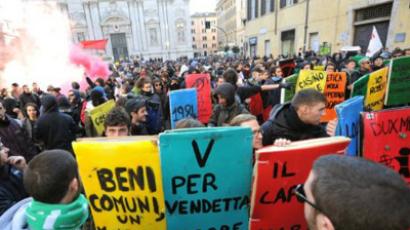
Students march during a demonstration to protest against the cuts in the education budget and against the austerity measures in Europe on November 17, 2011 in Rome (AFP Photo / Andreas Solaro) 18.11.2011, 13:09 2 comments

EU crisis management ‘stuck in past’

Massive protests have shaken Rome and Athens, where demonstrators riled against their new eurocrat leaders. Greece and Italy are seen as the teetering dominos that could spell the end of the whole eurozone.

Eurozone crisis
Demonstrators burn an EU flag during a protest in Thessaloniki on November 17, 2011 (AFP Photo/Sakis Mitrolidis) 18.11.2011, 08:35

Greeks in streets again: ‘Austerity junta’ warned

Thousands of Greeks have taken to the streets of Athens in a warning to the new PM, effectively appointed by Brussels.

Eurozone crisis
A picket to protest against the anti-austerity measures that hit Greece (AFP Photo / FRED DUFOUR) 17.11.2011, 22:03 4 comments

Fierce clashes, firebombs as thousands flood Athens (VIDEO)

Masked youngsters have attacked police in Athens as tens of thousands poured onto the streets to protest the unity government’s public spending cuts and steep tax hikes.

Eurozone crisis
Students and demonstrators pose during an action to occupy the gardens of the Venice Biennale of art to protest against the cuts in the education budget and against the austerity measures in Europe on November 17, 2011 in the laguna of Venice (AFP Photo / ANDREA PATTARO) 17.11.2011, 19:59 1 comment

Italians rage as bankers take over

Italian protesters clashed with police Thursday as thousands took to the streets around the country in anger at budget cuts and the Brussels-backed “bankers’ government.”

Eurozone crisis
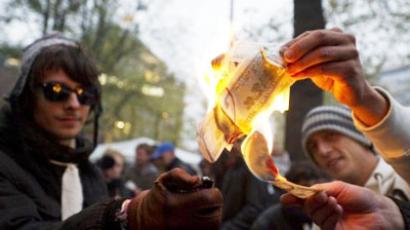
Protesters burn fake bills as they still camp in front of the Beursplein 5 stock exchange building in Amsterdam (AFP Photo / VALERIE KUYPERS) 17.11.2011, 11:43 4 comments

Dutch ditch euro? Netherlands ‘Neuro’ plan

Its hour has struck and the eurozone's second-most stable economy, the Netherlands, is beginning to feel the first hand effects of contagion, with the previous apathy among its taxpayers quickly giving way to animosity.

Eurozone crisis

UK, Germany vie for influence in debt-hit EU

Published: 18 November, 2011, 16:19
Edited: 19 November, 2011, 03:21

David Cameron and Angela Merkel (AFP Photo / Odd Andersen)

(16.4Mb) embed video
TRENDS: Eurozone crisis

TAGS: Meeting, Crisis, Protest, Merkel, Politics, Budget, Matt Trezza, Government Spending, Big deal, Economy, Global economy, Cameron, Laura Smith


German Chancellor Angela Merkel has hosted talks with British Prime Minister David Cameron on Friday, as the two countries fight to take charge over their troubled common continent.

­Following their talks, the two politicians urged decisive action to help stabilize the eurozone. None of the key issues upon which they disagree were mentioned.

­Substantial differences

­As austerity measures in Italy and Greece are accompanied by changes in the countries’ governments, Merkel calls for more integration in the eurozone.

Though she has declared readiness to give up some sovereignty, this is seen by some British MPs as an attempt to have more control over the continent.

UK Independence Party leader Nigel Farage has warned of a “German-dominated Europe” speaking at a European Parliament debate.

“None of you have any democratic legitimacy for the roles you hold,” Farage reminded the Members of Parliament, comparing them to hyenas for their common role in the taking down of Papandreou. “Into this vacuum, albeit reluctantly, in steps Angela Merkel, and we are now living in a German-dominated Europe, something this European Union was supposed to stop.”

Cameron, contrary to Merkel, is pushing for less integration, eying the UK taking powers back from Brussels to achieve more economic and political flexibility.

While members of Merkel’s Christian Democratic Union (CDU) party have repeatedly attacked Britain for its lack of support of Europe, British MP’s declare their unwillingness to live in a German-dominated Europe.

The controversial “Robin Hood” financial transactions tax remains the main economic stumbling block.

It threatens London’s position of a major financial center, so the British are reluctant to accept it.

CDU’s leader Volker Kauder was very vocal in his criticism of the UK for opposing the move, blaming it for defending its own interests only.

Another source of tension is the role of the European Central bank. The British and the French want to lend money as a last resort. Merkel expects that to involve printing money and inflation, which scares the Germans.

Some British media went as far as to write of certain “leaked German documents”, which talk about a secret plan to create a whole new economic order in the center of Europe.

­Journalist and author Alan Woods told RT that in his view, the whole experience of the recent crisis demonstrates the impossibility of unifying economies which are pulling in radically different directions.

“They [the leaders] come out smiling, they agree there is a need to do something. But when it comes down to concrete proposals on what is to be done, there is no agreement at all – there is sharp disagreement, particularly between Germany and Britain, but I would say also among other European countries. These tensions are not going to get any better – they will get worse.”


embed video

0 (4 votes)
 
Back to top
next MORE NEWS
Students march during a demonstration to protest against the cuts in the education budget and against the austerity measures in Europe on November 17, 2011 in Rome (AFP Photo / Andreas Solaro) 18.11.2011, 13:09 2 comments

EU crisis management ‘stuck in past’

Massive protests have shaken Rome and Athens, where demonstrators riled against their new eurocrat leaders. Greece and Italy are seen as the teetering dominos that could spell the end of the whole eurozone.

Eurozone crisis
AFP Photo / Attila Kisbenedek 18.11.2011, 17:15 17 comments

Eurasian Union: Greater than EU, but not new USSR

Three former Soviet republics have launched a new regional integration project, with at least two others on track to join in. Critics accuse Moscow of rebuilding the USSR, but architects of project say the aim is to become a better version of the EU.

Bianca December 26, 2011, 01:35
0

It is getting comical.  Competing for the influence?  How about competing for the responsibility to fix the problem?  I do not blame UK for not wanting to be part of EU.  That is their choice, and for them, it may be just the right decision.  But, for crying out loud --- how can UK have the nerve to tell others what to do?  A country that does not want Euro, and did not participate in any effort (with money that is, not talking) to address the debt crisis --- suddenly want influence in Europe? 

If it were not true, one would laugh.   

Alan (unregistered) November 21, 2011, 02:40
+1

Orac4Prez wrote in #7

How can anyone realistically take any notice of the English.  They aren't part of the Euro monetary union. Their economy is an absolute basket case and they want to take charge!  Get Real. All they want to do is pick (steal) the best parts of the Euro union without being prepared to actually participate in an ethical manner. David Cameron is incompetent and less credible than any of the Prime Ministers of the PIGS!   Talk about the blind wanting to lead the blind...


Well, the British (not the English) are one of 5 Permanent members of the UN Security Council, they still have the 5th or 6th biggest economy in the world, they are a cultural super-power and also remain a major military power.  Not bad for a little island!  Maybe that's why she commands so much attention...

AcrossHU November 19, 2011, 12:03
+2

It’s true that German firms and products flooded E.U., and this is the main cause of crises.

Germany is doing the same in Europe, what the US in the world, the only difference is that it uses only technological superiority and bribery tactics to oppress others without military threatening.
Europe failed because it deepened the gaps between the nations and people instead of alleviating them. They created tension instead of harmony, which on long run destroys the system.