VERSIONS: روسيا اليوم NOTICIAS FREEVIDEO ИНОТВ RTД
breakingnews
Go to main page   News   Space powers propose roadmap for flight to Mars  
MORE ON THE STORY
Phobos-Grunt in orbit (Photo from ralfvandebergh.startje.be) 14.12.2011, 13:47 10 comments

US, Japan, Australia? Mars probe will hit Earth in January

The ill-fated Phobos-Grunt probe that got stuck in the orbit after an unsuccessful launch will fall to Earth on January 11, probably affecting four continents, the US Strategic Command shared its latest forecast.

Russia has launched the country's first interplanetary mission in 15 years (image from http://www.federalspace.ru) 10.11.2011, 20:42 17 comments

Martian curse: Russian probe may crash in populated area

Russian scientists are struggling to get the country's first interplanetary mission in 15 years back on track. Should they fail, the probe that was due to head to the Martian moon Phobos may well turn into the “most toxic falling satellite ever.”

The Zenit-2SB rocket carrying the Phobos-Grunt module taking off from Baikonur space center in Kazakhstan (RIA Novosti / Oleg Urusov) 09.11.2011, 11:42 1 comment

Three days to save Martian moon probe

Russia launched an unmanned probe to one of Mars’ moons – Phobos – in the early hours of Wednesday, but it has hit technical trouble. Federal Space Agency officials say they have three days to sort the problem out.

Mars 25.02.2009, 13:36 6 comments

Russia to send mission to Mars this year, Moon in three years

The Russian Luna Glob mission to the Moon is set for 2012, informs ITAR-TASS news agency. The mission aims to collect lunar soil samples and will help to choose a landing site for future missions.

23.12.2008, 18:36

Manned flight to Mars one step closer?

An experiment based on a manned flight to Mars is planned to be launched in March 2009. Ten candidates have been selected for participation in the 105-day-long experiment.

Members of the Mars500 crew Alexey Sitev of Russia (front C), Romain Charles of France (back R), Sukhrob Kamolov of Russia (back C), Diego Urbina of Italy (front R), Alexander Smoleevskiy of Russia (back L), and Wang Yue of China (front L) smile for the press before being locked into the Mars500 isolation facility in Moscow on June 3, 2010 (AFP Photo / Alexander Nemenov) 04.11.2011, 10:07 6 comments

Mock Mars mission ‘returns’ to Earth

The crew of the international “mission” to Mars has finally “returned” to Earth in Moscow, bringing one of the world's most grueling scientific experiments to a close.

Mars-500
Director of the "Mars-500" project Boris Marukov (RIA Novosti / Grigory Sysoev) 03.11.2011, 11:06 2 comments

Raising a foot to step on Mars: 17-month virtual trip over

The ambitious experiment simulating a manned mission to Mars is coming to an end on Friday, when the virtual space travelers will “land” back on Earth. RT has spoken to the head of the project Boris Morukov.

Space powers propose roadmap for flight to Mars
Published: 05 January, 2012, 16:18

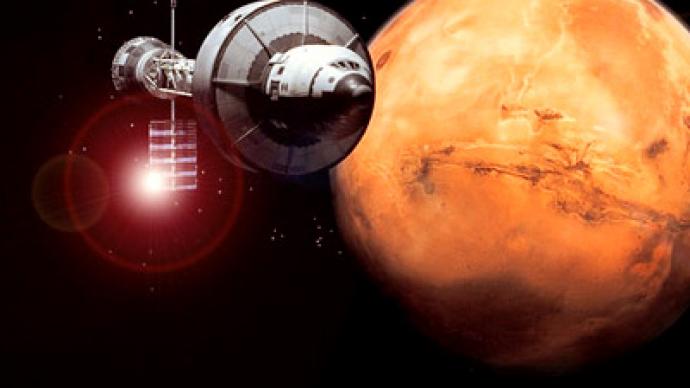
Image from infokart.ru

Image from infokart.ru

TAGS: Space, Russia, SciTech, Crisis, Politics, Economy


Despite various economic issues undermining efforts by the world’s leading space powers to forge a program for future manned flights to the Red Planet, an international working group has come up with a universal space exploration roadmap.

­The effort by the partner nations in the International Space Station project, namely Russia, the United States, Canada, Japan and the European Space Agency, was also supported by China, India, Kazakhstan, Ukraine and other countries.

"This is not merely an ISS club, but a broader project," the chief of human spaceflights programs of Russia’s federal space agency Roscosmos, Aleksey Krasnov, added.

The proposed roadmap may be based on three alternative routes: preparation of a manned expedition to Mars from scratch, the testing of technologies on the Moon prior to a flight to Mars, or a flight to an asteroid followed by a journey to Mars.

"Which of them will be chosen has yet to be decided," Aleksey Krasnov explained, adding that any of the options would suit Roscosmos.

"Our position is that the Moon could be an intermediate point for testing new know-how and new approaches to human spaceflights, and only afterwards could a step be made towards Mars, which is our goal," he said.

"Talks have been uneasy thus far. You can see what is going on in the world economy,” Krasnov told Interfax-AVN. “Such programs require government-approved funding, which is the most difficult goal for all of us. It is very difficult to give the go-ahead to billions in funding required to accomplish flights beyond low orbits amid such serious economic instability. We have not forged a final decision yet."


+1 (1 votes)
 
Back to top
next MORE NEWS
Khimki forest felling begins in the vicinity of the Sheremetyevo airport (RIA Novosti/Alexander Vilf) 05.01, 11:28 4 comments

Timber barons wreak devastation in Russia’s Far East

Russia’s coastal region on the border with China, some 8,000 kilometres from Moscow, is the meeting point of two mighty rivers – the Amur and the Ussuri. It harbors some of the most incredible habitats for the country’s wildlife.

Communist-affiliated protesters, including many laidoff workers, gather in the center of Athens on December 20, 2011 during a rally to demand immediate measures for the unemployed (AFP Photo / Louisa Gouliamaki) 05.01, 19:05 4 comments

‘EU lacks sense of society to politically unite’

“A monetary union without political union is impossible to maintain,” economist Arjo Klamer said 20 years ago. And as Europe struggles to deal with the euro crisis, the EU countries are still too different to politically unite, Klamer told RT.

Eurozone crisis
rodfel2001 April 22, 2012, 14:23
0

Something is bothering me. They say that Mars has no magnetic field and we know that a planet must be protected by a magnetic field against the CME (Corona Mass Ejection.)
If Mars has no magnetic field, what will protect a living organism on its surface when the Sun will get angry? Another thing, if Mars has no magnetic field, it's either its cores are non metallic or if they are, they're simply not rotating and if they're not rotating, they don't supply any output and the planet surface is left unprotected against the CME.

I think that the first thing mankind must think about primarily is how to protect any future colony against asteroid fallout and CME, unless all of our settlements will be undergrounded. Who knows! Maybe in the future we will find a way to restart the planet cores (if they are static) and restore the Magnetic field, then, we will be able to reengineer the Atmosphere and make the planet's surface suitable for human settlement.

For the time now, I don't see the usefulness of going on Mars, if not for the prestige. Why not go to the moon and use it as a training platform for more deeper space exploration. In fact, the Moon has everything we need for our planetery exploration training. It is a planet and as such is supposed to be rich in resources. Why risking a long trip to practically deep space without a permanent settlement on the moon. If something goes wrong at least a rescue mission will have a four hundred thousand kms head start and much weaker gravity to deak with on its way out. Unless, as they say, we never made it to the moon and we still don't know how to deal with the Van Hallen belt. 

 power plant is dead.

Majed January 06, 2012, 17:00
0

they can't make a manned flight to mars because they never reached the moon. why do you think they never made it to the moon since last century? the answer is simple: because it is impossible. there is a van allen radiation belt litlle further from earth which humans can't cross because the radiation would be too great over there. you would see shooting stars with your eyes closed! the aircraft would have to be very thick to pass through this belt that is why only unmanned vehicles can be sent. watch the movie moon landing hoax and it will show you that gagarin never made it to space!

Vlada (unregistered) January 06, 2012, 07:33
+2

Why go to Mars before making trip to Moon a more perfunctory action? Besides, Moon is much closer and making a permanent base there would help to improve space technologies needed for a very complicated Mars mission (later in the future).

I believe that any of the leading space nations (China, Japan, Russia) could get to the Moon in a relatively short term, say 2 years, if they would really decide to do that. I think US wouldn't be able to get to the Moon that quickly (say, 3-5 years) due to NASA has already become an ineffective, money-eating organization (some private US contractors could do that more efficiently).