VERSIONS: روسيا اليوم NOTICIAS FREEVIDEO ИНОТВ RTД
breakingnews
Go to main page   News   Ordinary Syrians will bear brunt of sanctions  
MORE ON THE STORY
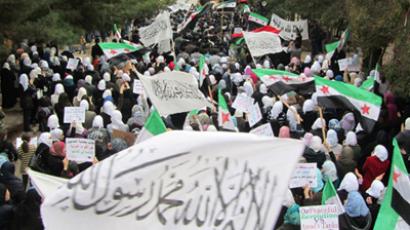
Syrian anti-government protesters waving the former Syrian flag during a demonstration in Khirbet al-Ghazaleh (AFP Photo / Youtube) 21.12.2011, 14:59 5 comments

Russia calls for 'efficient influence' on Syrian opposition

In an effort to stabilize the situation in this embattled Arab Republic, Russia is calling for some degree of influence exerted on the Syrian opposition, which has been rebelling against the government of President Bashar al-Assad since January.

Syria unrest
The aircraft carrier "Admiral Kuznetsov" (RIA Novosti / Sergey Eshenko) 21.12.2011, 12:56 83 comments

Russian navy in Syria: Thorn in US side

The US-based intelligence-gathering firm Stratfor says most of the claims by the Syrian opposition about the seriousness of the country's crisis are untrue. The company insists protesters are exaggerating, to win support from powers like the US.

Syria unrest
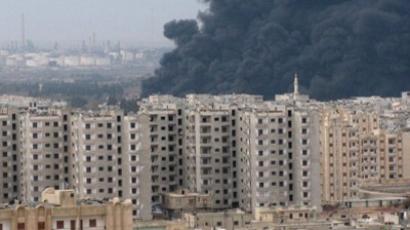
Thick plume of smoke rising above an oil refinery, situated to the west of the flashpoint city of Homs(AFP Photo / SANA) 20.12.2011, 10:49 10 comments

Syrian opposition calls for foreign intervention

Syria's opposition wants an Arab military intervention to “protect civilians from government security forces” – even after Damascus signed an Arab League protocol allowing observers to monitor a regional peace initiative to end months of bloodshed.

Syria unrest
Black smoke is seen from Homs refinery December 8, 2011, Syria (Reuters / SANA / Handout) 21.12.2011, 12:44 4 comments

Fighting in Syria continues ahead of observer mission

Syria's opposition is divided over whether they need military help from outside in their fight against the government. The split became apparent as the country witnessed some of the fiercest battles in its nine-month-old crisis.

Syria unrest
Demonstrators protesting against Syria's President Bashar al-Assad march through the streets in Homs December 13, 2011. (	
REUTERS/Handout) 16.12.2011, 00:56 3 comments

‘Syria in danger of repeating Libyan scenario’

London-based political analyst Chris Bambery told RT that there have recently been increased calls for foreign intervention in Syria, mostly by the Syrian National Council.

Arab world protests

Ordinary Syrians will bear brunt of sanctions

Published: 22 December, 2011, 10:53
Edited: 23 December, 2011, 03:53

Posters of Syrian President Bashar al-Assad decorate a street in Jabal Mohsen area (AFP Photo / Joseph Eid)

(27.7Mb) embed video
TRENDS: Syria unrest

TAGS: Crisis, Politics, Human rights, Marina Dzhashi, Sara Firth, Economy, Syria


Arab League observers are due to arrive in Syria on Thursday as part of a plan to halt violence. That is after one of the bloodiest weeks since the beginning of the unrest, with more than 200 people having been killed in the last few days.

­The US has renewed its call for President Assad to step down, warning of new international measures unless it withdraws security forces from the streets. Syria is already suffering under a set of sanctions.

The unrest in Syria has been ongoing for nearly ten months now, but the capital, Damascus, has remained largely sheltered from the conflict. In fact, in the bustling center, it seems like business as usual. But as winter sets in, the winds of change have been blowing a little stronger. The Arab League has imposed tough economic sanctions, and their effects are being felt even in Damascus.

In a poor area in the suburbs of the capital, Um Firas’s family struggles to make ends meet. In order to support his wife and son, who has learning difficulties, he sells fava beans for a living, barely making 150 Syrian pounds a day – about US $3.

And now, the fuel for his vending cart has become harder to get hold of, with shortages due to the economic sanctions driving petrol prices up.

“There are fewer products available and the prices are being pushed higher,” Um Firas told RT.
“There have been fights over gas. We have been trying to manage by cutting back as much as we can. Sometimes, when we can’t afford it, we just don’t eat.”

The economic situation in Syria is one of the areas where President Assad had been seen to be making progress, albeit slowly. But for a population which had started seeing the results of economic opportunity, blocked financial transactions, fuel shortages and power blackouts have now become the norm.

“Because of the economic sanctions, people rush to stockpile fuel and gas just in case,” a local resident explains. “People are a little bit afraid of the fact that water or gas might run out, and this is why you see these queues.”

Put in place by the Arab League, it was hoped the sanctions would force the government’s hand when it came to ending the violence in the country. But inside Syria, many feel it is everyday people who are being punished. And it is feared there could be even darker financial times ahead.

“The share prices on our stock market are slowing down,” says Mamoun Hamdan, a CEO at Damascus Securities Exchange. “It’s affected by some laws. For example, the increase of the capital of all private banks in Syria and the increase of interest rates of the banks are affected indirectly by the decisions of investors.”

An advance team from the Arab League will be paving the way for an observer mission due at the end of the month. Much of the opposition, though, remains skeptical about whether even that will bring about any real change.

For those caught up in the worst conflict areas, change cannot come a moment too soon. It is imperative too for families like Um’s, who are finding life under the sanctions increasingly desperate.

­‘They won’t encourage Assad to act differently’

­Sibel Edmonds, founder of the National Security Whistleblowers Coalition, says sanctions will only provoke violence in Syria, causing deeper restlessness in the conflict-ridden country. “And this is what we have been doing from our base in Turkey, from dropping leaflets to actually having defectors working with the US and NATO, trying to provoke violence,” Edmonds says.

She adds that what the US is doing will not calm the situation, or encourage Assad to change his actions.

“I’m not a big fan of Bashar Assad, but neither am I a defender of Bahrain or Saudi Arabia. Even with Egypt – what was it: we were absolutely supporting Mubarak’s regime, and then we changed our stand, and started putting our NGO friends – and these are the US government's friends – to actually support, fund and direct the uprising.”


­


embed video

+1 (1 votes)
 
Back to top
next MORE NEWS
Iraqi Vice President Tariq al-Hashimi  (AFP Photo / YASSER AL-ZAYYAT) 21.12.2011, 23:54 7 comments

Iraqi sectarian schism widens as Kurds harbor fugitive VP

The Iraqi Prime Minister has demanded that Kurdish authorities hand over the country’s Vice President Tariq al-Hashemi, who fled to the country's Kurdish region to evade an arrest warrant issued on terrorism charges.

Paula Slier  shares what never made it into her live news reports. 22.12.2011, 11:05 3 comments

RT’s 10 that shaped 2011: Egypt Revolution

With 2012 just nine days away, RT continues its own countdown with ten special reports on events that have shaped 2011. We are looking back at major stories through the eyes of RT correspondents who witnessed them.

RT's top 10 of 2011
Nay Lin Maung December 23, 2011, 02:19
+1

It is what the prices of the citizen has to pay no matter what happened in country of the Syria because western countries try to close the doors for the government Syria not to do businesses with other countries.


Adef December 22, 2011, 14:49
+1

This proves what maliki are saying , the fact that hachemi is responsible of this killing with the help of saudi arabia and USA

Jandy December 22, 2011, 14:39
+1

Usual US strategy for psychological warfare. Target the civilians and destroy a country from inside.

Attack on Hiroshima and Nagasaki  both civilian city instead of Japan HQ.

Dresden through WWII over 200,000 civilian victims.

Vietnam, Serbia, Iraq, Libya and now Syria. The target in Western are always civilian, same tactic as mafia who kills family relatives rather than an opponent...