Russians celebrate the birth of Christ
Published 6 Jan, 2011 14:00 | Updated 11 Jan, 2011 20:50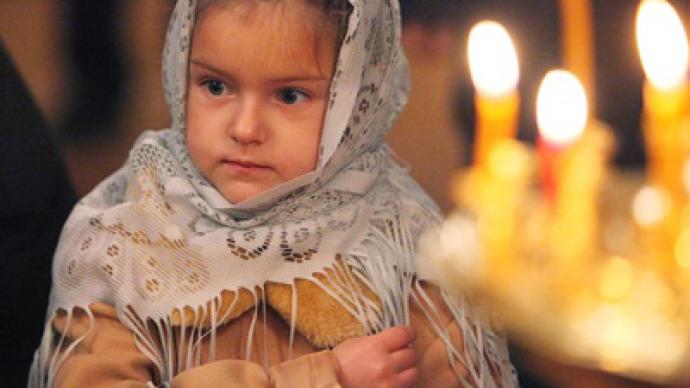
Russian Orthodox Christians are celebrating Christmas, which according to their Church’s calendar falls on January 7.
Russians mark religious feasts following the Julian calendar, which was introduced by Julius Caesar in 46 B.C. As a result, Orthodox churches celebrate Christmas 13 days later than those using the Gregorian calendar, which was adopted in 1582.This Christmas Eve, vigils were being held in roughly 8,500 monasteries and churches all across Russia.The Patriarch of Moscow and All Russia, Kirill, led a service in Moscow before starting an all-night Christmas vigil in Christ the Savior Cathedral. An estimated 5,000 people attended the ceremony, including Russia’s president, Dmitry Medvedev, and his family. The traditional Russian Orthodox Mass includes liturgy that lasts more than an hour. A number of other Orthodox churches also celebrate Christmas on January 7, including those in Serbia, Ukraine, Georgia, Macedonia and Montenegro.Previously Christmas was celebrated in Russia on December 25, much as it was elsewhere in the Christian world. But after the Revolution in 1917, the holiday was banned throughout the Soviet Union, along with other religious celebrations. It was only in 1992 that the holiday began to be openly celebrated again. Today Christmas is widely celebrated in Russia. People usually gather together with loved ones, go to church and then enjoy a holiday dinner after a day of fasting from dairy and meat products.Sergey Gerbilsky is a child of the Soviet Union, which slapped a ban not only on freedom of speech, but on freedom of faith too. He and his wife Olga traveled a lot. They lived in Canada and Brazil, but nowhere is Christmas so solemnly recognized as in Russia. Sergey believes it is not only about buying gifts and having a good time. ‘We cook Lent dishes on Christmas Eve, go to church and never decorate a fir tree for New Year. It took a while to explain it to our child, that a Christmas tree is decorated on Christmas only – for God and not for Santa,' says Olga.Today this child of emigrants is happy to be back in a country which has returned to its roots.Father Georgy Roshchin from the Russian Orthodox Church’s Public Relations Department announced that Christmas service in the main Orthodox cathedral of Christ the Savior in Moscow lasted until 2:30 a.m. The same schedule was followed at most other cathedrals in Russia; however, in some monasteries all-night vigils were held that lasted up to seven hours. “It’s a free service [in the Christ the Savior Cathedral in Moscow], anyone can go inside the cathedral and share the prayers with his Holiness Patriarch Kirill,” he said. “Most of the people like to go to their own parishes, where they go regularly to celebrate with their own priest. Christmas is a very merry and happy holiday.”