VERSIONS: روسيا اليوم NOTICIAS FREEVIDEO ИНОТВ RTД
breakingnews
Go to main page   News   Protesters clash with Mubarak supporters in Cairo  
MORE ON THE STORY
02.02.2011, 09:39 3 comments

Egyptian president refuses to step down, will not seek re-election

After more than a week of violent protests across the country, Egypt's president Hosni Mubarak has announced he will not seek re-election in September. This has not stopped the protests, demanding Mubarak steps down.

Egypt unrest Arab world protests
Cairo: Egyptian protestors pray on February 1, 2011 at Cairo’s Tahrir Square. (AFP Photo / Mohammed Abed) 01.02.2011, 22:44 7 comments

Cairo: million-strong demonstration

The streets of Cairo are empty. Cars are pulled over by the police after every 50 or 100 meters.

Egypt unrest Arab world protests
EGYPT, Cairo : An Egyptian army soldier joins a crowd of Muslim demonstrators during a prayer at the Tahrir square in central Cairo January 30. (AFP Photo / Marco Longari) 31.01.2011, 23:11

“ElBaradei suits everyone but only as an interim leader”- Russian political analysts

Amid ongoing violence in Egypt, political analysts all over the world try to predict whether Mohhamed ElBaradei could be a compromise leader and finally oust President Mubarak.

Egypt unrest Arab world protests
AFP Photo / Mohammed Abed 31.01.2011, 09:35 3 comments

Egyptian opposition unites against Mubarak

The Egyptian opposition has come together as a united force after six days of bloody anti-government riots. The nationwide demonstrations to remove President Hosni Mubarak from power have resulted in more than 100 killed and thousands injured.

Egypt unrest Arab world protests
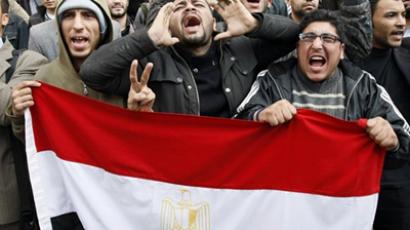
Egyptian demonstrators hold their national flag during demonstration in Cairo (AFP Photo / Mohammed Abed) 31.01.2011, 17:39 11 comments

Mubarak hopes to thwart "mega protest" with new government

Egyptian President Hosni Mubarak, in an effort to defuse a precarious political standoff that has entered its seventh day, has sworn in a new government.

Egypt unrest Arab world protests
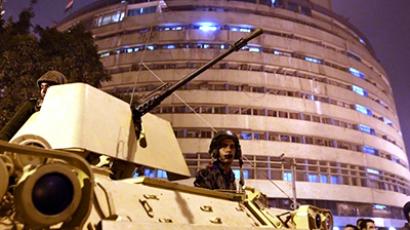
Egypt, Cairo : Members of the Egypt's President Hosni Mubarak Republican Guard deploy outside the national television building in Cairo on January 28, 2011.  (AFP Photo/Khaled Desouki) 28.01.2011, 23:45 3 comments

US eyes Middle East unrest with own interest in mind

Protests inspired by the revolt in Tunisia have dominoed along Egypt, Yemen and Algeria with citizens calling for governmental change. What will this mean for US involvement in the region?

Egypt unrest
AFP Photo / Marco Longari 31.01.2011, 11:32 1 comment

Russians advised to leave Egypt amidst turmoil

Russia’s Foreign Affairs Ministry expressed hope that the situation in Egypt would become stable soon while, at the same time, strongly urging Russian citizens to postpone trips to the country.

Egypt unrest

Protesters clash with Mubarak supporters in Cairo
Published: 02 February, 2011, 18:45
Edited: 16 February, 2011, 15:44

(21.3Mb) embed video

TAGS: Arms, Conflict, Election, Military, Scandal, Africa, Middle East, Protest, Politics, Paula Slier, Nadezhda Kevorkova, Opposition


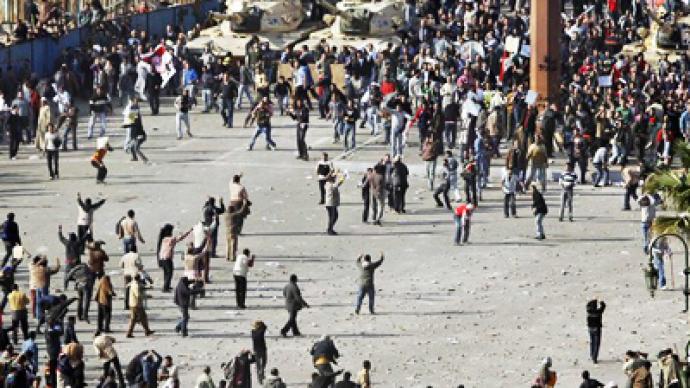
On Wednesday over 200,000 Egyptians gathered in downtown Cairo to protest against President Hosni Mubarak, along with thousands others in support of the regime. The list of people injured in these protests has grown hundreds of names longer.

At least 500 more people were injured during clashes between protesters and police on January 2. One person was reportedly killed. The death toll of the nine-day unrest has risen to 300 people, and more than 8,000 people have been injured.

The most brutal clashes were witnessed on Tahrir Square, the main square of Egypt’s capital. Shooting was heard around the area. However, it was not clear who opened fire, Al Jazeera reported. According to journalists, the army might have opened fire in the air to make the clashing sides calm down.

Government supporters tore down anti-government banners and engaged in fights that left some injured. The opposition is urging Egyptians to continue protesting, AP reported, despite Mubarak’s announcement that he would not seek reelection in September. The announcement did not stop the protestors from demanding that Mubarak step down now.


Kevorkova, RT

According to RT correspondent Nadezhda Kevorkova, who reported from the opposition demonstration in Cairo, protesters were flocking to the city center. Many of them were students, though there were also women, some with children. They had difficulty getting to the square through the walls of supporters of the Mubarak regime.

They [government supporters] are being brought from all over the country,” she said. “There are groups of them who get violent and start hassle people here and there. Some of them are throwing stones into the crowd. There are many injured, who mostly get help right here on the square.”

The two sides reportedly threw stones at each other. It was difficult to say which one started the fight.

Several thousand supporters of Mubarak, including some riding horses and camels, attacked anti-government protesters. The latter, however, dragged at least six attackers off their horses and badly beat them up with sticks, AFP reported.


Kevorkova, RT

According to RT correspondents in Cairo, the army was nowhere to be seen. It was maintaining a perimeter border, standing firm on the city’s outskirts. Earlier on Wednesday, the army issued a statement on Egyptian state television calling for the protests to stop. That appeared to be the first word that the military seemingly does not support the demonstrations.

“Protestors have seized several tanks, armored personnel carriers and other army vehicles,” Kevorkova reported later on Wednesday. “Officers and soldiers simply left the vehicles. The army is inside the Cairo Museum, behind fences, and does not undertake any actions.”

“People, at the same time, are still arriving to the square, forcing pro-government supporters back. The two sides continue pelting each other with stones,” RT’s correspondent explained.

Author and radio host Stephen Lendman believes that Washington is behind the events unfolding in Egypt:

“It is no question that the street anger is very real. There’s no question that Egyptians, that the vast majority of them, want Mubarak out, and they want real change. And it’s practically no question in my mind that Washington has had a long standing plan to remove him.”

embed video

­Dahlia Scheindlin, an international political consultant speaking from Tel Aviv, believes the Israeli government is very concerned over the unrest in Egypt and against destabilization as Israel does not have too many friends in the region.

The only thing Israel can do right now is to project that it’s willing to work with whatever government is democratically elected [in Egypt] and not try to close doors right now. But Israel has a lot of fears on its mind, and it is not just some general fear, it is particular things. Israel is afraid of Islamic take-over in Egypt. Israel is afraid of destabilization spreading to Palestinian areas. Israel is afraid of a leader who might not be a full partner in dealing with Iran,” Dahlia Scheindlin concludes.


embed video

­“Will that 30-year-old peace we’ve had with Egypt last?” asked pro-Israel advocate Neil Lazarus, summing up Israel’s current mood toward the recent events in Egypt. Lazarus points out that there is a generation in Israel that does not even remember the 1979 handshake between Menachem Begin and Anwar Sadat.

The Arab world today is saying, ‘If that can happen in the streets of Cairo, perhaps it can happen here,’” Lazarus said. “So democracy does seem to be spreading. The question is, will that democracy lead to a rise of Islamic fundamentalism, or will it continue the peace process that Israel has been looking for with other countries and the peace they have already with Egypt and Jordan and the process with Palestinians?


embed video

Fabrizio Tassinari, head of the Research Unit on Foreign Policy and EU studies at the Danish Institute for International Studies and author of the book “Why Europe Fears Its Neighbors,” believes Europe takes too little interest in the politics of its southern neighbors.

“The European Union was clearly taken by surprise by the events in Egypt and those in Tunisia,” he said. “It has always had very close ties with most of the governments in those regions, so it would be only natural if the EU took a much more proactive stand once the uprisings on the streets had actually calmed down.”


embed video

+5 (7 votes)
 
Back to top
next MORE NEWS
02.02.2011, 15:15 3 comments

Russian court sentences Jehovah’s Witness for resisting treatment of son

A Russian court has fined a woman for rejecting doctors’ advice to allow her five-year-old son to have a blood transfusion. Her decision resulted in the boy’s death in hospital. The verdict is the first such precedent in the country.

02.02.2011, 20:17 2 comments

Obama’s turn to sign New START treaty

A new nuclear arms reduction treaty between Russia and the US is closer to coming into force as Barack Obama signs off the ratification document in the Oval Office in Washington DC on Wednesday.

START treaty
Larry February 03, 2011, 05:22
0

My heart goes out to those brave Egyptian protesters. All they want is a normal lifestyle...I can't tell if Mubarak is just moronic or really cynical....He had a chance to live out his days at home until now...but..now that he's unleashed his thugs he's going to have to leave town...Before he could have explained that one of the major tenets of Democracy is that the loser doesn't get killed...but now...

endy February 03, 2011, 01:57
0

Weather you call it spreading a democracy or dictatorship in the Middle East orchestrated by the CIA USA and Israel one thing is clear--the Jews and USA are losing foothold in the region.

PR101 February 02, 2011, 23:08
0

Bogdanov Brutality works to a point and there is slightest doubt in mind that what have witness today on the streets of Cairo was privately OK in Washington. In fact there is a brilliant article that backs this assertion on today’s edition at the U.S popular left learning website counterpunch. This indicate how pathetic and despite the U.S imperialist elite are willing to go to sustain the status quo but I can assure you all indications point that in fact this brutal tactic will consolidate and stiffen the opposition groups. Pinochet’s brutality was aided by the Cold War and supposed war against communism. Thus under cover of war on communism, Pinochet was helped with weapons and money to slaughter students and suppress the peasant in the countryside but the same cannot be repeated in Egypt. What is clear is that today’s brutal attempt to suppress demonistrators in Cairo and elsewhere in Egypt point to the end of the Mubarak regime and that with the end of the Mubarak regime Israel will be forced to make a meaningful peace accord with Palestinians.