
Samaritan-Pigman seeks to rid Latvian forests of trash
Published: 09 October, 2010, 06:26
Edited: 10 October, 2010, 17:09
TAGS: Ecology, Thrills&Spills, Baltic states
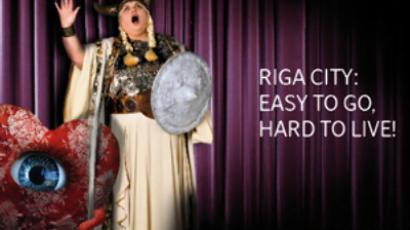
A legend on the trot, Mr. Pigman is the long-awaited answer to the Latvian State Forest's problem of illegal waste disposal.
“Just look at this mess! Scoundrels! How could they litter like this?” Mr. Pigman asks, pointing to mounds of trash sprawled across the side of the road.
This snout-donning, snuffling super-swine spends his days charging around Latvia, trying to clean up the woods and make the littering culprits squeal for mercy. There is even a legend to accompany him.
“If you litter in the forest you will turn into a pig,” Mr. Pigman’s secretary, Ginta Bormane, warned.
And this may be more than a bluff, as Mr. Pigman is not all “oink.”
“Once a forest warden called us and said he'd found the remains of a car,” Mr. Pigman recalled. “By the serial number we managed to find the owner and fined him – 200 lats [US $400]”
When Mr. Pigman started his work six years ago, Latvia's forests had become a pig sty, rife with areas that looked more like garbage dumps.
Since then, the Pig has saved their bacon. Mr. Pigman, who like all superheroes refuses to reveal his true identity, works with police, educates school children, lobbies parliament and keeps on the hoof, rooting out those who litter and raising public awareness.
In fact, he has become quite a Latvian celebrity.
“The world has four superheroes: Superman, Batman, Spiderman and the Latvian Tsukmans – Pigman,” he says.
But with this grand Duke-of-Pork achieving such success, one may wonder if this means there might be no more rubbish in Latvian forests. Mr. Pigman claims this is his promise.
“Pigman will work until the last plastic bag or last bottle is gone from the forest,” said his secretary.

Austrians sack Russian prima ballerina over erotic photosRussian prima ballerina Karina Sarkissova has been sacked from The Vienna State Opera following her participating in an erotic photo session. |
Georgian businesses accustomed to standover tacticsWhile Georgian President Mikhail Saakashvili likes to portray an image of his country as free and democratic, many say his version of democracy is at odds with their experience. |
We have more serious problems to draw our attention to - the Hungarian toxic sludge disaster and its devastating consequences for whole Europe. The good Samaritans ( of journalism) in Russia, where are you?


Svetlana is right. In the West, legislation requires specific safety measures to be in place to guard against possible public hazards, a free press generally makes sure that known hazards are not forgotten about, and free elections ensure that politicians ignore such things at the risk of losing office. But despite such an ethic being in place for generations already, corruption, apathy and/or greed (spending money on accidents that haven’t yet happened cuts into profits that could otherwise be reaped immediately) means that even in most Western countries, avoidable public calamities happen regularly. Unfortunately, the likelihood for these is much greater in nations that have freed themselves from Communist rule, because such countries have lived for generations under an ethos where human life was of little value, the “masses” (what a horrible word!) were often held in not much greater regard than cattle, corruption was rife, authority was discredited, altruism was a foreign concept, and personal initiative, especially personal initiative in the cause of reform, was strongly discouraged. As a result of being forced by Soviet control to become oriented to such beggarly values, such countries contain many public disasters simply waiting to happen, and of course Russia itself tops the list. One is sometimes lucky in that the potential dangers do not always become actual ones. In the present case, Hungary was unlucky. The only remedy that I know of to this kind of brooding danger involves relentless and courageous reforms on the level of legislation, law enforcement, a massive re-education of people to the principles of occupational health and safety, encouragement and rewarding of personal initiative including personal initiative in unmasking governmental and workplace incompetence, credible and respected civil governance and a courageous free press. Countries that follow such values will have fewer calamities to mourn; those that don’t will have more.