VERSIONS: روسيا اليوم NOTICIAS FREEVIDEO ИНОТВ RTД
breakingnews
Go to main page   News   Shady side of Earth: Western trace in space probe’s failure?  
MORE ON THE STORY
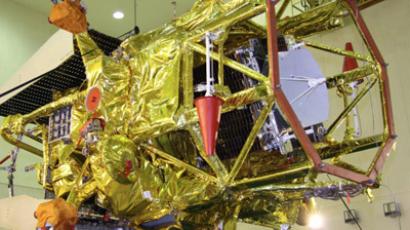
Russian interplanetary probe Phobos-Grunt, photo by Thierry Legault, www.astrophoto.com  (video uploaded on YouTube by Thierry Legault on 4 Jan 2012) 07.01, 07:44 5 comments

Doomed Martian probe caught on camera days before downfall

An amateur astronomer from Paris has managed to shoot video of the Russian interplanetary probe Phobos-Grunt, currently stuck in orbit and expected to fall to Earth in mid-January.

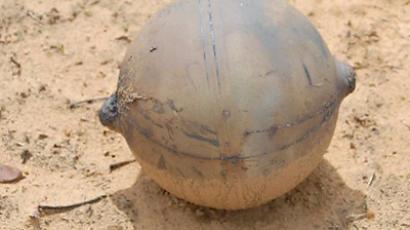
Namibia, Desert Region : A handout photo provided by the National Forensic Science Institute shows a giant metallic ball of 1,1 metre in diameter weighing some 6 kilograms that fell out of the sky on a remote grassland in Namibia, prompting baffled authorities to contact NASA and the European space agency (ESA) on December 21, 2011. AFP Photo / National Forensic Science Institute) 23.12.2011, 19:05 11 comments

The Gods must be crazy: Metal ‘Teletubby head’ falls near Namibian village

Mystery surrounds a 13-pound unidentified flying object which fell from the skies in northern Namibia. Despite efforts by researchers to identify its composition and origins, nobody has been able to establish where the metal sphere came from.

Works on Fobos-Grunt interplanetary station  (RIA Novosti / 
Oleg Urusov) 13.12.2011, 20:55

Phobos designer admits mission to Mars has failed

Scientists have given up all hope that the Phobos-Grunt space probe will reach Mars.

Fobos-Grunt (Phobos –Soil) spacecraft inside one of the premises of Russian leased Kazakhstan's Baikonur cosmodrome (AFP PHOTO) 05.12.2011, 22:25

Russian Mars probe starts decaying

The Russian interplanetary moon mission that barely got off the planet has started falling apart.

The automatic Fobos-Grunt interplanetary station in assemblage building's pad. (RIA Novosti) 24.11.2011, 15:13 20 comments

­Did US 'climate weapon' knock-out Russian probe?

Russian space experts are struggling to decode fresh telemetry signals received from the stricken Phobos-Grunt probe. Meanwhile, rumors are circulating that America’s ionosphere research site in Alaska caused the spacecraft’s failure.

Shady side of Earth: Western trace in space probe’s failure?

Published: 10 January, 2012, 14:49
Edited: 10 January, 2012, 20:20

The automatic Fobos-Grunt interplanetary station being set at the Baikonur assemblage building's pad (RIA Novosti)

(27.8Mb) embed video

TAGS: Space, Russia, Accident, Politics, Prime Time Russia, Natalia Novikova


Doomed Martian probe Phobos-Grunt, which was due to fulfill a Russian mission on one of the Red Planet’s moons, might have been a target of external influence. The probe failed while flying over the western hemisphere, outside of Russia’s control.

In an interview to the Russian newspaper Izvestia, head of the Russian space agency Roscosmos, Vladimir Popovkin, said that intended influence on the probe cannot be completely excluded.

”I do not want to blame anyone, but these days there are very powerful means to influence space vehicles,” he told the newspaper, adding that it is still unclear why the probe’s engine failed to start in the first place.

The official also made a more generic allegation on possible reasons behind the accident with the probe station.

“We do not understand frequent failures of our space vehicles when they fly over the shadow, for Russia, part of the Earth,” Popovkin said. “Right there we are unable to see the vehicle and to receive its telemetry.”

Previously, reports emerged claiming that the probe station may have been influenced by powerful American radars in Alaska, which the vehicle was passing.  

Popovkin confirmed, however, that the probe was possibly doomed from the moment it was launched into space. The official said that the project was created in the conditions of the limited funds and employed risky technological decisions. 

“Besides, the probe had been created for a very long time and expiration dates for some parts had been nearing,” he said. “If we had not sent it to Mars in 2011, we would have had to throw it away, writing off expenditures of five billion rubles.”

Russian interplanetary space station Phobos-Grunt, aimed at collection of earth samples from the Martian satellite of Phobos, was launched on November 9 from Baikonur Cosmodrome. The mission was supposed to last for two-and-a-half years but aborted shortly and unexpectedly with engine failure. 

After the rocket carrier separated from the station, its engines failed to fire to take it onto the high orbit so it could eventually gear off for Mars. The vehicle is still floating in the Earth orbit and expected to fall in the coming days, presumably on January 15.


+5 (11 votes)
 
Back to top
next MORE NEWS
AFP Photo / Joseph Eid 10.01, 12:11 5 comments

Syria’s pathway: From one dictatorship to another?

Despite an Arab League observer mission in Syria, there has been no let up in the bloodshed. Author and scholar Gene Sharp told RT in exclusive interview that non-violence is the only way for people to bring about democratic change.

Arab world protests
Bashar Assad (Reuters /Syrian TV via Reuters TV) 10.01, 15:09 34 comments

Assad to nation: ‘The victory is near’

President Assad accuses "foreign conspirators" of efforts to destabilize the situation in Syria. Addressing the nation, he claimed that the international community’s aim to cause “psychological collapse” has failed and the victory is near.

Arab world protests
Joel McGinley January 13, 2012, 06:24
0

I cannot imagine that the US would have any reason to disable this Mars scientific probe. However, from my work with US shuttle-launched space- craft, I do know of one case where an orbiting satellite was "confused" by ground-based radar. It was over the US radar site on Hawaii, the radar signal affected the attitude system, and caused the spacecraft to start a "backflip". The operators, when they regained control, decided to complete a 360 degree backflip because it was easier to continue the turn than stop/reverse the rotation.  This was the U of Texas "Wake Shield Facility" which was making thin coatings for computer chips in the vacuum. So, such interference can happen, but we must hope that the Russians were aware of this and made the radio systems resistant to such interference?

Vince (unregistered) January 12, 2012, 06:34
+1

This is the most stupid claim I have ever heard being made by a head of a space agency that another country was responsible for bringing down rockets and probes. Popovkin needs to get a grip on reality. Stop these silly accusations and concentrate on hard work. It will eventually pay off. Funding for Russia's space agency is not the issue anymore. Carelessness and downright foolishness unfortunately is!

Roger (unregistered) January 11, 2012, 14:26
0

It's strange. As I was reading the article I thought it was almost certainly making fun of the scientist. Americans take things too seriously, and have never been renowned for sophisticated humour. However, it is true that the only thing a Russian won't take if you leave it lying around is responsibility.