VERSIONS: روسيا اليوم NOTICIAS FREEVIDEO ИНОТВ RTД
breakingnews
Go to main page   News   Phobos fail: What really happened to Russia’s Mars probe?  
MORE ON THE STORY
Zenit-2SB launch vehicle carrying Russia's Phobos-Grunt automatic interplanetary station (AIS) is launched into space from the Baikonur Cosmodrome. RIA NOVOSTI / Oleg Urusov 17.01, 15:58 48 comments

Did US radar down Russian Mars probe?

An electromagnetic pulse from a US radar station in the Pacific is being investigated as a possible cause in the malfunctioning of the Russian Phobos-Grunt martian probe.

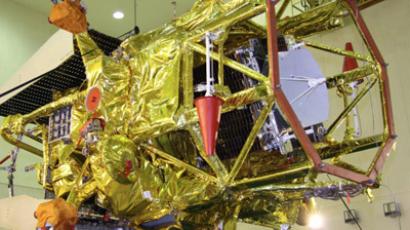
The automatic Fobos-Grunt interplanetary station in assemblage building's pad. (RIA Novosti) 24.11.2011, 15:13 20 comments

­Did US 'climate weapon' knock-out Russian probe?

Russian space experts are struggling to decode fresh telemetry signals received from the stricken Phobos-Grunt probe. Meanwhile, rumors are circulating that America’s ionosphere research site in Alaska caused the spacecraft’s failure.

RIA Novosti / Oleg Urusov 15.01, 22:00 33 comments

Touchdown! Russia’s elusive Mars probe crashes into Pacific - or Brazil?

Russia’s Phobos-Grunt, whose mission to a Martian moon went astray before circling the Earth, has finally plunged into the Pacific Ocean, says Russia's Defense Ministry. But other experts insist it landed somewhere in central Brazil.

image from http://www.roscosmos.ru 15.01, 01:19 6 comments

Falling probe-ability: Guesswork over space debris crash point

Russia’s stray Phobos-Grunt, the Flying Dutchman of space, keeps wandering the skies, looking for an ocean to land in – or a place to moor. Russia’s Space Agency has for the fourth time revised its predictions as to where the spacecraft will fall.

Russian interplanetary probe Phobos-Grunt, photo by Thierry Legault, www.astrophoto.com  (video uploaded on YouTube by Thierry Legault on 4 Jan 2012) 07.01, 07:44 5 comments

Doomed Martian probe caught on camera days before downfall

An amateur astronomer from Paris has managed to shoot video of the Russian interplanetary probe Phobos-Grunt, currently stuck in orbit and expected to fall to Earth in mid-January.

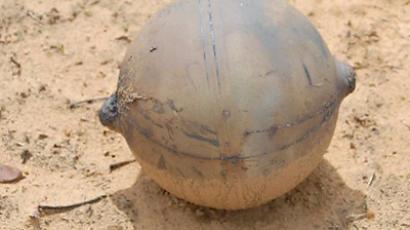
Namibia, Desert Region : A handout photo provided by the National Forensic Science Institute shows a giant metallic ball of 1,1 metre in diameter weighing some 6 kilograms that fell out of the sky on a remote grassland in Namibia, prompting baffled authorities to contact NASA and the European space agency (ESA) on December 21, 2011. AFP Photo / National Forensic Science Institute) 23.12.2011, 19:05 11 comments

The Gods must be crazy: Metal ‘Teletubby head’ falls near Namibian village

Mystery surrounds a 13-pound unidentified flying object which fell from the skies in northern Namibia. Despite efforts by researchers to identify its composition and origins, nobody has been able to establish where the metal sphere came from.

Phobos fail: What really happened to Russia’s Mars probe?
Published: 19 January, 2012, 14:19

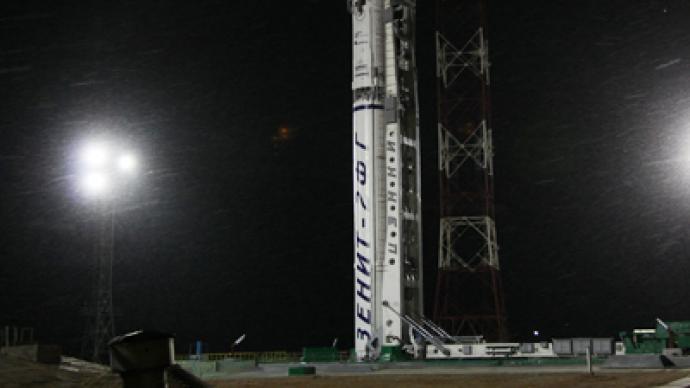
Zenit-2SB launch vehicle carrying Phobos-Grunt automatic interplanetary station (AIS) at the Baikonur Cosmodrome before blastoff (RIA Novosti / Oleg Urusov)

Zenit-2SB launch vehicle carrying Phobos-Grunt automatic interplanetary station (AIS) at the Baikonur Cosmodrome before blastoff (RIA Novosti / Oleg Urusov)

TAGS: Space, Russia, SciTech, Accident, Vehicles, USA


From US radar influence to manufacturing mistakes: Russian space authorities are considering various reasons why the Phobos-Grunt mars probe failed to leave Earth’s orbit after launching last November.

Vladimir Popovkin, who heads the Russian space agency, Roscosmos, on Thursday dismissed as a low priority a theory that an American radar had caused Phobos-Grunt’s systems to collapse.  However he said it would nonetheless be investigated.

"The commission is considering this as one of the [possible] causes,” Popovkin said in an interview to Vesti FM radio station.

He added that should the radar theory be shown to be plausible, Roscosmos will definitely “get in touch with NASA partners” asking them to participate in an experiment to uncover the truth. Popovkin also confirmed that investigators are considering a whole range of possible reasons for the failure, the most likely of which are thought to be engineering and design errors.

“The principal ones are manufacturing and testing mistakes, design ideology mistakes, industrial mistakes and so on,” he said.

Deputy Prime Minister Dmitry Rogozin has said he will be taking the investigation into Phobos-Grunt’s mission failure under his personal control.

The US authorities denied once again on Wednesday that America had nothing to do with the failure of the Russian probe. According to State Department spokesperson Victoria Nuland, it was the United States that tried to help reestablish contact with Phobos-Grunt after it became stranded in orbit. Although the operation did not end successfully, the US also helped to monitor the probe’s final orbits and its entry into the Earth’s atmosphere, AP reports.

In an earlier interview with the Russian newspaper Izvestia, Vladimir Popovkin said that it was suspicious that so many Russian space vehicles, including the ill-fated Phobos-Grunt, have broken down while floating above the Western hemisphere. Later reports suggested the space failure might have been caused by a powerful electromagnetic emission from the US radar stationed on the Marshall Islands in the Pacific.  

NASA spokesperson Bob Jacobs denied that the US space agency was using the military radar equipment at the time Phobos-Grunt malfunctioned. Jacobs added that at the time, the agency was using radar located in the Mojave Desert in the western United States and in Puerto Rico, the Washington Post newspaper reported on Tuesday.


Russia’s Phobos-Grunt Martian probe was launched on November 9 from the Baikonur space center in Kazakhstan. The probe was designed to collect and bring back to Earth samples of soil and rock from Phobos, one of the Red Planet’s two moons. However the space vehicle’s engines failed to fire on the so-called support orbit, which resulted in eventual fall of the probe back on Earth late last Sunday.



+5 (7 votes)
 
Back to top
next MORE NEWS
Libyan families Visit the body of slain Libyan leader Muammar Gaddafi inside a storage freezer in Misrata (Reuters / Thaier Al-Sudani) 19.01, 14:02 14 comments

Time runs out for effective probe of brutal Gaddafi murder

While Libya has been quick to shake off 40 years of Colonel Muammar Gaddafi's legacy, his children are still waiting for justice. The lawyer of the late leader's daughter has been telling RT why his killing in October still hasn't been investigated.

Libyan conflict
Iran subs poised to torpedo US warships in Gulf (AFP Photo / Jamejamonline / Ebrahim Noroozi) 19.01, 16:13 95 comments

Iran subs poised to torpedo US warships in Gulf

An Iranian commander has warned that Tehran is on full alert in case of enemy threats, and has the best submarines in the world ready to “ambush and hit enemy vessels, especially US Aircraft carriers, from the seabed throughout the Persian Gulf.”

Iran tension
pepe (unregistered) January 21, 2012, 19:26
0

If it is proved that the US gov't is sabotaging the Russian space program, which is plausible based upon the established character of the US gov't and it's leaders (i.e., greedy zionists and their puppets), then what?  What ultimatum can be issued short of turning the guns on Israel? 

Nay Lin Maung January 19, 2012, 22:28
-1

God causes it.


or


Human causes it. If human causes, the leadership of the Russia Federation has to investigate it.


CyriltheSquirrel January 19, 2012, 21:19
+1

Could the downing of Phobos-Grunt have anything to do with the 'teletubbies mystery head that fell on Namibia' story currently playing on RT...   Anyway, I expect that when PG2 is being launched there will have been strenuous attempts at hardening it against all EM interference, an encrypted back-up channel or two and strict monitoring against sabotage... After all, we would not wish anyone's (Uncle Sam's included) finger prints on a fatality in a developing country would we?