VERSIONS: روسيا اليوم NOTICIAS FREEVIDEO ИНОТВ RTД
breakingnews
Go to main page   News   US, Japan, Australia? Mars probe will hit Earth in January  
MORE ON THE STORY
Russia has launched the country's first interplanetary mission in 15 years (image from http://www.federalspace.ru) 10.11.2011, 20:42 17 comments

Martian curse: Russian probe may crash in populated area

Russian scientists are struggling to get the country's first interplanetary mission in 15 years back on track. Should they fail, the probe that was due to head to the Martian moon Phobos may well turn into the “most toxic falling satellite ever.”

Works on Fobos-Grunt interplanetary station  (RIA Novosti / 
Oleg Urusov) 13.12.2011, 20:55

Phobos designer admits mission to Mars has failed

Scientists have given up all hope that the Phobos-Grunt space probe will reach Mars.

Fobos-Grunt (Phobos –Soil) spacecraft inside one of the premises of Russian leased Kazakhstan's Baikonur cosmodrome (AFP PHOTO) 05.12.2011, 22:25

Russian Mars probe starts decaying

The Russian interplanetary moon mission that barely got off the planet has started falling apart.

The automatic Fobos-Grunt interplanetary station in assemblage building's pad. (RIA Novosti) 24.11.2011, 15:13 20 comments

­Did US 'climate weapon' knock-out Russian probe?

Russian space experts are struggling to decode fresh telemetry signals received from the stricken Phobos-Grunt probe. Meanwhile, rumors are circulating that America’s ionosphere research site in Alaska caused the spacecraft’s failure.

Planting unit of Phobos-Grunt (AFP Photo / Maxim Marmur) 23.11.2011, 16:15 1 comment

Beam me up: Martian probe responds to Aussie call

A Russian space probe bound for a Martian moon, which for two weeks had been gradually falling and failing to respond to communication, has finally answered a signal from a ground station in Australia.

Fobos (RIA Novosti) 14.11.2011, 22:45

Russia still hopeful about Red Planet dream

Russia's Space Agency has not given up hope of completing its mission to Mars.

US, Japan, Australia? Mars probe will hit Earth in January

Published: 14 December, 2011, 13:47

Phobos-Grunt in orbit (Photo from ralfvandebergh.startje.be)

Phobos-Grunt in orbit (Photo from ralfvandebergh.startje.be)

TAGS: Scandal, Space, SciTech, Accident, Vehicles


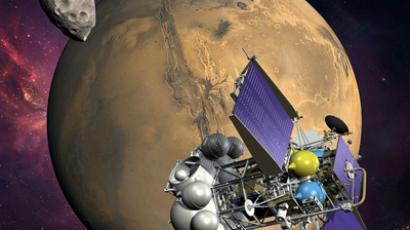
The ill-fated Phobos-Grunt probe that got stuck in the orbit after an unsuccessful launch will fall to Earth on January 11, probably affecting four continents, the US Strategic Command shared its latest forecast.

­The current orbit of the vehicle suggests that it could collide with the surface on a vast part of the globe, from latitude 51.4°N to latitude 51.4°S. anywhere in Africa, Australia, Japan, North America or southern part of Western Europe, but definitely not on the larger part of the Russian territory.

A more-or-less exact prognosis on the coordinates of the crash can only be made several hours before the collision.

According to the previous forecast, the probe was due to enter atmosphere on January 9.

On Monday Viktor Khartov, the head of the Lavochkin bureau that designed the interplanetary station Phobos-Grunt, officially announced that the probe – worth $161 million – will not be able to reach Mars and is considered lost.

The spaceship, which promised to break Russia’s 20-year-long absence from interplanetary flights, was launched on November 9. It was intended to travel to Mars and land on its moon Phobos, later bringing probes back on Earth.

The rocket booster performed with precision, but the vehicle’s engines refused to start, placing it in an incorrect orbit.

For two weeks scientists were unable to contact the probe, but even after the vehicle responded, all efforts to get it back on track proved to be in vain. Then the connection was lost altogether.

There have been reports that two small objects have detached from the probe, but what exactly happened remains unknown.

Phobos-Grunt was initially delivered on orbit with apogee of 340 km and perigee 207 km. Despite being offline, evolutions of the orbit of the probe have been registered: it started to gain altitude at a pace 0.5 km per day, but on November 21 the process reversed. As of now, the space vehicle has orbit with apogee of 281 km and perigee 201 km.


+1 (1 votes)
 
Back to top
next MORE NEWS
Richard Perle 14.12.2011, 12:51 23 comments

‘Man of Mass Destruction’? RT challenges Iraq War architect

As the day draws closer for the US to withdraw its troops from Iraq, many are questioning Washington’s rhetoric towards Iran in view of the failures of the Iraqi campaign. RT spoke to one of the chief architects of America’s war in that country.

'Carbon dioxide is controlled by world temperatures rather than the other way around' 14.12.2011, 14:27 12 comments

‘Carbon dioxide has zero effect on global warming’

Ottawa has pulled out of the 1997 anti-global warming Kyoto Protocol, saying the treaty is “not working.” Piers Corbyn, the founder of the Weather Action Foundation, says Canada is doing the right thing.

hopeleaves December 15, 2011, 11:52
0

Nay is converting English language from China, of course it will be garbled. Not weird, but probably biased.

Hat December 15, 2011, 09:38
0

Nay Lin Maung wrote in #7

Who control the Japan?


Australia is not strong enough to challenge working at the space programs unless he gets from somebody out.


Sometimes i think you are from outer-space with your weird comments haha ... but don't be mad ... i have nothing against you ... i just feel you are from a different world.

nay lin is right December 15, 2011, 08:39
+1

lol, its just diferent there Nay good place