
Pesky pests prevent property sales in the UK
Published 6 Aug, 2009 18:47 | Updated 6 Aug, 2009 22:47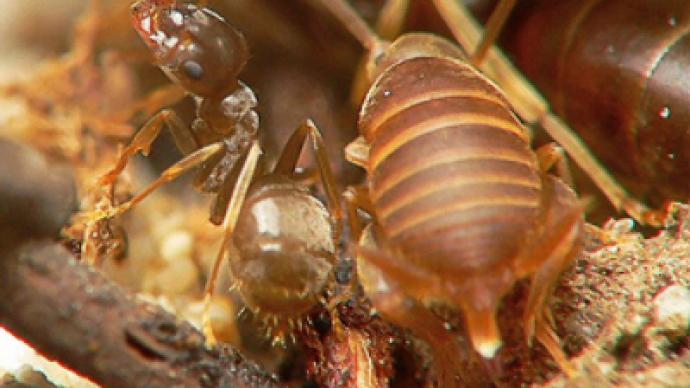
An invasion of pests arriving in an increasingly warmer Great Britain is not only posing a threat to native species but proving precarious to the property market.
For years Sarah Pennels has suffered long and tiresome battles, desperately trying to exterminate the large colonies of ants which frequently invade her house and garden during summertime in Leicester. But the ants seemed to have the last laugh by choosing to invade Mrs. Pennels’ fuse box as she showed a couple interested in buying her property the source of electricity in their potentially new home. Laughing embarrassingly as thousands of ants swarmed in between wires, fuses and cables, the couple hastily left telling a highly bemused and embarrassed Mrs. Pennels they had a “few more properties to view.”
Resiliently resisting the lacing of ant powder, Sarah Pennels swept the ants away, but the 53-year-old house wife was forced to call in a pest squad to finally destroy the cause of her unsuccessful viewing.
The pest controller quickly concluded that due to the sheer vastness of ants enjoying life inside her fusebox, they were most definitely a new breed of ants to be found in Great Britain, Lasius neglectus, or more commonly known as the “Asian super ant.”
Being almost identical in appearance and size as native species, it would be practically impossible to determine colonies of “super ants” from their domestic counterparts, except for two unique attributes:
their insistence on working in colonies up to 100 times larger than typical ant formations and their love for electrical circuitry.
But creating electrical cutouts, posing as a fire hazard and putting off potential house buyers are not the Asian super ants only misdemeanors. Unlike common ants their colonies do not attack each other, and so they can quickly form super-colonies which cover vast areas, often bigger than a hectare in size. Because of this supremacy, these ants are a threat to native species, as they quickly outpace them in the search for food.
“The ants pose little direct threat to us as they don't bite people or pets, but their habit of creating super-colonies means they pose a threat to native species by out competing them for food and space,” Simon Ford, a nature conservation adviser for the National Trust, told The Telegraph newspaper.
The reason behind the arrival of the Asian super ants in the UK remains ambiguous and uncertain. Many experts believe the most likely way this species were able to invade the UK was by hitching a ride in plant pots from Asia. However, the belief that Britain's changing climate is the reason to why the ants are thriving and spreading in the UK is more widespread.
Mrs. Pennels is convinced that her ant problem becomes worse each summer as the summers gradually become warmer as a result of global warming. The housewife told RT that her 25-year hatred of ants hit its pinnacle with the arrival of the Asian super ant.
“I thought I had the little blighter's under control ahead of people coming to view the house," she said. "You can imagine my surprise therefore when thousands, literally, swarmed out of the fuse box as I proudly showed the people what powered the house. The viewing had gone well up to then. But after that they couldn't leave fast enough. Ants are the bane of my life!”
However, it seems ants are not the only creatures to have colonized Great Britain and jeopardized the sale of houses.
Experts believe a new species of fly, the Atlantopsocus adustus, more commonly called the barkfly, reached the UK on southerly winds from the Atlantic. Its arrival is strongly linked to Britain's milder and more humid climate.
This species of fly, which likes to hover around wood and bark, has settled on Britain's Cornish coast, where the weather is particularly mild. It was discovered at five different National Trust sites on this stretch of coastline. Janet Lister, the National Trust's Nature Conservation Adviser, believes this new species of insects has colonized the UK because of the changing climate.
“These new discoveries demonstrate that non-native species, which are used to living in warmer climates, are now able to survive here as a result of global warming,” she told the BBC.
Mr. and Mrs. James from West Sussex are well aware of the barkfly's invasion of the UK and are more than a little miffed by the disturbances pests like these can cause. Last year the couple was selling their Sussex home and in order to control the large population of barkfly that relentlessly tried to reside in their children's spectacular tree house in the garden, the James' had installed an ultraviolet fly trap.
“No one will ever know this handsome sconce is trapping flies” was the sales pitch for this “slim and discreet” method of combating the fly invasion, and the couple believed they had the problem under control. Until, that is, they opened the door of the tree house to show a very interested family their potentially soon-to-be new and lavish “garden den.”
“A carpet of flies spread across the beautiful wooden floor, spilling out from the UV machine," they said. "It was very embarrassing. Needless to say we didn't here from that family again!”
One requirement of these attractive ultraviolet units, which prove irresistible to flies and lure them on to an electrical grid, is that the special hygienic tray where the dead flies are disposed is emptied regularly. Although Mr. and Mrs. James admit they had forgotten about the device for some weeks, they are convinced that the affects of global warming ultimately cost them the sale of their house.
Our planet's gradual progression toward destruction seems to be aversely affecting the most unlikely of markets and situations, as new species of pests riding on gentle tides of warmer weather are creating havoc and causing an already unstable property market to become even more shaky.
Gabrielle Pickard for RT