Israeli government doesn’t have power to go for peace – former Palestinian PM
Published 25 Apr, 2010 06:08 | Updated 25 Apr, 2010 21:47The US Middle East envoy is trying to revive Israeli-Palestinian peace talks - despite more spanners being thrown in the works. Mahmoud Abbas has poured scorn on creating a Palestinian state within temporary borders.
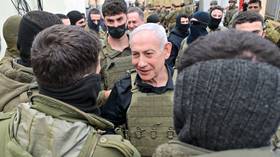
Meanwhile Israel's Prime Minister, Benjamin Netanyahu, has rejected Washington demands to stop building Jewish settlements in disputed East Jerusalem.
RT asks former Palestinian Prime Minister, Ahmed Qurei, member of the executive committee of the Palestine Liberation Organization and head of the Jerusalem department, where all this now leaves hopes for a deal.
RT: Mr Qurei, do you think that American pressure on the Netanyahu government to halt the settlement building will succeed?
Ahmed Qurei: There's lots of tension on the Israeli and Palestinian sides. Israel is not agreeing to the basic rights of the Palestinians to statehood and is continuing to implement its policies against Palestinians in the West Bank, especially in areas from before 1967. There’s no doubt that the American government, if it wants to, can exert a lot of pressure on Israel but we're not asking the US to take action against Israel or to cancel Israel's rights, if there are any Israeli rights. What we're asking them to do is to push Israel in the direction of getting Palestinian rights in the West Bank and Gaza and on the land of ’67.
I think the US has been taking action recently to put pressure on Israel and Netanyahu's government, but for there to be peace, on the one side there has to be Palestinian unity, there has to be one Palestinian decision so that the Palestinian people can support this decision. And on the other side, the Israeli government has to be a government that is ready to push its people towards peace and I don’t think the current Israeli government has the power or the will to go for peace.
RT: So on the question of construction freezes, Netanyahu has said that building in Jerusalem is the same as building in Tel Aviv and therefore they have a right to do it. What is your response to that?
AQ: I think that this is the real problem. As long as Netanyahu looks at Jerusalem as part of Israel, there won't be a resolution. This illusion that Jerusalem is part of Israel and that the Palestinians or Arabs will ever accept any resolution is unacceptable and needs to be taken away. Jerusalem, East Jerusalem is an integral part of the Palestinian state and it is the future capital of any Palestinian state.
RT: You spoke about the Palestinian Authority. Do you see any kind of resolution within the Palestinian Authority between Hamas and Fatah?
AQ: I think yes, it's possible and it should happen. Even if there's a difficulty in discussions and in the talks, it's an issue that has to be resolved. There won't be any resolution to the Palestinian issue if there isn't unity between the Palestinian parties and this situation that we are currently in. The division between the West Bank and Gaza is very difficult, and I've led negotiations in Cairo and we sat with leaders from Cairo and we spoke about all the problems. Egypt drafted a concept paper, which we in Fatah have accepted, and I think that it's very legitimate and it's a very good starting point. I hope that Hamas will sign this agreement and afterwards we can sit and discuss the details.
I hope the Mid-East quartet will insist on unity between the Palestinian parties and that they will help and push for this unity, rather than putting conditions which would make it almost very difficult to get to an agreement.
RT: What about future Palestinian elections because the longer that they are delayed, the more opportunity perhaps there is for the division between Hamas and Fatah to get deeper. Do you foresee elections any time soon?
AQ: I don't think we can hold any elections unless there is an agreement between Fatah and Hamas, and when I mean agreement, I mean a unity between all the parties supported by the Palestinian people. Until this happens, there will always be one party who refuses to accept the results of the elections and they will fight any decision reached by the elections.
RT: Economically, is it viable and realistic that the West Bank and Gaza become part of one economy in a future Palestinian state?
AQ: I don't think that there can be a viable economic Palestinian state until there is economic and political unity between Gaza and the West Bank and with East Jerusalem as the capital of the Palestinian state. From our experience with the Israelis so far, not one tourist that comes through Tel Aviv from Ben Gurion airport spends a cent in East Jerusalem. Jerusalem is important, from a religious and political point of view, but also economically.
RT: But Israel says it will have nothing to do with Hamas, so what does this mean for future negotiations between Palestinians and Israelis?
AQ: One of the requirements of a real peace process is unity between the West Bank and Gaza, and when I say unity, it also means a political agreement – political unity between all parties in the West Bank and Gaza and one political decision. Israel needs to understand this. With its recent decision to deport Palestinians, it only takes us further away from any peaceful resolution. For Palestinians, they need to understand that they need to have one political decision, one political direction and unity between the different parties.
RT: Do you think Hamas is sabotaging efforts at reconciliation?
AQ: I think the fact that we have different points of view is proof of real democracy and taking decisions. The fact that we have Hamas and we have Fatah and the rest of the Palestinian political parties is living proof of democracy, and it's good to have disagreements and also different points of view.
Why is it considered democracy when other countries have different parties, but when Palestinians have a disagreement or different points of view, then this is not democracy? The Palestinian struggle has left different marks and different points of view, and it has affected people differently. That's why we have a lot of different opinions, but at the end of the day, if we unite under one government, then we will have agreement on the major issues and we will have agreement on the goal and the agenda and how to achieve the agenda.
RT: Do you think Hamas will ever let go of Gaza?
AQ: I think this is a different issue. I don't think the question should be whether Hamas is in control of Gaza and the West Bank is under Fatah. I think when we get to an agreement and we sit together, the only question will be where will we go forward and the main issue here for us is how to sit down together and how to reach unity, not who is responsible for which area and who will leave where. I think what Hamas is doing in Gaza is not helping the situation. It's furthering the division between the two sides, and when you ask Hamas, they say that they're doing this because Fatah and Hamas haven't reached an agreement, but what we say in Fatah is that there is the concept paper by Egypt that we have signed and that Hamas should follow that, and it will be our starting point to negotiate and talk about unity.
RT: What is your view on a state with temporary borders?
AQ: Officially we refuse this. Fatah, the PA, the PLO – we have all refused this. We will not accept a state with provisional borders. Now is the time for real action and for a real agreement and for a final agreement. We don't want temporary solutions for this problem anymore. The Israeli Foreign Minister Avigdor Lieberman once said they should solve this problem just like they solved it in Cyprus; one side on the North, another on the South and that's that. I don't think we will accept that. We don't want something temporary which will create even more problems in the future.
RT: Salam Fayad [current Palestinian Prime Minister] called for unilateral statehood within two years. Is this a concept that you would support?
AQ: I think if there is a foolproof plan in this sense, a mechanism that will be backed by the international community as well as locally, and that the state will be created on borders from '67 with East Jerusalem as its capital, then this will be acceptable, but if it is a plan that is not well-thought through and there will be difficulties in achieving it, then I don't think this is something any of us would like to see.
At this point we don't want or need to delay any of the issues. We have put this on the table, we will negotiate Jerusalem first. In the face of all the Israeli actions that have been taking place in settlements in Jerusalem, we have said that we will not sit at the table unless Jerusalem is discussed.
RT: You spoke about the Middle East Quartet. What role specifically can Russia play in the Middle East Quartet?
AQ: Russia is a very powerful player in international policy and is a very good friend of the Palestinian people. Moscow can be a major player in pushing the peace process forward and helping the Palestinian people to reach an agreement with the Israelis. I don't want to be pessimistic here, but the situation as we see it is not just grave, it's very dangerous.
RT: Do you think a Middle East conference in Moscow could achieve anything?
AQ: No doubt. I truly believe that any conference that takes place in Russia that is well-focused and well-prepared will help the peace process along. You need real partners who are really interested in finding a resolution to this conflict.