VERSIONS: روسيا اليوم NOTICIAS FREEVIDEO ИНОТВ RTД
breakingnews
Go to main page   News   ‘Syrian opposition cannot agree on anything’  
MORE ON THE STORY
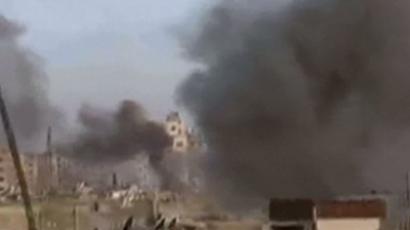
An image grab taken from a video uploaded on YouTube on February 6, 2012 shows what was described as shelling on the Baba Amro district of the restive city of Homs in central Syria (AFP Photo / Youtube) 08.02, 16:19 64 comments

Death and diplomacy: Homs on the brink

Homs is now the physical and political frontline of the unrest engulfing Syria. Heavy fighting continues for the fifth straight day in the rebel stronghold city, 165 kilometers north of Damascus.

Syria unrest
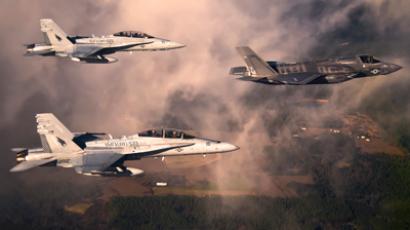
A US Marine Corps F-35 Lightening II multirole fighter jet is escorted by two USMC F-18 Hornets as it flies towards Eglin Air Force Base, Florida in this U.S. Air Force handout photo dated January 11, 2012 (Reuters / DoD / U.S. Air Force / Staff Sgt. Joely Santiago / Handout) 08.02, 17:23 65 comments

Syria: White House preaches peace as Pentagon preps for war

The White House is saying “no” to arming opposition and other military involvement in the Syrian conflict – for the moment. Pentagon and US Central Command launched a review of US military capabilities in case that “no” turns a “yes.”

Syria unrest
Video from YouTube channel MrAA991 08.02, 17:33 32 comments

This is how we roll: FSA shows off APC (VIDEO)

Syrian rebels are rolling out armored hardware in their battle against government forces, if this footage is an indicator of the situations in Homs.

Syria unrest
Arab League observers in Damascus on January 9, 2012  (AFP Photo / Joseph Eid) 09.02, 10:07 38 comments

UN, Arab League to get stronger observer mandate in Syria

The Arab League and UN are considering a joint mission to Syria. It must be stronger in numbers and equipment, and the mandate different. President Assad agreed to resume the mission during the Russian foreign minister’s visit to the embattled state.

Syria unrest
Members of Free Syrian Army (FSA). (REUTERS / Ahmed Jadallah) 08.02, 23:44 55 comments

Syrian opposition getting 'daily shipments' of arms

With recent reports of fierce fighting in Homs, many wonder where the opposition is getting so many arms from. No wonder, argues Professor Ibrahim Alloush, as “weaponry is being smuggled into Syria in large quantities from all over the place.”

Syria unrest

‘Syrian opposition cannot agree on anything’

Published: 09 February, 2012, 11:05

AFP Photo / Youtube

(46.5Mb) embed video
TRENDS: Syria unrest

TAGS: Middle East, Protest, Bill Dod, Opposition, Syria


The West continues to put more pressure on Syrian leader Bashar Assad to step aside and shows its support to the opposition. But who are the opposition and could they handle Syria?

­“When we say opposition we really are talking about politicians who have assumed leadership roles in opposing the Syrian regime,” Camille Otrakji, a contributing editor with Syria Comment online magazine, told RT. He explained that the Syrian opposition should be distinguished from the Syrian people.

He added that many of them have little to do with the people as they have been living abroad for decades.

Also the opposition comprises the Kurds whose “main motivation is autonomy or separation.

Another group is the Islamists, who want to play a bigger role in Syrian politics – something the Assad regime will not accept. “Syria is a much more diversified country where you have so many minorities and they aren’t really comfortable with Islamic rule like Egyptians or Tunisians might be,” Otrakji explained.

Moreover the opposition includes leftists, communists. “The regime has not been kind to communists in the past. They’ve been imprisoned just like Islamists.”

Otrakji also stresses that the opposition is not able to produce any document that highlights their political program. “They really cannot agree on anything because you have those who want Kurdish separation, those who are Islamists and you have secularists and communists. There is no logical place where they can all meet and agree.”

Besides, none of them is strong enough to assume power after the removal of President Assad, he concludes.


+13 (17 votes)
 
Back to top
next MORE NEWS
Arab League observers in Damascus on January 9, 2012  (AFP Photo / Joseph Eid) 09.02, 10:07 38 comments

UN, Arab League to get stronger observer mandate in Syria

The Arab League and UN are considering a joint mission to Syria. It must be stronger in numbers and equipment, and the mandate different. President Assad agreed to resume the mission during the Russian foreign minister’s visit to the embattled state.

Syria unrest
AFP Photo / Umar Media 09.02, 11:41 7 comments

‘Drones multiply militants’ – Pakistani FM

American drones hitting targets on Pakistani territory is illegal, and involvement of the Pakistani spy agencies with Taliban not even worthy of comment, said Pakistan’s Foreign Minister, exclusive to RT.

9/11 tragedy
Nenad February 22, 2012, 15:26
0

“They really cannot agree on anything because you have those who want Kurdish separation, those who are Islamists and you have secularists and communists. There is no logical place where they can all meet and agree.”

Well that is the final goal of the West. They can rule over Syria on much easier way when the country is too fragile and unstable and the most important thing they can be closer to the final destination of  their "trip" i.e. Iran. But Iran is not Syria, nor Lybia or Afghanistan.

nobliss February 13, 2012, 08:27
0

To expand its operations in Syria, the rebel Free Syrian Army (FSA) must secure supplies of weapons, food, water and other necessities. The most important supply lines for the rebels -- though also the most difficult to maintain -- come from Lebanon. The Sunni-concentrated region of Homs in Syria depends heavily on supplies smuggled from northern Lebanon and the northern Bekaa Valley. Lebanese villages such al Al Fakiha, Arsal and Al Qaa have helped provide shelter to Syrian defectors and supplies to Syria's insurgents from the northern Bekaa. Another route that could be used to smuggle supplies runs through the northwestern tip of Lebanon where the Quleiat airstrip is located. This corner of Lebanon is predominately Sunni, and there are rumors that Lebanese officials sympathetic to the FSA are preparing the Quleiat airstrip. FSA rebels operating in the Damascus suburbs rely on the southern supply route that starts on the Lebanese side of the Anti-Lebanon Mountains near the central Bekaa Valley. The most important smuggling route in this region runs through Deir al-Ashaer on the Anti-Lebanon mountain range. Several main roadways connect Rif Damascus to Deir al-Ashaer, but the most likely route for rebel supply lines runs through valleys and various passes throughout the Anti-Lebanon Mountains in an attempt to circumvent border checkpoints. Zahle receives supplies from Jouneih, the mostly Christian seaport city 15 kilometers north of Beirut. The southern route presents the most challenges, traversing mountainous border terrain. Supplies must be smuggled through valleys, cross checkpoints with bribable guards, traverse dangerous back roads through the mountains, or be taken by foot or animal through mountain passes. Be safe.

nobliss February 13, 2012, 08:03
0

The text, however, had to be dropped due to Russian objections that it amounted to “regime change”, which was a threat to the principles of national sovereignty as protected under the UN charter. This is contrary to the “Responsibility to Protect” doctrine, which was recognised as a concept by all countries (Russia and China included) at the UN World Leader’s Summit in 2005.

Responsibility to Protect is a concept for intervention in a state by the international community for the prevention of genocide, ethnic cleansing, mass killings and human rights violations taking place, in a country which is unwilling (or unable) to stop it. In the event of any such acts occurring, the wider international community has a collective responsibility to take whatever action is necessary to prevent it. Both the Russians and the Chinese, whose modern history has been dominated by bloody foreign interventions, are understandably reticent about any development of liberal interventionism that protects a people from the violent abuses of its government.  Considering the poor human rights records in both these countries, it is unsurprising that they will be wary of a liberal doctrine that legitimises external interference along the grounds of human rights. However, it is callous in the extreme for the Russians to cite the UN charter’s protection of national sovereignty as the rationale for its support for the Assad government.  Or for the Russians to justify their current intransigence with a resolution against Syria by suggesting that the UN resolution that allowed for “all necessary means” to protect the Libyan people went too far in toppling the brutal dictatorship of Gaddafi. The Russians were quite happy to cite the “Responsibility to Protect” doctrine with their invasion of Georgia in 2008 or use interventionism with their ongoing suppression of “terrorist” separatist groups in the Northern Caucuses or recent use of energy blackmail to interfere with Ukrainian elections. The real hypocrisy of Russia lies however with the realpolitik of their global strategic ambitions